
In today’s fast-paced economy, the ability to accept credit card payments is no longer a luxury but a fundamental necessity for nearly any business aiming for growth and sustainability. From bustling retail shops to innovative e-commerce platforms and service providers on the go, credit cards represent the preferred payment method for billions of transactions worldwide. For entrepreneurs and established businesses alike, understanding the intricacies of accepting these payments is crucial, not just for operational efficiency, but for enhancing profitability and ensuring financial health. This guide dives deep into the financial considerations, tools, and strategies involved in setting up and optimizing credit card payment acceptance, firmly positioning it within the realm of sound business finance.

The Financial Imperative: Why Accept Credit Cards?
The decision to accept credit card payments is, at its core, a strategic financial one. It directly impacts revenue generation, customer acquisition, and operational costs. Businesses that fail to offer this option often find themselves at a significant disadvantage, hindering their potential for growth and market reach.
Expanding Your Customer Base and Boosting Sales
One of the most immediate financial benefits of accepting credit cards is the dramatic expansion of your potential customer base. Many consumers exclusively use credit or debit cards, either for convenience, security, or to earn rewards. By not accepting cards, you are effectively turning away a substantial segment of the market. Furthermore, studies consistently show that consumers tend to spend more when using credit cards compared to cash, as the immediate parting with physical money is less tangible, often leading to larger transaction values and impulse purchases. This directly translates to increased sales volume and higher average transaction values, bolstering your top-line revenue.
Improving Cash Flow and Reducing Payment Delays
For many businesses, particularly those operating with B2B models or services that involve invoicing, managing cash flow can be a constant challenge. Credit card payments offer a streamlined solution. Unlike checks that require deposit and clearing times, or invoices that may go unpaid for weeks, credit card transactions are typically processed and funded within 1-3 business days. This accelerated cash flow provides immediate access to funds, improving liquidity, allowing for timely bill payments, and reducing reliance on short-term credit. It also significantly reduces the administrative burden and costs associated with chasing outstanding invoices.
Enhancing Professionalism and Customer Convenience
In the eyes of the modern consumer, a business that accepts credit cards projects an image of professionalism, legitimacy, and modernity. It signals that you are established and equipped to handle transactions securely and efficiently. This convenience is paramount to customer satisfaction; in an era where instant gratification is expected, forcing customers to seek out an ATM or pay with an inconvenient method can lead to frustration and lost business. Providing a seamless payment experience contributes to a positive customer journey, encouraging repeat business and fostering loyalty, which are invaluable assets for long-term financial stability.
Understanding the Core Components of Credit Card Processing (Financial Tools)
Accepting credit card payments involves more than just swiping a card. It requires a sophisticated infrastructure of financial tools and services that facilitate the secure transfer of funds from the customer’s bank to your business account. Understanding these components is essential for making informed financial decisions.
Merchant Accounts vs. Payment Service Providers (PSPs)
The foundation of credit card acceptance lies in how your business connects to the financial networks.
- Merchant Account: Traditionally, businesses needed a dedicated merchant account, a special bank account that holds funds from credit card sales before they are transferred to your regular business checking account. These accounts are usually obtained directly from an acquiring bank and involve an underwriting process. While they often come with potentially lower transaction fees for high-volume businesses, they can involve setup fees, monthly minimums, and more complex contractual obligations.
- Payment Service Providers (PSPs): For many small and medium-sized businesses, PSPs like Square, Stripe, or PayPal have become the go-to solution. PSPs act as aggregators, allowing many businesses to share a single merchant account. This simplifies the setup process, often eliminating monthly fees and offering a simpler, flat-rate pricing structure. While seemingly more expensive per transaction for very high volumes, PSPs provide ease of use, integrated services, and a lower barrier to entry, making them an excellent financial tool for startups and growing businesses. The choice between the two is a critical financial decision, balancing cost, convenience, and scalability.
Payment Gateways: The Digital Bridge for Transactions
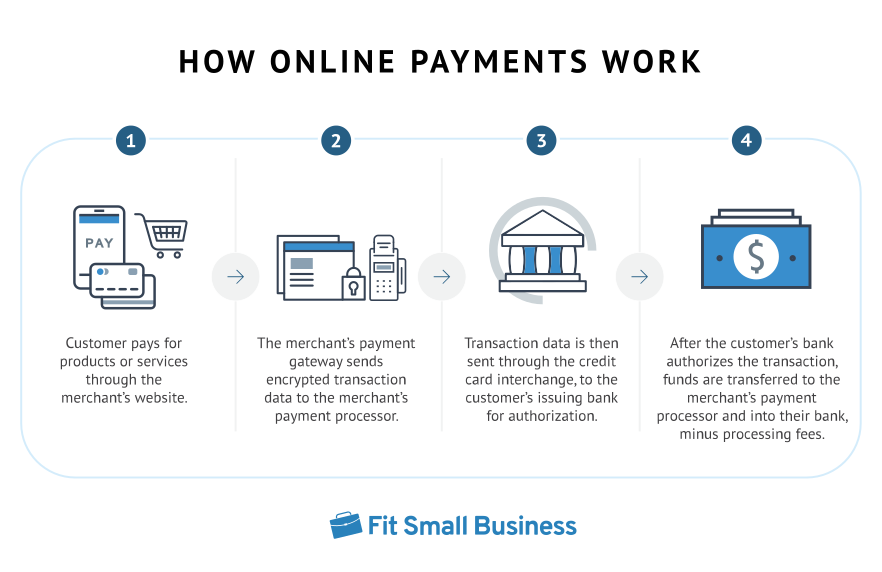
A payment gateway is the digital equivalent of a physical credit card terminal. It’s the secure service that authorizes credit card transactions online or, in some cases, with virtual terminals for phone orders. When a customer enters their card details on your e-commerce site, the payment gateway encrypts this sensitive information and securely transmits it to the acquiring bank and the card network (e.g., Visa, Mastercard) for approval. It then relays the approval or decline back to your website. A robust payment gateway is crucial for online sales, ensuring secure data handling and compliance with industry standards, thereby protecting your business from potential financial liabilities related to data breaches.
Point-of-Sale (POS) Systems: Hardware and Software for In-Person Sales
For brick-and-mortar businesses, a Point-of-Sale (POS) system is the central financial management tool. Modern POS systems are far more than just cash registers; they are integrated hardware and software solutions that manage sales, inventory, customer data, and sometimes even employee management. They include card readers (for EMV chip cards, magstripes, and NFC contactless payments), receipt printers, and a display. A good POS system streamlines checkout, reduces errors, provides valuable sales data for financial analysis, and integrates seamlessly with payment processors to handle credit card transactions efficiently. Investing in a suitable POS system is a strategic decision that impacts both operational efficiency and financial reporting.
Mobile Payment Solutions: Flexibility on the Go
The rise of smartphones has revolutionized payment acceptance, offering unparalleled flexibility. Mobile payment solutions typically involve a small card reader that plugs into a smartphone or tablet, coupled with a dedicated app. These are ideal for businesses that operate outside a traditional storefront – food trucks, market vendors, independent contractors, or home service providers. They allow businesses to process credit card payments virtually anywhere with a cellular signal or Wi-Fi, capturing sales opportunities that might otherwise be lost. From a financial perspective, mobile solutions significantly lower the overhead for payment acceptance, empowering small businesses and solopreneurs to compete more effectively.
Navigating the Cost Structure: Fees and Pricing Models
Accepting credit card payments comes with associated costs, which are crucial for businesses to understand and manage to protect their profit margins. These fees are not uniform and can significantly vary based on the processor, card type, and transaction method.
Interchange Fees: The Unavoidable Base Cost
Interchange fees are the largest component of credit card processing costs, typically accounting for 70-90% of the total. These fees are paid by your acquiring bank (or PSP) to the cardholder’s issuing bank (the bank that issued the credit card). Interchange rates are set by the card networks (Visa, Mastercard, Discover, American Express) and vary based on numerous factors: the type of card (e.g., standard, rewards, business, corporate), the transaction method (card-present vs. card-not-present), the merchant category code (MCC), and even the transaction amount. These fees are non-negotiable and represent the fundamental cost of transferring funds and risk.
Assessment Fees: Card Brand Charges
In addition to interchange fees, card networks (Visa, Mastercard, etc.) charge their own smaller fees, known as assessment fees. These fees are paid by the acquiring bank directly to the card networks for using their infrastructure and brand. They are generally a percentage of the transaction volume plus a small fixed fee per transaction. Like interchange fees, assessment fees are standard and non-negotiable for businesses.
Processor Markups: Understanding Pricing Models
The remaining portion of your processing fees is the processor’s markup, which is how the payment processor makes its profit. This is where pricing models come into play, and where businesses have the most leverage to negotiate and choose the most financially advantageous option.
- Tiered Pricing (or Bundled Pricing): This model groups various interchange rates into a few broad categories, typically “qualified,” “mid-qualified,” and “non-qualified.” While appearing simple, it can be opaque. Transactions that don’t meet strict criteria (e.g., card-not-present, rewards cards) are shunted into higher-cost tiers, leading to unpredictable and often higher overall costs.
- Interchange-Plus Pricing: Considered the most transparent model, this involves the processor charging the direct interchange fee plus a fixed percentage and/or a fixed per-transaction fee (e.g., “interchange + 0.20% + $0.10”). This model clearly separates the non-negotiable interchange and assessment fees from the processor’s markup, allowing businesses to see exactly what they are paying their processor and making it easier to compare offers. This is generally preferred for medium to high-volume businesses.
- Flat-Rate Pricing: Popular with PSPs like Square or Stripe, this model charges a single, fixed percentage for all transactions (e.g., 2.9% + $0.30 for online, 2.6% + $0.10 for in-person). While often higher than interchange-plus for large businesses, its simplicity and predictability make it ideal for small businesses, startups, or those with lower transaction volumes, as it eliminates complex fee structures and often monthly minimums.
Hidden Fees and Best Practices for Cost Management
Beyond the core transaction fees, businesses must be vigilant for potential hidden fees. These can include statement fees, PCI compliance fees, annual fees, batch fees, chargeback fees, early termination fees, and minimum processing fees. Always review your processing statements meticulously. To manage costs effectively:
- Negotiate: For merchant accounts, don’t hesitate to negotiate rates, especially as your volume grows.
- Compare: Obtain quotes from multiple processors and compare them side-by-side using a detailed cost analysis, not just advertised rates.
- Understand Your Volume: Choose a pricing model that aligns with your business’s transaction volume and average ticket size.
- Optimize Processing: Ensure you are swiping/dipping cards correctly, using address verification services (AVS), and obtaining signatures when required to qualify for the lowest interchange rates.
Choosing the Right Solution for Your Business (Strategic Financial Decisions)
Selecting the ideal credit card processing solution is a strategic financial decision that can significantly impact your operational efficiency, customer satisfaction, and bottom line. It requires a careful assessment of your unique business needs and a thorough evaluation of available options.
Assessing Your Business Needs: Volume, Type, and Risk
The first step is a comprehensive self-assessment.
- Transaction Volume and Average Ticket Size: Do you process a few high-value transactions or many small ones? This will heavily influence whether a flat-rate or interchange-plus model is more cost-effective.
- Business Type (In-Person, Online, Mobile): What is your primary sales channel? A retail store will prioritize a robust POS, while an e-commerce business needs a reliable payment gateway and virtual terminal. A mobile service provider needs flexible mobile readers.
- Industry and Risk Profile: Certain industries (e.g., high-ticket items, recurring billing, regulated industries) are considered higher risk and may face different pricing structures or require specialized solutions. Understanding your risk profile helps in finding compliant and cost-effective processors.
Key Factors in Evaluating Payment Processors
When evaluating potential payment processors, focus on these critical financial and operational aspects:
- Pricing Transparency: Prioritize processors with clear, straightforward pricing. Avoid those that use opaque tiered models without detailed explanations. Always ask for a full breakdown of all potential fees.
- Security and PCI DSS Compliance: Protecting customer data is paramount. Ensure the processor is fully PCI DSS compliant and offers robust fraud prevention tools (e.g., tokenization, encryption, AVS). Non-compliance can lead to severe financial penalties and reputational damage.
- Customer Support: When a payment system goes down, it directly impacts sales. Reliable and responsive customer support is invaluable for troubleshooting and minimizing downtime.
- Integration Capabilities: Can the processing solution seamlessly integrate with your existing e-commerce platform, POS system, accounting software (e.g., QuickBooks, Xero), or CRM? Good integration saves time and reduces manual errors, contributing to operational efficiency.
- Contract Terms: Scrutinize contract length, early termination fees, and any clauses regarding rate increases. Flexibility can be a significant financial advantage.
Integrating with Accounting and Business Management Software
For optimal financial management, your credit card payment system should integrate seamlessly with your wider accounting and business management software. Such integration automates transaction recording, reconciles sales data, simplifies tax preparation, and provides a holistic view of your financial performance. This reduces manual data entry, minimizes errors, and frees up valuable time for strategic financial planning rather than administrative tasks. From a financial perspective, this efficiency gain translates directly into cost savings and more accurate reporting.
Ensuring PCI DSS Compliance: Protecting Your Financial and Reputational Assets
The Payment Card Industry Data Security Standard (PCI DSS) is a set of security standards designed to ensure that all companies that process, store, or transmit credit card information maintain a secure environment. Achieving and maintaining PCI compliance is not optional; it’s a mandatory requirement to protect cardholder data. Non-compliance can lead to severe fines from card brands, increased transaction fees, and a damaged reputation, all of which have significant financial ramifications. Your chosen payment processor should provide tools and guidance to help you maintain compliance, including secure payment gateways, tokenization, and regular security audits. Proactive security measures are an investment in your business’s long-term financial health and trustworthiness.
Optimizing Your Payment Acceptance Strategy for Profitability
Beyond merely accepting credit cards, businesses should actively optimize their payment strategy to enhance profitability and mitigate financial risks. This involves continuous monitoring, adaptation, and leveraging available tools.
Minimizing Chargebacks and Fraud
Chargebacks – when a customer disputes a transaction with their bank – are a significant financial drain. Each chargeback often results in lost revenue, a chargeback fee from your processor, and administrative costs. Excessive chargebacks can even lead to your merchant account being terminated. Proactive fraud prevention is key:
- Use AVS (Address Verification Service) and CVV (Card Verification Value): For online transactions, always require these details.
- Implement 3D Secure: Services like Verified by Visa and Mastercard SecureCode add an extra layer of authentication for online purchases.
- Maintain Clear Communication: Provide excellent customer service, clear return policies, and prompt shipping to prevent customer dissatisfaction that could lead to chargebacks.
- Keep Records: Maintain detailed records of all transactions, including proof of delivery, to dispute fraudulent chargebacks effectively.
Leveraging Data for Financial Insights
Modern payment systems, especially comprehensive POS and e-commerce platforms, collect a wealth of transaction data. This data is a goldmine for financial analysis. By regularly reviewing sales trends, peak transaction times, average transaction values, and popular products, businesses can make informed decisions about inventory management, staffing, marketing campaigns, and pricing strategies. Integrating this payment data with your accounting and analytics tools provides a deeper understanding of your financial performance and helps identify opportunities for profit optimization.

Future-Proofing Your Payment Infrastructure
The payments landscape is constantly evolving, with new technologies like contactless payments, mobile wallets (Apple Pay, Google Pay), and even cryptocurrencies emerging. Businesses should choose solutions that are adaptable and can incorporate these future payment methods with minimal disruption. Investing in flexible, scalable payment infrastructure ensures that your business remains competitive, caters to evolving customer preferences, and is prepared for future financial trends without needing costly overhauls, thus protecting your long-term investment.
In conclusion, accepting credit card payments is a multifaceted aspect of modern business finance. It requires a strategic approach to selecting the right tools, understanding the associated costs, ensuring security, and continuously optimizing the process for maximum profitability. By mastering these elements, businesses can not only meet customer expectations but also unlock significant growth opportunities and build a more robust financial future.
aViewFromTheCave is a participant in the Amazon Services LLC Associates Program, an affiliate advertising program designed to provide a means for sites to earn advertising fees by advertising and linking to Amazon.com. Amazon, the Amazon logo, AmazonSupply, and the AmazonSupply logo are trademarks of Amazon.com, Inc. or its affiliates. As an Amazon Associate we earn affiliate commissions from qualifying purchases.