
For most individuals, purchasing a home represents the single largest financial transaction of their lives. Central to this monumental decision is understanding the mortgage – specifically, the 30-year fixed-rate mortgage, which has long been the bedrock of American homeownership. While the allure of owning a piece of the American dream remains constant, the financial landscape underpinning it is anything but static. Mortgage rates fluctuate daily, influenced by a complex interplay of economic indicators, global events, and market sentiment. Consequently, prospective homebuyers and existing homeowners alike often find themselves asking: “What is the average 30-year mortgage rate?”

This question, while seemingly straightforward, unravels into a nuanced discussion involving economics, personal finance, and strategic planning. The “average” rate is a vital benchmark, a pulse check on the housing market, but it is rarely the exact rate any one individual will receive. This comprehensive guide will demystify the 30-year fixed mortgage, explore the forces that shape its rates, teach you how to interpret average rate data, and provide actionable strategies for securing the best possible financing for your unique situation. Understanding these dynamics is not just about saving money; it’s about making informed decisions that lay a strong foundation for your long-term financial well-being.
Demystifying the 30-Year Fixed Mortgage
The 30-year fixed-rate mortgage is a cornerstone of real estate financing, offering stability and predictability that many borrowers covet. Before diving into the intricacies of average rates, it’s crucial to grasp what this loan product entails and why it maintains such enduring popularity.
The Enduring Popularity of the 30-Year Term
A 30-year fixed-rate mortgage means that your interest rate, and consequently your principal and interest payment, remains unchanged for the entire three-decade duration of the loan. This characteristic predictability is its greatest asset. For families planning budgets, this means no surprises in their largest monthly expense, offering peace of mind even if interest rates climb in the broader market. The extended repayment period also results in lower monthly payments compared to shorter-term mortgages (like a 15-year fixed), making homeownership more accessible by improving affordability, especially for first-time buyers or those purchasing higher-value properties. This stability allows homeowners to plan for other financial goals, such as retirement savings or children’s education, without the specter of fluctuating mortgage payments.
Fixed vs. Adjustable: Why Stability Matters
The alternative to a fixed-rate mortgage is an adjustable-rate mortgage (ARM), where the interest rate can change periodically after an initial fixed period (e.g., 5/1 ARM, 7/1 ARM). While ARMs often offer a lower introductory rate, the unpredictability of future rate adjustments can introduce significant financial risk. If market rates rise, ARM payments can increase, potentially straining a household budget. Conversely, if rates fall, an ARM borrower might benefit, but this benefit is not guaranteed. The fixed nature of the 30-year mortgage insulates borrowers from rate hikes, providing a stable financial environment even in volatile economic times. For most homeowners seeking long-term security and budget predictability, the 30-year fixed-rate mortgage remains the preferred choice, making its average rate a critical metric to watch.
The Dynamic Forces Shaping Mortgage Rates
Understanding the “average” 30-year mortgage rate requires a deeper look into the intricate economic machinery that determines these figures. Mortgage rates are not set in a vacuum; they are a direct reflection of broader economic health, monetary policy, and the supply and demand for credit.
Macroeconomic Indicators: Inflation, Fed Policy, and Bond Yields
At the highest level, mortgage rates are largely influenced by macroeconomic trends. Inflation is a primary driver; lenders demand higher interest rates to compensate for the erosion of their money’s purchasing power over time. When inflation is high or expected to rise, mortgage rates generally follow suit. The Federal Reserve’s monetary policy, particularly its actions regarding the federal funds rate, plays a significant indirect role. While the Fed does not directly set mortgage rates, its influence on short-term interest rates and the overall credit market ripples through to long-term rates. When the Fed raises its benchmark rate to combat inflation, it typically leads to an increase in borrowing costs across the economy, including mortgages.
Perhaps the most direct influence comes from the bond market, specifically the yield on the 10-year Treasury note. Mortgage-backed securities (MBS) – bonds secured by a pool of mortgage loans – compete with Treasury bonds for investors’ attention. As the yield on the 10-year Treasury rises or falls, so too does the yield on MBS, directly impacting mortgage rates. This is why economists and mortgage professionals closely monitor the bond market for clues about future rate movements. Other indicators like GDP growth, employment figures, and consumer confidence also play supporting roles, painting a comprehensive picture of economic strength that lenders use to assess risk and price their loans.
Lender-Specific Factors and Market Competition
While macroeconomic forces set the general direction, individual lenders also contribute to rate variations. Each bank, credit union, or mortgage broker has its own cost of funds, operational expenses, profit margins, and risk assessment models. This leads to competitive pricing strategies. A lender with lower overhead or a strong desire to increase market share might offer slightly more attractive rates to draw in borrowers. Conversely, a lender specializing in niche markets or with higher operational costs might price their loans a bit higher. This competition is a significant reason why shopping around is critical; even small differences in rate can translate into substantial savings over a 30-year term.
Borrower-Specific Variables: Your Financial Profile’s Role
Crucially, the “average” rate reported by national surveys is just that – an average. The specific rate you qualify for will be heavily influenced by your individual financial profile. Your credit score is paramount; a higher score (typically 740 or above) signals lower risk to lenders, often earning you the most favorable rates. Your debt-to-income (DTI) ratio, which compares your total monthly debt payments to your gross monthly income, is another critical factor. A lower DTI (ideally below 43%) demonstrates your ability to manage additional debt.
The down payment you make also matters; a larger down payment (e.g., 20% or more) reduces the lender’s risk exposure and can lead to a better rate. The loan-to-value (LTV) ratio (the loan amount divided by the home’s appraised value) is directly tied to this. Furthermore, the type of loan (e.g., conventional, FHA, VA, USDA) and whether you choose to pay discount points (upfront fees paid to lower your interest rate) will impact your final rate. Even the property type and its location can subtly influence pricing due to varying market risks and local regulations. All these borrower-specific elements mean that two different applicants applying for the same loan at the same time could receive vastly different interest rates.
Navigating Average Rates: What Do They Really Mean?
The “average 30-year mortgage rate” is a frequently cited figure in financial news, offering a snapshot of the current market. However, it’s essential to understand its origins and limitations to make it a useful tool in your homebuying journey.
Key Sources for Average Mortgage Rate Data
Several reputable organizations track and publish average mortgage rates, providing valuable benchmarks for consumers. The most widely referenced source in the United States is Freddie Mac’s Primary Mortgage Market Survey (PMMS). This weekly survey collects data from a broad sampling of lenders across the country, focusing on conforming loans with good credit profiles and a 20% down payment, without discount points. The PMMS is an excellent indicator of general market trends. Other reliable sources include the Mortgage Bankers Association (MBA), which publishes its Weekly Mortgage Applications Survey, and various financial news outlets and aggregators that compile data from multiple lenders. While these averages offer a crucial context, remember they represent a specific type of borrower and loan scenario.
The Nuance of “Average”: Why Your Rate May Differ
It cannot be overstated: the “average” rate is a statistical composite, not a personal guarantee. As discussed, your actual rate will be a personalized calculation based on your credit score, DTI, down payment, chosen lender, and even the nuances of the property you’re financing. If your credit score is lower than the typical borrower surveyed, or if your down payment is less than 20%, you should expect a rate higher than the reported average. Conversely, an exceptionally strong financial profile, combined with strategic rate shopping, might allow you to secure a rate below the average. The average should be used as a guiding light, indicating whether rates are generally high or low, rising or falling, rather than a definitive quote for your specific situation.

Historical Perspectives on 30-Year Mortgage Rates
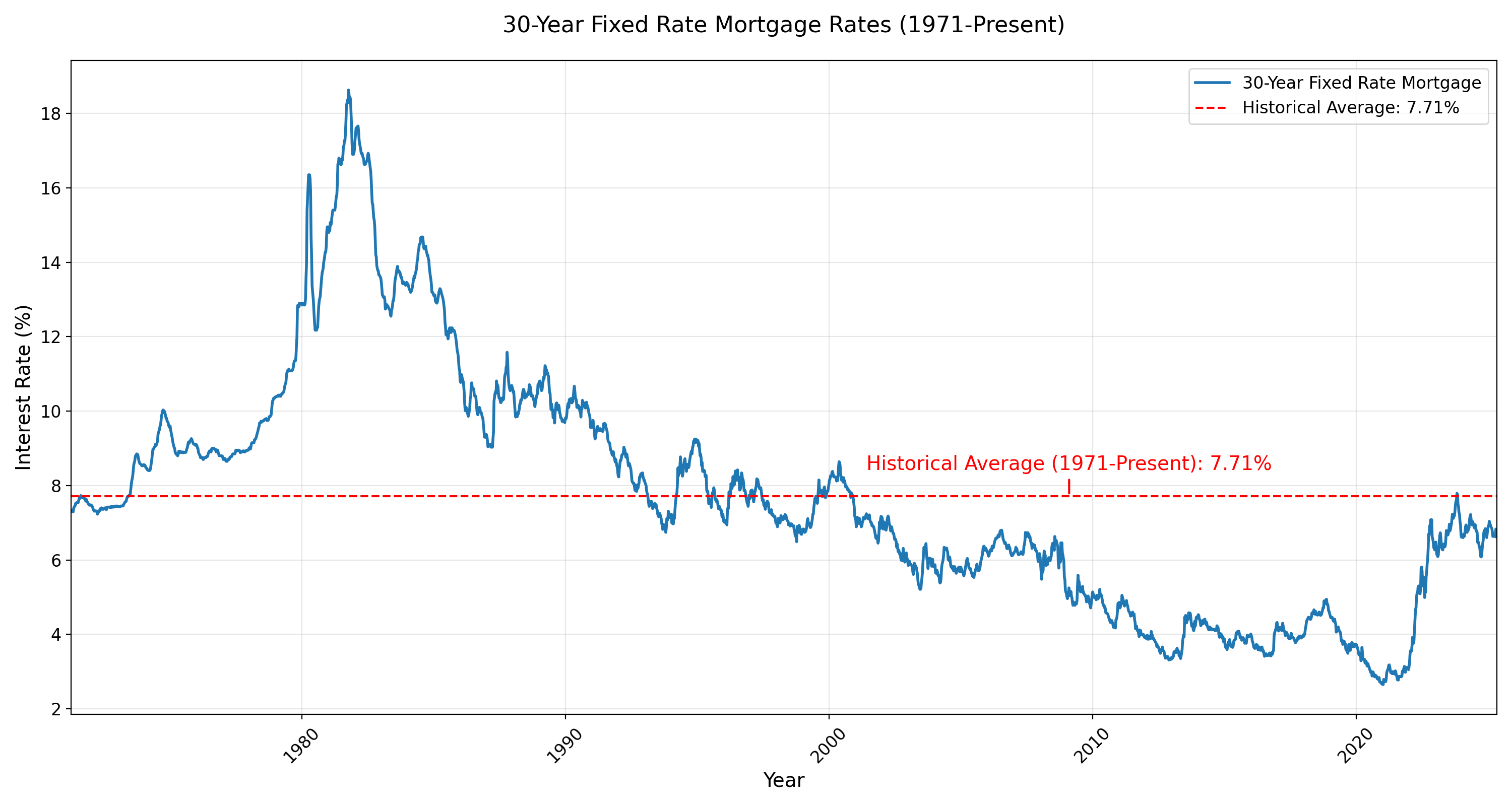
Reviewing historical mortgage rate trends offers invaluable context and a sense of perspective. Over the past five decades, 30-year fixed mortgage rates have seen dramatic swings. In the early 1980s, rates soared into the double digits, peaking above 18%. Since then, a general downward trend has prevailed, punctuated by periods of increases and decreases. The early 2020s saw rates hit historic lows, hovering below 3%, making homeownership incredibly affordable for many. However, subsequent inflationary pressures and aggressive Fed policy led to a rapid ascent, pushing rates to levels not seen in over two decades. Understanding these cycles helps to contextualize current rates. While a rate of 7% might seem high compared to 2021, it is significantly lower than the historical peak. This historical context informs expectations and strategies, helping borrowers understand what constitutes a “good” rate in a given economic environment.
Strategies to Optimize Your Mortgage Rate
While macroeconomic forces are beyond individual control, borrowers have significant agency in shaping the interest rate they ultimately receive. Proactive financial planning and diligent shopping can translate into substantial savings over the life of a 30-year mortgage.
Enhancing Your Creditworthiness
Your credit score is arguably the single most impactful factor within your control. Lenders use it to assess your risk profile. A higher score signifies a responsible borrower less likely to default, meriting a lower interest rate. To improve your creditworthiness:
- Pay bills on time, every time: Payment history is the largest component of your credit score.
- Reduce outstanding debt: A lower credit utilization ratio (how much credit you’re using versus how much is available) improves your score.
- Avoid opening new credit accounts: This can temporarily lower your score by shortening your average account age and signaling potential financial instability.
- Check your credit report for errors: Disputing inaccuracies can quickly boost your score. Aim for a FICO score of 740 or higher to qualify for the most competitive rates.
Maximizing Your Down Payment
A larger down payment reduces the loan-to-value (LTV) ratio, signaling lower risk to the lender and often resulting in a better interest rate. A 20% down payment is often considered ideal because it also helps you avoid private mortgage insurance (PMI), an additional monthly cost that protects the lender. While 20% isn’t always feasible, even increasing your down payment from, say, 5% to 10% can make a difference in your rate and overall loan terms. Accumulating a substantial down payment demonstrates financial discipline and commitment, which lenders appreciate.
The Impact of Mortgage Points and Loan Types
Mortgage points, also known as discount points, are essentially prepaid interest. One point typically costs 1% of the loan amount and can reduce your interest rate by a certain fraction (e.g., 0.25%). Deciding whether to pay points involves a break-even analysis: how long will it take for the monthly savings from the lower rate to offset the upfront cost of the points? If you plan to stay in the home for a long time, paying points might be a wise investment.
The type of loan also matters. Conventional loans, backed by Fannie Mae and Freddie Mac, often offer the best rates for borrowers with excellent credit. Government-backed loans like FHA, VA, and USDA loans have specific eligibility requirements but can be beneficial for those who qualify, often featuring lower down payments or unique benefits (e.g., no down payment for VA loans). Researching which loan type best suits your financial situation is crucial.
Shopping Around for the Best Lender
This is perhaps the most straightforward yet often overlooked strategy. Do not settle for the first quote you receive. Interest rates and fees can vary significantly between lenders on the same day. Contact multiple banks, credit unions, and mortgage brokers. Obtain Good Faith Estimates (GFEs) or Loan Estimates (LEs) from at least three to five different sources. Compare not just the interest rate, but also closing costs, fees, and the Annual Percentage Rate (APR), which provides a more comprehensive measure of the loan’s total cost. A fractional difference in interest rate can save tens of thousands of dollars over 30 years. Using online comparison tools and working with a mortgage broker who has access to multiple lenders can streamline this process.
The Long-Term Financial Implications of a 30-Year Mortgage
Securing a 30-year fixed mortgage is not merely about the immediate monthly payment; it’s a 30-year commitment with significant long-term financial implications that deserve careful consideration.
Understanding Amortization and Total Interest Paid
One of the most critical aspects of a 30-year mortgage is its amortization schedule. In the early years of the loan, a disproportionately large portion of your monthly payment goes towards interest, with only a small amount reducing your principal balance. As the loan progresses, this ratio gradually shifts, with more of your payment applying to the principal. This front-loading of interest means that over the full 30-year term, you will pay significantly more in total interest than the original principal amount, especially with higher interest rates. For example, on a $300,000 loan at 7%, you could pay over $400,000 in interest alone. Understanding this mechanism can motivate borrowers to consider making extra principal payments when financially possible, which can drastically reduce the total interest paid and shorten the loan term.
Weighing Refinancing Options
The 30-year fixed mortgage offers stability, but market rates don’t always stay higher than your original rate. If interest rates drop significantly after you’ve secured your mortgage, or if your credit profile substantially improves, refinancing becomes a viable option. Refinancing involves taking out a new loan to pay off your existing mortgage, ideally at a lower interest rate, reducing your monthly payments, or shortening your loan term. However, refinancing comes with its own closing costs, so it’s essential to perform a break-even analysis to determine if the long-term savings outweigh the upfront expenses. Market conditions and your personal financial goals should dictate when and if refinancing is a smart move.
Building Equity and Financial Security
Despite the substantial interest paid, a 30-year fixed mortgage is a powerful tool for building long-term wealth and financial security. As you make payments and the value of your home potentially appreciates, you build equity – the portion of your home’s value that you own outright. This equity can be leveraged for future financial needs, such as home improvements, education expenses, or even a down payment on another property, through options like a home equity loan or a cash-out refinance. Owning a home provides a tangible asset that often grows in value over time, offering a hedge against inflation and a stable foundation for your overall financial portfolio. The consistency of the 30-year fixed payment allows for predictable equity growth, contributing significantly to your net worth over decades.
Conclusion: Beyond the Average: Securing Your Financial Future
The question “what is the average 30-year mortgage rate?” serves as an indispensable starting point for anyone navigating the complex world of home financing. It offers a crucial benchmark, a barometer for the broader housing market, and a historical context for current economic conditions. However, as we’ve explored, the journey from an average rate to your specific rate is paved with individual financial nuances, strategic decisions, and diligent effort.
Understanding the macroeconomic forces at play – from inflation and Federal Reserve policy to the intricate dance of the bond market – empowers you to interpret market trends more intelligently. Critically, recognizing the profound impact of your personal financial profile, including your credit score, debt-to-income ratio, and down payment, shifts the focus from passive observation to proactive engagement. By meticulously improving your creditworthiness, maximizing your down payment, and strategically shopping for the best lender, you are not merely accepting an average; you are actively shaping a mortgage deal that aligns with your financial well-being.
Ultimately, a 30-year fixed-rate mortgage is more than just a loan; it’s a long-term commitment to a significant asset. Armed with knowledge about amortization, the potential for refinancing, and the invaluable process of building home equity, you can transform a daunting financial undertaking into a cornerstone of your wealth-building strategy. Moving beyond merely knowing the average, and actively working to secure the best possible terms, is the key to unlocking true financial security and achieving the enduring dream of homeownership.
aViewFromTheCave is a participant in the Amazon Services LLC Associates Program, an affiliate advertising program designed to provide a means for sites to earn advertising fees by advertising and linking to Amazon.com. Amazon, the Amazon logo, AmazonSupply, and the AmazonSupply logo are trademarks of Amazon.com, Inc. or its affiliates. As an Amazon Associate we earn affiliate commissions from qualifying purchases.