
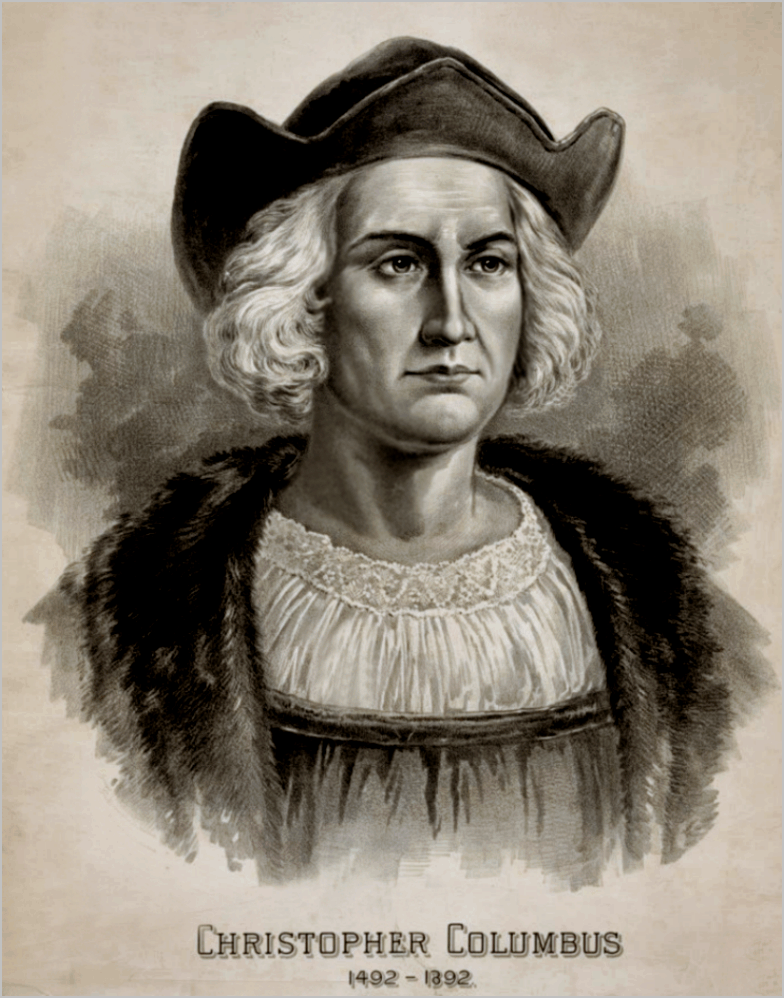
For centuries, the question of when and where Christopher Columbus was born remained a matter of scholarly debate and archival speculation. While traditional history books generally settle on 1451 in the Republic of Genoa, the lack of a definitive birth certificate from the mid-15th century has left the door open for various theories. However, in the 21st century, the quest to identify the exact origins and timing of Columbus’s life has shifted from the library to the laboratory.
Today, the intersection of big data, genomic sequencing, and artificial intelligence is providing a high-tech toolkit to solve one of history’s most enduring cold cases. This article explores the sophisticated technology and digital methodologies currently being utilized to pinpoint the chronological and geographical coordinates of the man who bridged two worlds.

Digital Archaeology: Leveraging Big Data to Trace 15th-Century Records
The primary challenge in verifying a 15th-century birth year lies in the fragmentation of historical records. To solve this, researchers are no longer relying on manual page-turning; they are utilizing “Digital Archaeology”—a suite of software tools designed to aggregate and analyze vast amounts of disparate data.
Cloud-Based Archiving and Global Database Integration
The effort to find Columbus’s birth records involves scanning and digitizing thousands of municipal, ecclesiastical, and commercial documents across Italy, Spain, and Portugal. Through high-resolution multispectral imaging, tech-driven historians can recover text from faded or damaged parchments that are invisible to the naked eye. These images are then hosted on centralized cloud platforms, allowing researchers worldwide to collaborate in real-time. By applying data mining techniques to these digitized archives, algorithms can identify patterns in naming conventions and witness signatures that correlate with the 1451 birth window.
OCR and AI-Powered Manuscript Translation
One of the most significant hurdles in historical tech is the variance in medieval handwriting. Traditional Optical Character Recognition (OCR) often fails when faced with 15th-century cursive. However, recent advancements in Hand-written Text Recognition (HTR) software, powered by neural networks, have changed the landscape. Tools like Transkribus use deep learning to “learn” an individual scribe’s style, allowing for the rapid transcription of thousands of Genoese tax records and maritime logs. By processing these documents at scale, AI can cross-reference mentions of the Columbus family (the Colombo family of Genoa), providing secondary evidence that supports a birth year between August and October of 1451.
Genomic Sequencing: The High-Tech Search for Biological Roots
Perhaps the most groundbreaking technological intervention in the search for Columbus’s origins occurred in the field of paleogenetics. In 2024, a major scientific study utilized DNA analysis to settle long-standing disputes about his heritage, which directly impacts the veracity of his recorded birth year.
Next-Generation Sequencing (NGS) and Bioinformatic Tools
To determine Columbus’s origins, scientists extracted DNA from his remains and those of his son, Hernando, and brother, Diego. The technology used, known as Next-Generation Sequencing (NGS), allows for the rapid sequencing of entire genomes from highly degraded ancient samples. Specialized bioinformatic software then compares these sequences against massive global databases of modern and ancient DNA. By analyzing Y-chromosome and Mitochondrial DNA markers, researchers can use molecular clock algorithms to estimate how many generations separate a subject from their ancestors, helping to validate or refute historical timelines regarding his family’s arrival in certain regions.
Carbon Dating and Chemical Analysis
While DNA tells us “who,” carbon dating and isotope analysis tell us “when.” Accelerate Mass Spectrometry (AMS) is the gold standard in radiocarbon dating technology, requiring only tiny samples to provide highly accurate age estimates. When applied to the biological remains associated with the Columbus family, this tech provides a chronological bracket. Furthermore, strontium isotope analysis of tooth enamel—a process involving thermal ionization mass spectrometry—can reveal the environmental conditions of a person’s childhood. If the chemical signature in the teeth matches the soil and water profiles of 1450s Genoa, it provides a tech-validated confirmation of his birth location and era.
Predictive Modeling and Chronological Calibration
Determining a birth year from 500 years ago is not just about finding a date; it is about reconciling different time-keeping systems. The transition from the Julian to the Gregorian calendar, and the various ways “years” were recorded in different kingdoms, requires sophisticated computational modeling.
Algorithmic Analysis of Medieval Calendars
Modern chronological software uses complex algorithms to “translate” 15th-century dates into modern standardized formats. When a document from the 1400s mentions an event happening in the “twelfth year of the reign of King John II,” software helps calculate the exact overlap with the modern calendar. By inputting every known date from Columbus’s life—his first voyage, his marriage, and his legal testimonies—into a Bayesian chronological model, researchers can work backward. This statistical approach calculates the highest probability of his birth year, consistently pointing toward the mid-1451 mark as the only date that fits all subsequent data points.
Forensic Reconstruction and Digital Twin Technology
Using CT scans of the skull and 3D modeling software, forensic artists and digital engineers have created “Digital Twins” of Christopher Columbus. This technology allows researchers to estimate the age of the individual at the time of death with high precision. By analyzing bone density and cranial sutures through digital skeletal analysis software, experts can confirm if the physical age of the remains matches the chronological age he would have been if born in 1451. This adds a layer of biological verification to the written record, ensuring that the “man in the box” matches the “man in the documents.”
The Future of Historical Inquiry: AI-Driven Historiography
As we move forward, the question of when Columbus was born will likely be answered with even greater certainty as Large Language Models (LLMs) and specialized AI agents are trained specifically on historical datasets.
Neural Networks and Fact-Checking the Past
We are entering an era where AI can perform “sentiment analysis” and “contradiction detection” across millions of pages of historical text. An AI trained on 15th-century European history can identify if a specific claim about Columbus’s birth year is an outlier or if it aligns with the socio-economic reality of the time. For instance, if a document claims he was born in a year when his father was documented to be elsewhere, the AI can immediately flag the inconsistency. This automated fact-checking reduces human bias and the “myth-building” that often plagues historical biographies.
The Ethics of Digital History and Virtual Archives
The tech-driven search for Columbus’s birth year also raises important questions about digital ethics. As we digitize sensitive cultural heritage and sequence the DNA of historical figures, the tech community must ensure data privacy and ethical handling of biological information. Virtual archives, protected by blockchain technology, are being proposed as a way to ensure that historical data remains immutable and transparent. By using decentralized ledgers, we can ensure that once a piece of evidence (like a birth record) is verified and uploaded, it cannot be tampered with or “re-interpreted” by future political agendas.
Conclusion: Synthesis of Bits, Bytes, and Biography
The quest to answer “What year was Christopher Columbus born?” has evolved into a masterclass in how technology can illuminate the past. We are no longer limited by the physical decay of paper or the subjectivity of 19th-century historians. Through the power of:
- Digital Archaeology, we can read the unreadable.
- Genomic Sequencing, we can trace the biological truth of his lineage.
- Computational Modeling, we can reconcile ancient calendars with modern precision.
- Artificial Intelligence, we can filter out historical noise to find the signal.
While the consensus remains 1451, the “proof” is now written in code and genetic markers rather than just ink. As technology continues to advance, our ability to reconstruct the lives of historical figures will only become more granular, proving that in the digital age, no mystery is truly safe from discovery. The year 1451 is no longer just a date in a book; it is a data point validated by the most sophisticated tools of the 21st century.
aViewFromTheCave is a participant in the Amazon Services LLC Associates Program, an affiliate advertising program designed to provide a means for sites to earn advertising fees by advertising and linking to Amazon.com. Amazon, the Amazon logo, AmazonSupply, and the AmazonSupply logo are trademarks of Amazon.com, Inc. or its affiliates. As an Amazon Associate we earn affiliate commissions from qualifying purchases.