
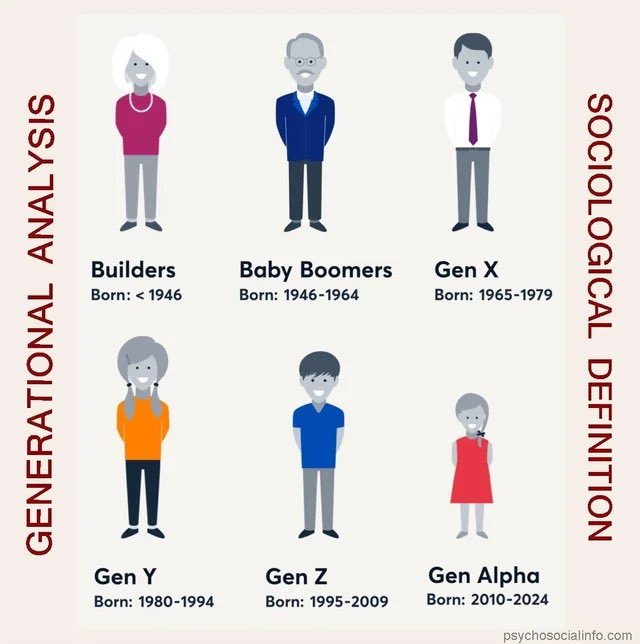
As we move through 2024, a significant demographic milestone is being reached. Every child born this year belongs to the final cohort of Generation Alpha. Named by social researcher Mark McCrindle, Generation Alpha encompasses those born between 2010 and 2024. This makes 2024 the “closing” year of a generation that has never known a world without the iPad, Instagram, or high-speed wireless connectivity.
However, from a technology perspective, those born in 2024 are distinct even from their older Alpha siblings born a decade prior. While the early Alphas were the “Mobile-First” generation, the 2024 cohort is the world’s first “AI-Native” group. As they enter a world where artificial intelligence is integrated into every app, toy, and educational tool, their cognitive development and interaction with technology will set a new precedent for human-digital synergy.

The Transition Point: From Generation Alpha to Generation Beta
Understanding the generation born in 2024 requires looking at both where they fit in the current chronological timeline and the technological landscape they are inheriting. As the 15-year cycle of Generation Alpha concludes, we are on the precipice of Generation Beta (beginning in 2025).
Defining the 2024 Cohort
Those born in 2024 are the “tail-end” Alphas. Historically, the final years of a generation serve as a bridge to the next. These infants will grow up alongside the first wave of Generation Beta, meaning their early childhood will be defined by the rapid-fire stabilization of technologies that are currently in their experimental phases. While an Alpha born in 2010 witnessed the rise of the smartphone, the Alpha born in 2024 will witness the potential decline of the handheld device in favor of more immersive, ambient tech.
Why 2024 is a Pivotal Technological Marker
The year 2024 is widely regarded by tech analysts as the “Year of Implementation” for Generative AI. For a child born today, AI is not a “tool” they will learn to use in middle school; it is the fabric of their environment. From AI-monitored nurseries to algorithmically generated lullabies, the 2024 cohort’s biological development is being mirrored by the exponential growth of machine learning. They are the first group whose entire digital footprint—from prenatal ultrasounds shared on social media to their first words recorded by smart speakers—will be processed by advanced neural networks.
Growing Up in an AI-Native World
For the generation born in 2024, the concept of “searching” for information will likely feel archaic. We are moving away from the era of the search engine and into the era of the “Answer Engine.”
The Death of the Search Engine for Toddlers
Previous generations had to learn how to type queries into Google. The 2024 cohort will likely interact with information through natural language processing (NLP) from the moment they can speak. Software will no longer be a static interface; it will be a conversational partner. By the time these infants reach preschool, Large Language Models (LLMs) will have evolved into highly specialized “Personalized Tutors” that can explain the world in a way that is specifically calibrated to the child’s current vocabulary and emotional state.
Hyper-Personalized Educational Software
The educational tech (EdTech) landscape for those born in 2024 will be radically different. We are seeing a shift from standardized software to adaptive learning ecosystems. AI tools will monitor a child’s progress in real-time, identifying cognitive gaps and adjusting the curriculum instantaneously. For the 2024 birth group, “failing” a subject might become a thing of the past, replaced by “optimized learning paths” that leverage their unique neurological strengths.
The Shift from Mobile-First to Spatial-First
While the older members of Generation Alpha are characterized by their “Screen Time,” those born in 2024 may eventually view screens as a primitive technology. The hardware transition currently underway—moving from 2D screens to 3D spatial environments—will define their formative years.
Beyond the Glass: The Rise of AR and VR
With the release of high-end spatial computers like the Apple Vision Pro and the refinement of Meta’s Quest series, the 2024 cohort will be the first to treat Augmented Reality (AR) as a standard feature of their physical world. For them, a digital character standing in their living room will be as “real” as a physical toy. This shift from “looking at” a device to “being inside” a digital environment will fundamentally alter their spatial reasoning and perception of distance and presence.
Smart Homes as Interactive Ecosystems
The “Internet of Things” (IoT) is maturing. For a child born in 2024, the home itself is a computer. Smart appliances, lighting, and security systems are becoming more interconnected through protocols like Matter. This means that as the 2024 cohort grows, their environment will respond to their presence through facial recognition and behavioral patterns. The “smart home” won’t just be a convenience; it will be an active participant in their daily lives, managing everything from their sleep cycles via smart lighting to their nutritional intake via AI-integrated kitchens.
Digital Privacy and the Ethical Tech Landscape
Every generation faces a unique challenge. For the 2024 cohort, the primary challenge will be the negotiation of digital identity and privacy in an era of “Deepfakes” and pervasive data harvesting.
Reclaiming Data Sovereignty
As these children grow, they will inherit a digital world that has already begun to struggle with the ethics of data. However, the tech tools available to them will likely include Decentralized Identity (DID) and blockchain-based privacy frameworks. Unlike their parents, who gave away data freely to social media giants, the 2024 cohort may be the first to utilize “Self-Sovereign Identity” tech, allowing them to own and monetize their personal data rather than being the product.
The Impact of Early Digital Footprints
A major concern for the tech-savvy parent of a 2024 baby is “sharenting”—the act of posting a child’s life online before they can consent. By the time the 2024 cohort reaches adolescence, AI will be able to reconstruct a person’s entire life story from these early posts. This is leading to a surge in “Privacy Tech” for families, including software that automatically blurs children’s faces in photos or creates “Digital Trust” funds where a child’s data is encrypted until they reach the age of majority.
Future-Proofing for a Quantum and 6G Future
As we look toward the 2030s and 2040s—when the 2024 cohort will be entering the workforce—the underlying infrastructure of technology will have undergone a total transformation.
The Speed of Connection and Ubiquitous Computing
By the time these children are in primary school, 6G technology is expected to be the standard. This isn’t just “faster 5G”; 6G is projected to integrate sensing and communication, allowing for “Internet of Senses” experiences where touch and smell can be transmitted digitally. For those born in 2024, the latency between thought and digital execution will be near zero. They will grow up in a world of “ubiquitous computing,” where the internet is as invisible and essential as electricity or oxygen.
Preparing for the 2040 Workforce
The career paths for a child born in 2024 don’t exist yet. With the rise of Quantum Computing and advanced robotics, the “Tech” niche they will inhabit will require a different set of skills. They won’t need to learn “coding” in the traditional sense, as AI will handle syntax. Instead, they will need to master “Prompt Engineering,” “Systems Thinking,” and “Ethical Oversight.” Their value in the future economy will be defined by their ability to manage the AI agents and robotic systems that were being prototyped in the year they were born.

Conclusion: The Legacy of the 2024 Alpha
The generation born in 2024 stands at a unique crossroads. They are the final chapter of Generation Alpha, but they are the prologue to a new era of human existence defined by seamless integration with technology. They will be the first generation to grow up with AI as a companion, the world as a spatial playground, and data as a personal asset.
As we look at these infants today, we aren’t just looking at the youngest members of a demographic cohort; we are looking at the architects of a future where the boundary between “digital” and “physical” has finally, and permanently, dissolved. For the 2024 born, technology isn’t something you use—it’s the world you inhabit.
aViewFromTheCave is a participant in the Amazon Services LLC Associates Program, an affiliate advertising program designed to provide a means for sites to earn advertising fees by advertising and linking to Amazon.com. Amazon, the Amazon logo, AmazonSupply, and the AmazonSupply logo are trademarks of Amazon.com, Inc. or its affiliates. As an Amazon Associate we earn affiliate commissions from qualifying purchases.