
In the history of aviation, few technological leaps have been as transformative as the transition from mechanical “steam gauges” to the integrated electronic systems known as the Glass Cockpit. At the heart of this digital transformation is the Primary Flight Display (PFD). As a cornerstone of modern avionics, the PFD represents the pinnacle of human-machine interface (HMI) design, merging complex sensor data with intuitive graphics to provide pilots with a singular, unified source of situational awareness. Understanding the PFD is not just about understanding aviation; it is about understanding how sophisticated software and hardware integration can enhance safety and efficiency in one of the most demanding environments on Earth.

The Evolution of Avionics: From Steam Gauges to Silicon
The journey to the modern PFD began in the mid-20th century, an era dominated by discrete mechanical instruments. Pilots were required to perform a “cross-check”—a rapid scanning of six separate analog dials known as the “Six Pack.” These included the airspeed indicator, attitude indicator, altimeter, turn coordinator, heading indicator, and vertical speed indicator. While functional, this system placed a high cognitive load on the pilot, who had to mentally synthesize data from six different locations to form a cohesive picture of the aircraft’s state.
The Rise of the Glass Cockpit
The term “Glass Cockpit” refers to a flight deck where traditional mechanical gauges are replaced by large electronic displays. This shift began in the late 1970s and early 1980s with high-end commercial airliners and military jets. The primary driver was the need for better data management. As aircraft became faster and more complex, the amount of information available to the pilot increased exponentially. The PFD was developed as a software-driven solution to this information overload, consolidating the most critical flight data into a single, high-resolution screen directly in the pilot’s line of sight.
How Sensor Integration Powers the PFD
Unlike mechanical gauges, which often rely on direct pressure or gyroscopic force, a PFD is the visual output of a complex network of digital sensors. Two primary systems provide the “intelligence” behind the display:
- AHRS (Attitude and Heading Reference System): This replaces traditional mechanical gyroscopes with solid-state MEMS (Micro-Electro-Mechanical Systems) sensors. It measures the aircraft’s pitch, roll, and yaw with extreme precision.
- ADC (Air Data Computer): This system processes inputs from the pitot-static system to calculate airspeed, altitude, and vertical speed.
By digitizing these inputs, the PFD can display information with a level of accuracy and stability that analog instruments could never achieve.
Anatomizing the PFD: Core Data and Visual Components
The layout of a Primary Flight Display is a masterclass in information architecture. While different manufacturers like Garmin, Honeywell, and Rockwell Collins have their own aesthetic styles, the industry has standardized the placement of data to ensure that pilots can transition between different aircraft with minimal retraining.
The Attitude Indicator and Synthetic Vision
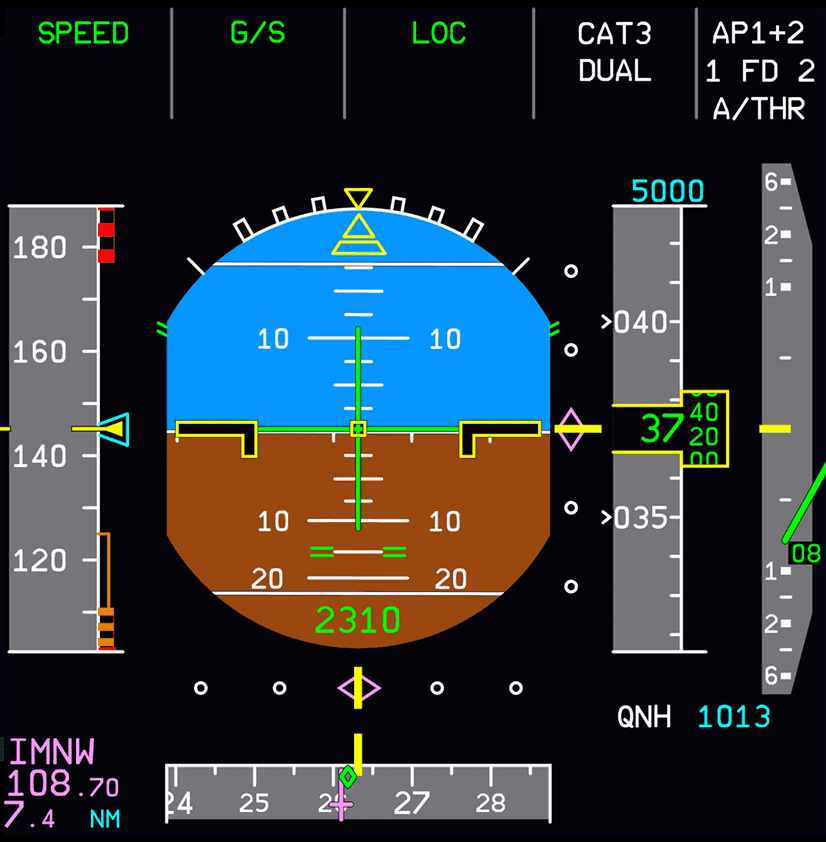
At the center of every PFD is the Attitude Indicator (AI). This is the most critical component, showing the aircraft’s relationship to the horizon. In modern high-tech PFDs, this central area has evolved from a simple blue-over-brown graphic to include Synthetic Vision Systems (SVS). SVS uses a 3D terrain database and GPS positioning to render a realistic view of the outside world on the screen. This allows pilots to “see” mountains, obstacles, and runways even in zero-visibility conditions, such as heavy fog or pitch-black night.
Airspeed and Altitude Tapes: Real-Time Data Processing
On either side of the central attitude indicator are the “tapes.” These are vertical scales that scroll as values change:
- The Airspeed Tape: Located on the left, it displays current speed. It often includes “trend vectors”—a software-calculated line that predicts where the speed will be in six seconds based on current acceleration. It also features color-coded bands (V-speeds) that warn the pilot of structural limits or stall speeds.
- The Altitude Tape: Located on the right, it shows the current MSL (Mean Sea Level) altitude. Like the airspeed tape, it includes a digital readout (the “altitude bug”) for the target altitude set by the autopilot.
The Horizontal Situation Indicator (HSI)
At the bottom of the PFD is the HSI, which combines the aircraft’s heading with navigation data. In the digital realm, the HSI is highly dynamic. It can overlay wind vectors (showing the speed and direction of the wind at the aircraft’s current altitude), GPS tracks, and navigation needles for ILS (Instrument Landing System) approaches. This integration ensures the pilot doesn’t have to look at a separate navigation display to understand their path over the ground.
Software Architecture and System Reliability
From a technology perspective, the PFD is more than just a monitor; it is a high-reliability computing node. Because the PFD is “mission-critical,” the software and hardware must meet rigorous certification standards (such as DO-178C in the United States).
Redundancy and Fail-Safe Mechanisms
In a modern digital cockpit, the risk of a “black screen” is mitigated through extreme redundancy. Most aircraft equipped with a PFD also feature a Multi-Function Display (MFD). In the event of a PFD hardware failure, the system can enter a “reversionary mode,” where the PFD data is automatically moved to the MFD screen. Furthermore, the underlying software is often partitioned, meaning a glitch in the navigation database cannot crash the core flight display software.
Human-Machine Interface (HMI) Design Principles
The PFD is a prime example of effective UX (User Experience) design in a high-stakes environment. Engineers use “de-clutter” logic to ensure that only the most relevant information is shown during different phases of flight. For instance, during a normal cruise, certain warning flags are hidden. However, if the aircraft enters an unusual attitude (e.g., an extreme bank or dive), the PFD software will automatically remove non-essential data and present large “recovery arrows” to guide the pilot back to level flight. This intelligent filtering of data is a hallmark of modern aerospace technology.
Advanced Features: Synthetic Vision and Augmented Reality
As we look toward the future of aviation technology, the PFD is becoming even more integrated with emerging tech trends like AI and Augmented Reality (AR).
Breaking the VFR Barrier with SVS
Synthetic Vision Systems (SVS) have revolutionized “General Aviation” and “Business Aviation.” By integrating high-resolution topographical maps with real-time GPS data, SVS transforms the PFD into a virtual window. For tech enthusiasts, this is comparable to the most advanced gaming engines, but with 99.999% reliability requirements. It reduces “Controlled Flight Into Terrain” (CFIT) accidents, which were historically one of the leading causes of aviation fatalities.
The Role of AI in Predictive Flight Path Monitoring
The next generation of PFDs is beginning to incorporate predictive algorithms. Rather than just showing where the aircraft is now, these systems use AI to model where the aircraft will be in the future, accounting for weather, fuel burn, and air traffic. If the AI detects a deviation from the safe flight envelope or a potential conflict with another aircraft, it can highlight the threat directly on the PFD using “Augmented Reality” overlays. This moves the PFD from a reactive tool to a proactive safety partner.
The Impact of PFDs on Modern Aviation Safety
The transition to Primary Flight Displays has fundamentally changed the nature of piloting. By consolidating information, reducing the physical movement required to scan instruments, and providing high-fidelity visual alerts, the PFD has made flying significantly safer.
Reducing Cognitive Load for Pilots
The primary benefit of the PFD is the reduction of the pilot’s “brain power” required for basic aircraft control. In the old days, a pilot in the clouds had to work hard just to keep the wings level and the altitude steady. With a PFD, the intuitive nature of the display allows that pilot to “fly the big picture.” This frees up cognitive resources for higher-level tasks, such as communicating with Air Traffic Control, managing complex weather patterns, and planning the arrival.

The Future of Integrated Flight Decks
As we move toward an era of autonomous and semi-autonomous flight, the PFD is evolving. We are seeing the rise of “Touchscreen Avionics,” where the PFD allows for direct interaction—similar to a tablet—enabling pilots to change headings or frequencies with a swipe. Furthermore, the integration of datalink technology allows the PFD to display real-time graphical weather (NEXRAD) and the positions of other aircraft (ADS-B In) directly on the primary display.
In conclusion, the Primary Flight Display is the crown jewel of modern cockpit technology. It represents a perfect synergy of hardware reliability, software sophistication, and human-centric design. As technology continues to advance, the PFD will likely integrate more AR features and AI-driven insights, further bridging the gap between the pilot’s intention and the aircraft’s performance. For anyone interested in the intersection of technology and the physical world, the PFD stands as a testament to how digital innovation can conquer even the most challenging environments.
aViewFromTheCave is a participant in the Amazon Services LLC Associates Program, an affiliate advertising program designed to provide a means for sites to earn advertising fees by advertising and linking to Amazon.com. Amazon, the Amazon logo, AmazonSupply, and the AmazonSupply logo are trademarks of Amazon.com, Inc. or its affiliates. As an Amazon Associate we earn affiliate commissions from qualifying purchases.