
In the landscape of computer science and software engineering, precision is the bedrock upon which reliable systems are built. However, precision does not always imply high-resolution floating-point numbers. Frequently, the most critical task for a developer is to reduce complexity—to take a continuous stream of data and map it into discrete, manageable integers. This is where the floor function becomes an indispensable tool. Whether you are building a responsive user interface, optimizing a search algorithm, or developing complex game physics, understanding the floor function is a fundamental requirement for any modern technologist.
Understanding the Mechanics of the Floor Function in Computing
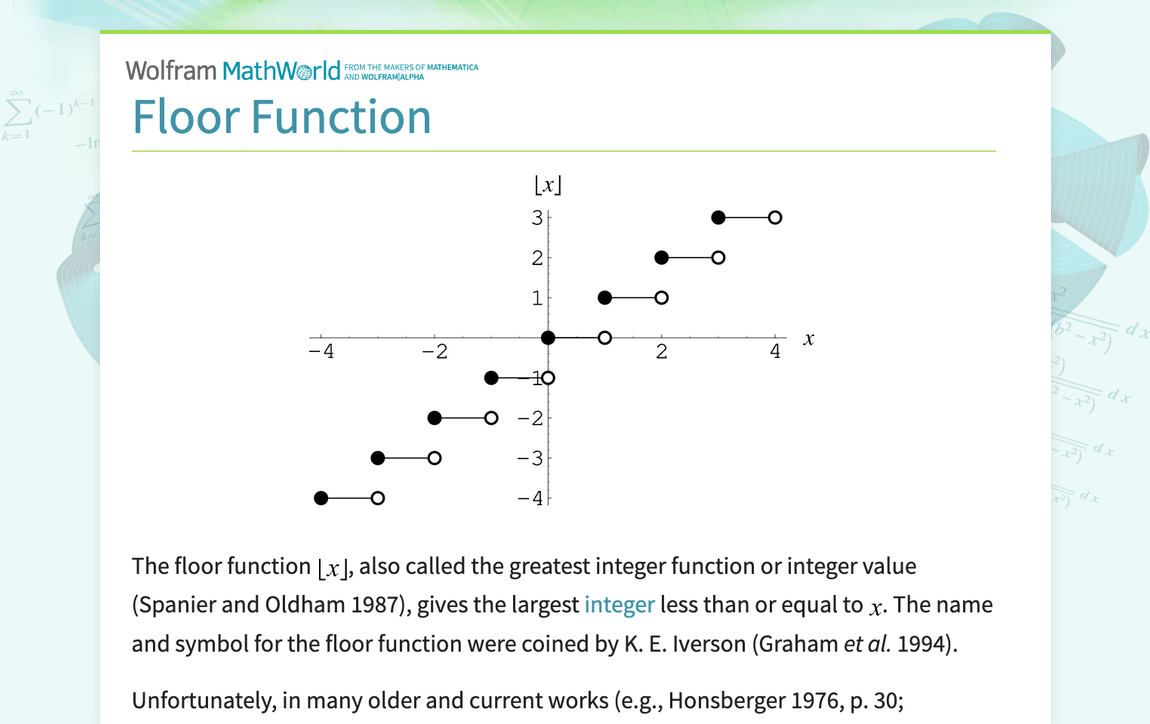
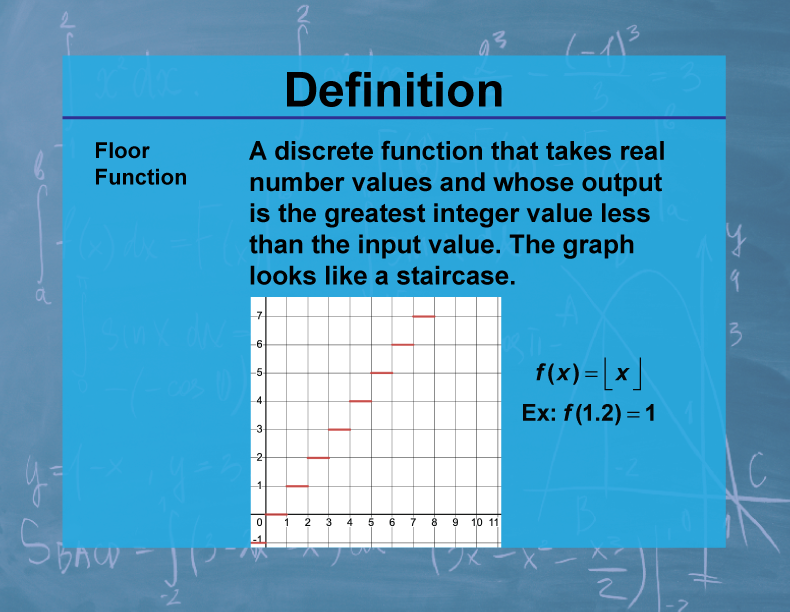
At its core, the floor function is a mathematical operation that takes a real number as an input and returns the greatest integer less than or equal to that number. In mathematical notation, it is represented by the symbols $lfloor x rfloor$. While the concept may seem elementary, its application within digital architecture is profound.
Mathematical Definition and Logic
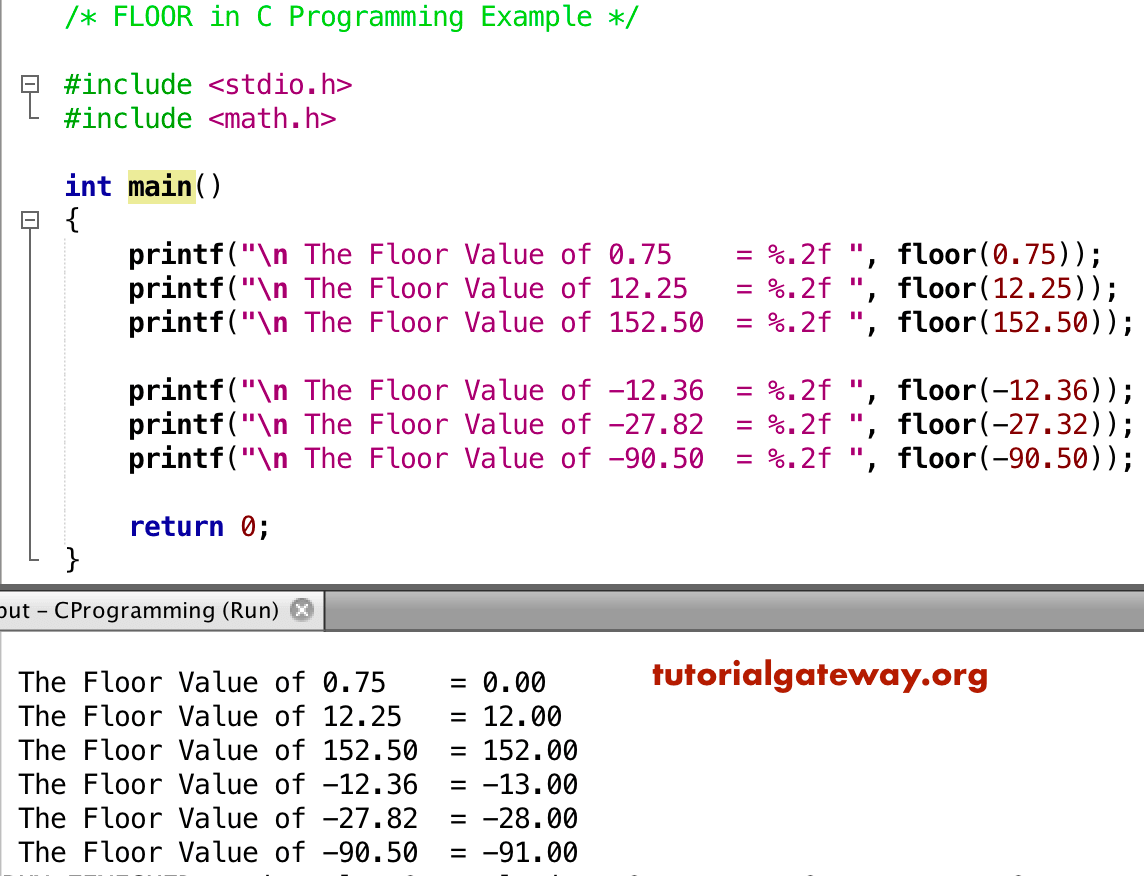
In a digital environment, data is often represented as floating-point numbers (decimals). However, hardware resources, memory addresses, and array indices require integers. The floor function acts as the bridge between these two worlds. For a positive number like 3.7, the floor function yields 3. For a negative number like -3.7, the floor function yields -4. This “rounding toward negative infinity” is a crucial distinction that separates the floor function from simple truncation, which would merely drop the decimal point.
For software developers, this logic ensures that a value never exceeds its allotted boundary. If you are calculating the number of containers required for a specific data payload, using a floor function allows you to determine the “completed” units of work, providing a baseline for resource allocation.
Comparison with Ceiling and Rounding Functions
To truly master the floor function, one must understand it in relation to its counterparts: the ceiling function and the rounding function. While the floor function ($lfloor x rfloor$) finds the highest integer below the input, the ceiling function ($lceil x rceil$) finds the lowest integer above the input.
Standard rounding (half-up or half-even) is non-linear and depends on the fractional value, which can introduce non-deterministic behavior in certain algorithms. In contrast, the floor function is consistent. It provides a predictable, downward-facing “staircase” effect. This predictability is vital in tech fields like cryptography and automated testing, where the output must be strictly reproducible across different hardware architectures.
Implementing Floor Functions Across Major Programming Languages
Every major programming language provides a built-in library to handle floor operations. However, the implementation details can vary slightly, especially concerning data types and performance overhead.
JavaScript: The Math.floor() Method
In the world of web development, JavaScript’s Math.floor() is one of the most frequently called methods in the standard library. Because JavaScript treats all numbers as double-precision 64-bit binary format (IEEE 754) by default, the floor function is essential for converting those doubles into integers for DOM manipulation or array indexing.
For example, when generating a random index for an array, a developer might use Math.floor(Math.random() * array.length). Here, the floor function ensures that the resulting index is always within the bounds of the array, preventing “out of bounds” errors that could crash a web application.
Python: The math.floor() and Integer Division
Python offers a highly readable implementation via the math module. By calling math.floor(x), Python returns the floor of x as an integral. Interestingly, Python also integrates floor logic directly into its arithmetic operators through “floor division” (//).
When a developer uses 10 // 3, Python returns 3. This is an optimized, low-level implementation of the floor function that avoids the overhead of a function call. In data science and AI applications where Python is the dominant language, floor division is used extensively to partition datasets and manage batches of information during machine learning model training.
C++ and Low-Level Implementations
In systems programming and game engine development (like Unreal Engine), performance is the highest priority. C++ provides the std::floor function within the <cmath> header. Unlike high-level languages, C++ allows developers to see how the floor function interacts with the processor’s floating-point unit (FPU).
At the assembly level, the floor function often translates to a specific CPU instruction that modifies the rounding mode of the processor for a single operation. This is significantly faster than manual bit-shifting or conditional logic, making it the preferred method for real-time applications where every microsecond of latency matters.
Crucial Use Cases in Software Development
Beyond simple mathematics, the floor function serves as a structural component in software architecture. It is used to solve problems related to space, time, and visual representation.
Pagination and Data Chunking
Consider a modern SaaS platform that displays thousands of user records. Loading all records at once would destroy performance and UX. Developers use the floor function to calculate pagination logic. If a system has 105 records and displays 10 per page, the floor function helps determine how many “full” pages exist before handling the remainder.
This chunking of data is essential for API development. When a backend service receives a request for a specific “offset,” the floor function is often used to calculate exactly which block of memory or database row the request corresponds to, ensuring efficient data retrieval.
Graphics, Grid Systems, and Game Physics
In game development and UI design, the screen is a grid of discrete pixels. However, physics engines calculate movement (velocity and acceleration) using continuous floating-point numbers. If a character’s position is calculated as $(10.7, 15.3)$, the graphics card cannot render half a pixel.
The floor function is used to “snap” these coordinates to the nearest pixel or grid cell. In tile-based games (like Minecraft or Stardew Valley), the floor function is what allows the game to determine which specific 3D block a player is interacting with based on their precise 3D coordinates. Without it, the interaction between continuous movement and a discrete world would be impossible to synchronize.
Cryptography and Hash Functions
In digital security, randomness and predictability must coexist. Many hashing algorithms use the floor function as part of their iterative transformations. By flooring certain intermediate values, developers can ensure that the algorithm produces a deterministic output while maintaining high entropy. It also helps in managing bit-depth; by flooring values, developers can force data into specific bit-widths (e.g., 32-bit or 64-bit integers), which is a requirement for many encryption standards.
Performance Optimization and Precision in AI and Machine Learning
As we move into the era of Artificial Intelligence, the floor function has found a new home in the optimization of neural networks and the processing of vast datasets.
Discretization of Continuous Data
Machine learning models often deal with sensor data—temperature, sound waves, or light levels—which are continuous. To make this data readable for certain types of models (like Decision Trees or Naive Bayes), the data must be “binned.” This process, known as discretization, frequently employs the floor function to group continuous values into discrete categories. For instance, flooring ages to the nearest decade allows a model to look for broad trends rather than getting lost in the noise of individual years.
Neural Network Activations and Quantization
One of the biggest trends in modern tech is “Model Quantization.” Large Language Models (LLMs) like GPT-4 require massive amounts of VRAM. To make these models run on consumer hardware or mobile devices, developers use quantization to reduce the precision of the model’s weights from 32-bit floats to 8-bit or even 4-bit integers.
The floor function is a key component of this scaling process. It allows the system to map a wide range of weights into a smaller, discrete set of values. While this involves a slight loss of precision, the gain in computational efficiency and reduction in power consumption is revolutionary, enabling AI to run locally on gadgets and smartphones.
Digital Security and the Precision of Integers
Finally, the floor function plays a quiet but vital role in maintaining the security and stability of digital systems by preventing common programming errors.
Preventing Floating-Point Errors in Logic
A common “bug” in software development occurs when floating-point math produces unexpected results due to binary approximation (e.g., $0.1 + 0.2$ not being exactly $0.3$). If a security protocol relies on an exact match between two calculated values, these tiny errors can lead to logic bypasses. By applying a floor function to both sides of a comparison, developers can normalize the data to integers, eliminating the “noise” of floating-point inaccuracies and ensuring that security checks are robust.
Access Control and Time-Based Tokens
Many Two-Factor Authentication (2FA) systems, like those using the Time-based One-Time Password (TOTP) algorithm, rely on the floor function. The system takes the current Unix timestamp (in seconds), divides it by a time step (usually 30 seconds), and applies the floor function.
$text{Counter} = lfloor (text{CurrentTime} – text{StartTime}) / 30 rfloor$
This ensures that the “counter” remains the same for the entire 30-second window. Without the floor function, the counter would be a constantly changing decimal, making it impossible for the server and the app to stay synchronized. This simple mathematical tool is, therefore, at the heart of the security protocols that protect billions of digital accounts every day.
Conclusion
The floor function is far more than a simple math lesson from grade school; it is a fundamental tool in the technologist’s toolkit. From the low-level optimization of C++ game engines to the high-level data processing of Python AI models, and from the security of 2FA tokens to the layout of web pages, the floor function provides the necessary bridge between the infinite precision of mathematics and the discrete reality of digital hardware. As software continues to grow in complexity, the ability to cleanly and predictably discretize data remains an essential skill for any developer aiming to build stable, efficient, and secure technology.
aViewFromTheCave is a participant in the Amazon Services LLC Associates Program, an affiliate advertising program designed to provide a means for sites to earn advertising fees by advertising and linking to Amazon.com. Amazon, the Amazon logo, AmazonSupply, and the AmazonSupply logo are trademarks of Amazon.com, Inc. or its affiliates. As an Amazon Associate we earn affiliate commissions from qualifying purchases.