
When discussing the Mall of America (MOA) in Bloomington, Minnesota, the conversation often revolves around its sheer scale as a retail behemoth. However, from a business and investment perspective, the true brilliance of the MOA ecosystem lies in its integrated hospitality strategy. For investors, real estate developers, and financial analysts, the two hotels physically attached to the complex—the JW Marriott and the Radisson Blu—represent a masterclass in “retail-tainment” synergy and high-yield commercial real estate.
Understanding which hotels are attached to the Mall of America is not just a logistical query for travelers; it is a fundamental look at how mixed-use developments maximize Revenue Per Available Room (RevPAR) and drive consistent consumer spending. This article explores the financial architecture and strategic branding that make these two properties some of the most lucrative hospitality assets in the Midwest.

The Strategic Value of Integrated Real Estate Assets
The integration of high-end hospitality directly into a retail environment is a calculated financial maneuver designed to capture “walled garden” spending. By physically attaching a hotel to a shopping center, the developers (Triple Five Group) created a captive audience. From a money management perspective, this reduces the “friction of distance,” ensuring that guest capital remains within the ecosystem for the duration of their stay.
Synergistic Revenue Streams
In traditional real estate, a shopping mall and a hotel operate as distinct silos. However, at the Mall of America, these entities share a symbiotic financial relationship. The hotels provide a steady stream of high-intent consumers (tourists and business travelers) to the retail tenants, while the mall’s attractions—such as Nickelodeon Universe and the SEA LIFE Aquarium—serve as built-in amenities for the hotels. This synergy allows the hotels to command a significant price premium compared to non-attached properties in the surrounding Bloomington area. For an investor, this translates to higher margins and a faster return on investment (ROI).
Location as a Competitive Advantage
In the world of commercial finance, “location” is often synonymous with “valuation.” The physical connection to the Mall of America provides these hotels with an “economic moat.” Even during harsh Minnesota winters, these properties maintain high occupancy rates because guests can access 5.6 million square feet of entertainment without stepping outside. This climate-controlled accessibility is a unique selling point that justifies a higher Average Daily Rate (ADR), shielding the assets from the seasonal volatility that often plagues other Midwestern hospitality investments.
Financial Profiles: JW Marriott vs. Radisson Blu
While both hotels are attached to the mall, they target different segments of the market, effectively diversifying the owner’s portfolio and capturing a broader range of consumer discretionary spending. Analyzing their financial positioning reveals how different tiers of luxury contribute to the overall economic health of the complex.
The Premium Tier: JW Marriott Minneapolis Mall of America
The JW Marriott represents the “Upper Upscale” or “Luxury” segment of the development. Opened in 2015 as part of a $325 million expansion, this property was a strategic move to attract high-net-worth individuals and corporate executives. From a business finance perspective, the JW Marriott focuses on high-margin services. Its 342 rooms are complemented by expansive meeting spaces and a sophisticated culinary program (Cedar + Stone, Urban Table).
Investors look at the JW Marriott as a “yield play.” By catering to the business traveler and the luxury shopper, the hotel achieves a higher ADR. Its presence also elevated the Mall of America’s brand, allowing the mall to attract more prestigious retail tenants who require a certain level of surrounding affluence to thrive.
The Lifestyle Tier: Radisson Blu Mall of America
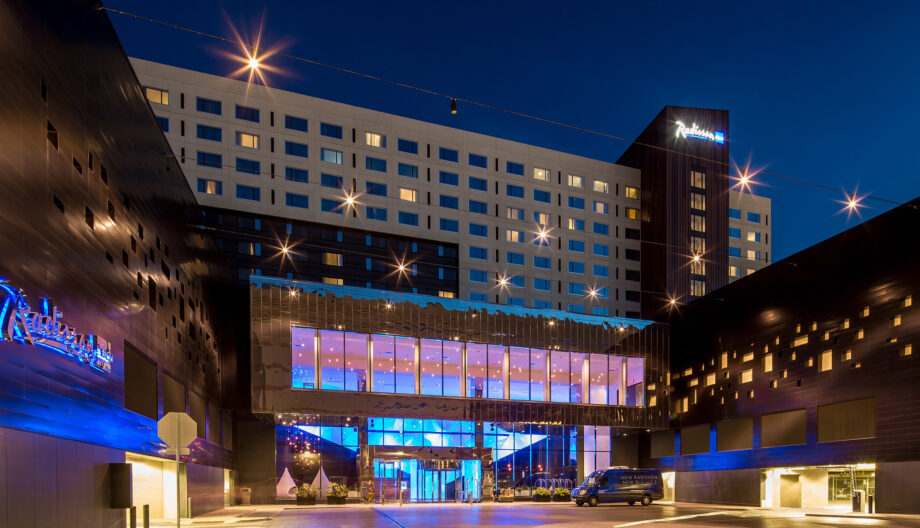
The Radisson Blu was the first hotel to be physically attached to the mall, opening in 2013. Its financial mission is slightly different: it serves as a “lifestyle” hotel, focusing on the modern, design-conscious traveler and families who want a premium but accessible experience. With over 500 rooms, it provides the “volume” necessary to sustain the mall’s foot traffic.
The Radisson Blu operates on a high-occupancy model. Because it was the pioneer of the attached-hotel concept at MOA, it established the proof of concept for integrated hospitality in this specific micro-market. Its success demonstrated that guests were willing to pay a premium for the convenience of a skybridge, paving the way for further capital investment in the mall’s North Entrance expansion.

The “Retail-tainment” Financial Multiplier
The term “retail-tainment” describes the fusion of retail and entertainment, but at Mall of America, it is a sophisticated financial engine. The hotels attached to the mall act as a multiplier for this engine, extending the “customer lifecycle” from a few hours to several days.
Boosting ADR through Accessibility
Average Daily Rate (ADR) is a key metric for hotel profitability. The hotels attached to the Mall of America consistently outperform their regional competitors in this metric. The reason is simple: convenience has a measurable dollar value. A guest is willing to pay $50–$100 more per night to avoid the costs and logistical hurdles of car rentals, ride-sharing, or shuttle schedules. For the hotel operator, this premium is almost pure profit, as the incremental cost of maintaining a “connected” room is negligible compared to a “non-connected” one.
Mitigation of Seasonal Retail Volatility
The retail industry is notoriously cyclical, with heavy reliance on the Q4 holiday season. However, by having over 800 luxury and upscale hotel rooms attached to the site, the Mall of America creates a stabilized “baseline” of spending. Business conferences hosted at the JW Marriott bring in midweek revenue during otherwise slow retail months (like February or October). This diversification of income streams—combining overnight stays, food and beverage, and event space—creates a more resilient financial profile for the entire development, making it a more attractive prospect for institutional lenders and bondholders.
Investment Outlook for Destination-Adjacent Hospitality
As the landscape of retail continues to evolve in the age of e-commerce, the “Mall of America model” offers a blueprint for how physical assets can remain relevant and profitable. The success of the attached hotels suggests that the future of large-scale commercial real estate lies in mixed-use diversification.
Diversification via Mixed-Use Developments
For personal finance enthusiasts and real estate investors, the takeaway is the power of diversification within a single asset. When a property is purely retail, it is vulnerable to shifts in consumer shopping habits. When it is purely hospitality, it is vulnerable to shifts in travel trends. By merging the two, the Mall of America creates a “diversified portfolio” in a single geographic footprint. This reduces the “beta” (risk) of the investment while maximizing the potential for “alpha” (excess returns).
Risk Management in Large-Scale Commercial Assets
Managing a multi-billion dollar asset like the Mall of America requires rigorous risk management. The attached hotels serve as a hedge against the “Amazon effect.” While consumers can buy clothes online, they cannot replicate the experience of a luxury stay combined with a weekend of live entertainment and high-end dining.
From a business finance perspective, the JW Marriott and Radisson Blu are not just places for sleep; they are “experience anchors.” They ensure that the Mall of America remains a destination rather than just a shopping center. For the banks and private equity firms involved in the financing of these structures, the presence of these hotels provides a level of security, knowing that the asset has multiple ways to generate cash flow even if the retail sector faces headwinds.
Conclusion: The Bottom Line on MOA Hospitality
In summary, the hotels attached to the Mall of America—the JW Marriott and the Radisson Blu—are the crown jewels of the complex’s financial strategy. They represent a sophisticated intersection of real estate, hospitality, and retail finance. By providing direct access to the mall’s 520+ stores and attractions, these properties command premium rates, drive consistent foot traffic, and provide a stabilized return for their owners.
For those looking at the world through a “money” lens, these hotels are a testament to the value of integration. They prove that in the modern economy, convenience is a commodity that can be priced, packaged, and sold at a premium. Whether you are an investor looking at Real Estate Investment Trusts (REITs) that specialize in mixed-use developments or a business student studying the evolution of the American mall, the attached hotels at MOA serve as a definitive case study in profitable synergy.
The next time you walk through the skyway from the Radisson Blu or descend the elevators at the JW Marriott, remember that you aren’t just entering a mall; you are participating in a highly optimized financial ecosystem designed to capture and maximize every dollar of consumer intent.
aViewFromTheCave is a participant in the Amazon Services LLC Associates Program, an affiliate advertising program designed to provide a means for sites to earn advertising fees by advertising and linking to Amazon.com. Amazon, the Amazon logo, AmazonSupply, and the AmazonSupply logo are trademarks of Amazon.com, Inc. or its affiliates. As an Amazon Associate we earn affiliate commissions from qualifying purchases.