
In the modern financial landscape, retail investors are constantly searching for an edge. While some turn to complex algorithmic trading and others rely on fundamental value analysis, a growing movement has emerged around a more unconventional data point: the Periodic Transaction Reports filed by members of the United States Congress. At the center of this fascination is Nancy Pelosi, the Speaker Emerita of the House.
The interest in “what Nancy Pelosi is buying” has transcended simple curiosity, evolving into a dedicated investment strategy for thousands of traders. By tracking the disclosures of the Pelosis—specifically the trades made by her husband, financier Paul Pelosi—investors believe they can gain insight into sectors poised for growth. This article explores the recent trends in the Pelosi portfolio, the financial mechanics behind their specific trade structures, and the broader implications for personal finance and portfolio management.
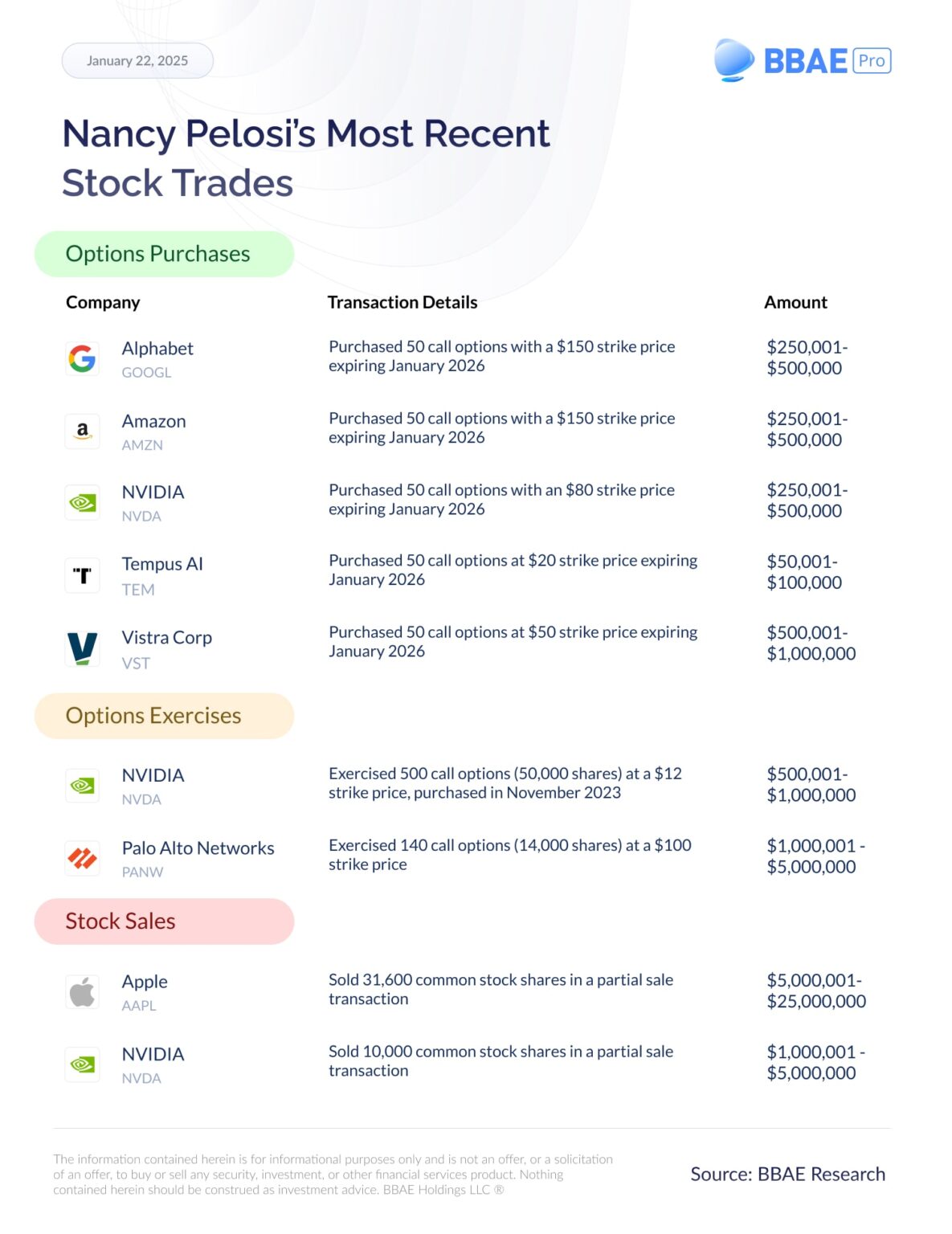
The Phenomenon of Congressional Trade Tracking
The fascination with Nancy Pelosi’s stock picks is rooted in the intersection of public policy and private capital. Under the STOCK Act (Stop Trading on Congressional Knowledge Act) of 2012, members of Congress are required to disclose any financial transaction exceeding $1,000 within 45 days. This transparency was designed to prevent insider trading, but it has inadvertently created a roadmap for retail investors.
The STOCK Act and Financial Transparency
The STOCK Act serves as the primary mechanism for the public to view the financial maneuvers of elected officials. For the Pelosi family, these disclosures often reveal high-conviction bets on some of the world’s most influential corporations. From a personal finance perspective, these filings provide a “delayed mirror” into the portfolios of individuals who are intimately familiar with the legislative hurdles and subsidies that can make or break an industry. While Pelosi herself famously does not own stocks personally—most trades are executed by her husband—the household’s financial moves are viewed as a singular strategic entity by the market.
The “Pelosi ETF” Mentality
The retail investment community has become so focused on these disclosures that social media bots and specialized financial platforms now provide real-time alerts the moment a Pelosi filing hits the wires. This has led to the conceptualization of the “Pelosi Portfolio” as a de facto index fund. Investors analyze these moves not just as individual stock picks, but as a sentiment indicator for the tech and energy sectors. The logic is simple: if one of the most powerful families in Washington is betting millions on a specific company, they likely anticipate a favorable macro-economic environment for that firm.
Breaking Down Recent Portfolio Additions
Analyzing the most recent filings reveals a clear preference for dominant, large-cap growth stocks, particularly those positioned at the forefront of the artificial intelligence (AI) revolution and cybersecurity. The Pelosis’ strategy rarely involves speculative penny stocks; instead, it focuses on “blue-chip” tech giants with massive moats.
The Big Bet on Artificial Intelligence: NVIDIA
Perhaps the most scrutinized move in recent Pelosi history involves NVIDIA (NVDA). In late 2023 and early 2024, filings revealed significant acquisitions of NVIDIA call options. From an investment standpoint, this was a high-conviction play on the backbone of the AI industry. By purchasing deep-in-the-money call options, the Pelosis captured the upside of the AI hardware boom. For retail investors following along, this signaled that the “AI bubble” might have more structural support than skeptics suggested, as the trade occurred during a period of intense valuation debate.
Cybersecurity and Infrastructure: Palo Alto Networks
Another notable addition to the Pelosi portfolio has been Palo Alto Networks (PANW). This move highlights a strategic pivot toward software-based security. In the realm of business finance, cybersecurity is no longer a luxury but a non-negotiable infrastructure cost. By investing in PANW, the Pelosi portfolio capitalized on the increasing frequency of global cyber threats and the subsequent surge in government and corporate spending on digital defense. This reflects a “thematic” approach to investing—identifying a global problem and investing in the primary solution provider.
The Core Holdings: Apple, Microsoft, and Alphabet
While new trades capture the headlines, the bedrock of the Pelosi strategy remains in “The Magnificent Seven.” Microsoft and Apple have been staples of their disclosures for years. These companies represent a “safety first” approach within the tech sector, offering a combination of reliable cash flow, massive share buyback programs, and leadership in cloud computing and consumer hardware. For the average investor, this serves as a reminder that even high-profile “insider” portfolios rely heavily on proven market leaders rather than purely speculative ventures.

Understanding the “Leaps” Strategy
One of the most distinctive aspects of the Pelosis’ trading style is their frequent use of “LEAPS” (Long-term Equity Anticipation Securities). Unlike the average retail trader who might buy common shares, the Pelosis often purchase call options with expiration dates far into the future.
The Power of Leverage and Capital Efficiency
Buying a LEAPS call option allows an investor to control a large number of shares for a fraction of the cost of buying them outright. For example, by purchasing call options on NVIDIA with a strike price well below the current market price, the Pelosis gain “delta”—meaning the option price moves almost in lockstep with the stock price—while keeping millions of dollars in liquid capital free for other investments. This is a sophisticated wealth-management tactic designed to maximize returns on capital while maintaining a specific risk profile.
Why Deep-in-the-Money Options?
A “deep-in-the-money” option is one where the strike price is significantly lower than the current stock price. These options have a high “intrinsic value” and a low “time decay” (theta) risk compared to out-of-the-money “lottery ticket” options. By choosing this instrument, the Pelosi strategy focuses on long-term capital appreciation rather than short-term gambling. It is a professional-grade financial maneuver that minimizes the impact of daily market volatility while ensuring participation in the long-term upward trajectory of the underlying asset.
The Risks and Rewards of “Copy-Trading” Politicians
While the prospect of following a powerful politician into a trade is enticing, it is not without significant financial risks. Investors must understand the mechanics of the market before blindly mirroring any public figure’s portfolio.
The Lag Time Dilemma
The biggest hurdle for retail investors is the reporting delay. The STOCK Act allows for a 45-day window to report trades. In a fast-moving market, 45 days is an eternity. By the time a Pelosi filing is made public, the stock may have already rallied 10% or 20% on the news that the trade occurred, or the market conditions that prompted the trade may have shifted. Following these trades requires a “buy and hold” mentality rather than an attempt to catch a short-term wave.
Diversification vs. Concentration
The Pelosi portfolio is highly concentrated in the technology sector. For an institutional-sized portfolio, this concentration can lead to massive outperformance during bull markets, but it also invites significant “drawdown” risk if the tech sector faces a correction. Retail investors with smaller accounts must be careful not to over-leverage themselves into a single sector just because a public figure did so. Proper personal finance management dictates that one should maintain a diversified base (such as an S&P 500 index fund) before adding “satellite” positions based on congressional filings.
Integrating Congressional Data into a Broader Strategy
For the savvy investor, Pelosi’s trades should not be the only reason to buy a stock, but rather a starting point for deeper fundamental analysis. Using this data as a “screener” can help identify which sectors are currently seeing institutional and political interest.
Utilizing Public Disclosure Tools
Today, several financial tools and websites aggregate these disclosures into readable formats. Tools like Quiver Quantitative or Unusual Whales allow investors to see the “net flow” of congressional money. If multiple members from both sides of the aisle are buying the same sector—such as domestic semiconductor manufacturers—it serves as a powerful signal of potential legislative tailwinds (like the CHIPS Act).

Conclusion: A Tool, Not a Crystal Ball
What stocks is Nancy Pelosi buying? The answer currently points toward a heavy concentration in AI infrastructure, cybersecurity, and dominant software platforms. However, the true lesson for the individual investor lies in the method rather than just the ticker. The Pelosi strategy emphasizes high-conviction bets on industry leaders, the use of sophisticated financial instruments like LEAPS to manage capital efficiency, and a focus on long-term growth themes.
Tracking these trades can be an insightful component of a modern investment strategy, but it should be tempered with an understanding of market lag and personal risk tolerance. In the world of money and investing, Nancy Pelosi’s filings are a valuable map, but the investor must still be the one to navigate the terrain. By combining the “what” of congressional buying with the “why” of fundamental analysis, retail investors can better position their portfolios for the evolving economic landscape.
aViewFromTheCave is a participant in the Amazon Services LLC Associates Program, an affiliate advertising program designed to provide a means for sites to earn advertising fees by advertising and linking to Amazon.com. Amazon, the Amazon logo, AmazonSupply, and the AmazonSupply logo are trademarks of Amazon.com, Inc. or its affiliates. As an Amazon Associate we earn affiliate commissions from qualifying purchases.