
In the annals of human achievement, few milestones carry as much weight as the moment Chuck Yeager piloted the Bell X-1 past Mach 1 in 1947. To the casual observer, “breaking the sound barrier” sounds like a simple matter of accelerating a vehicle until the speedometer hits a specific number. However, from a technological and aeronautical engineering perspective, it represents one of the most complex challenges in physics. It is the point where the fluid dynamics of air change fundamentally, requiring specialized hardware, sophisticated software, and innovative materials to survive.

To understand the speed required to break the sound barrier, one must look beyond a single digit. It is a journey into the heart of aerospace technology, where temperature, altitude, and aerodynamic design converge to redefine the limits of human travel.
The Physics of Mach 1: Defining the Technological Threshold
The “sound barrier” is not a physical wall, but a dramatic increase in aerodynamic drag that occurs as an object approaches the speed of sound. In technical terms, this threshold is known as Mach 1. However, the actual speed required to reach Mach 1 is a moving target, dictated by the environment in which the craft operates.
The Role of Atmospheric Variables
Sound is a pressure wave that travels through a medium—in this case, air. The speed at which these waves move depends heavily on the temperature of the medium. At sea level, on a standard day (15°C or 59°F), the speed of sound is approximately 761 miles per hour (1,225 km/h). However, as an aircraft climbs into the thinner, colder upper atmosphere, the speed of sound drops significantly. At 35,000 feet, where the temperature might be -55°C, Mach 1 is only about 660 mph (1,062 km/h).
From a technological standpoint, this variability means that flight control systems must be incredibly precise. Sensors must constantly calculate the “Local Mach Number” rather than relying on traditional ground speed to ensure the aircraft remains stable as it enters the transonic regime.
The Transonic Transition and Shock Wave Formation
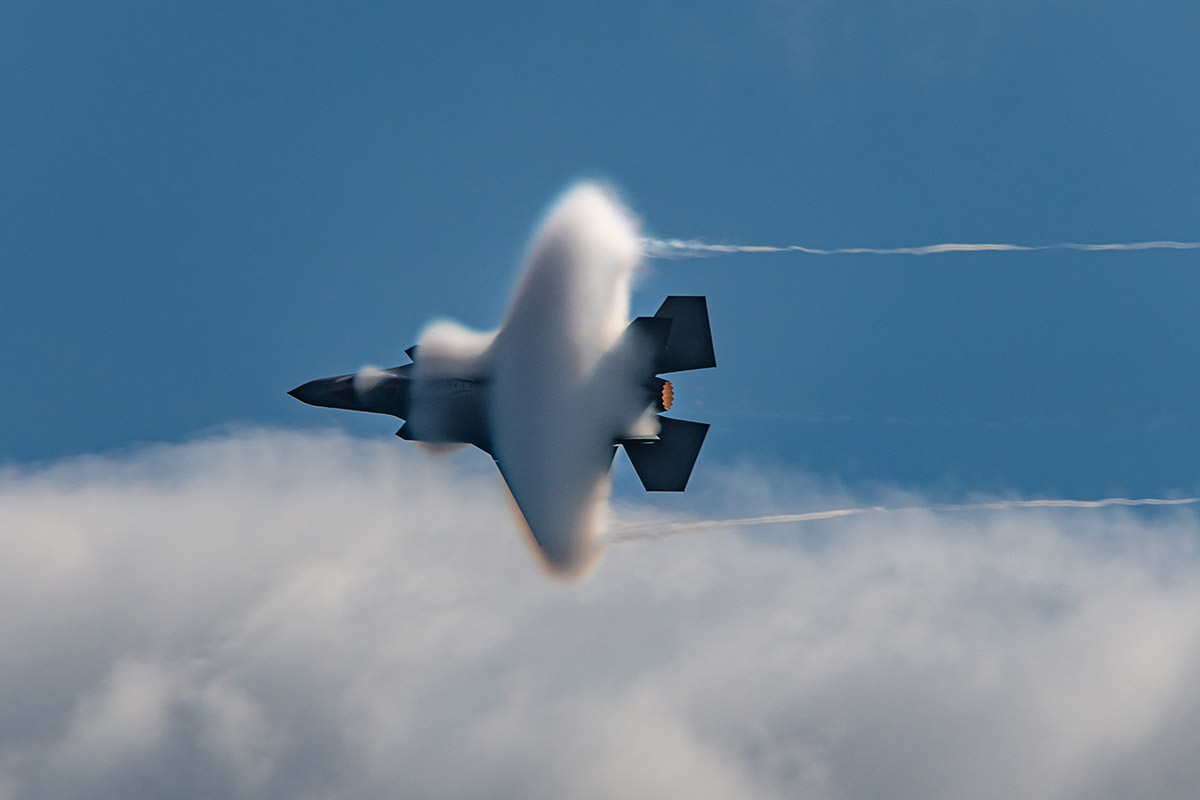
As a vehicle approaches Mach 1, it enters the “transonic” range. During this phase, air flows over some parts of the aircraft (like the curve of the wing) at supersonic speeds, while other parts remain subsonic. This creates a chaotic environment where shock waves begin to form on the airframe.
Technologically, this was the “barrier” that destroyed early experimental aircraft. These shock waves cause massive increases in drag and can shift the center of pressure on the wings, leading to a loss of control known as “compressibility.” Overcoming this required a total reimagining of airframe architecture, moving away from the thick, sturdy wings of WWII-era planes toward thinner, swept-back designs.
Engineering the Supersonic Machine: Hardware and Design Innovations
Breaking the sound barrier requires more than just a powerful engine; it requires a vehicle designed to manipulate the very air it displaces. Modern supersonic technology relies on three primary engineering pillars: aerodynamics, propulsion, and materials science.
Aerodynamic Shaping and the Area Rule
One of the most significant technological breakthroughs in supersonic flight was the discovery of the “Area Rule” by engineer Richard Whitcomb. He realized that to minimize the shock waves created at the sound barrier, the total cross-sectional area of the aircraft should change smoothly from nose to tail. This led to the “wasp-waist” design seen on many fighter jets, where the fuselage narrows at the point where the wings are attached.
Furthermore, the transition from straight wings to swept wings—and eventually delta wings—allowed aircraft to “hide” behind the shock wave generated by the nose of the plane. This reduces drag and allows for sustained flight above Mach 1 without an exponential increase in fuel consumption.
Advanced Propulsion: Afterburners and Ramjets
To push through the massive drag encountered at the sound barrier, engines need a massive burst of thrust. This is typically achieved through an “afterburner” or augmentor. In a turbojet engine, an afterburner injects raw fuel into the hot exhaust stream, creating a secondary combustion that provides the necessary “shove” to punch through the transonic wall.
However, modern tech is moving toward even more efficient systems. Variable-cycle engines are being developed that can behave like efficient turbofans at low speeds and switch to high-performance turbojets for supersonic cruise. For even higher speeds (hypersonic), engineers utilize Scramjets (Supersonic Combustion Ramjets), which have no moving parts and rely on the vehicle’s high forward speed to compress incoming air before combustion.
Materials Science and Thermal Management
Breaking the sound barrier creates immense friction. As air molecules are compressed against the leading edges of the aircraft, they generate heat. At Mach 1, this is manageable, but as planes reach Mach 2 or Mach 3 (like the Lockheed SR-71 Blackbird), the skin of the aircraft can reach temperatures that would melt conventional aluminum.
The technology used to combat this includes titanium alloys, carbon-fiber composites, and ceramic thermal protection systems. These materials must be lightweight enough for flight but durable enough to expand and contract under extreme thermal stress without losing structural integrity.
The Digital Frontier: Software and Simulation in Supersonic Development
In the early days of aviation, breaking the sound barrier was a matter of “test and see,” often with fatal results. Today, the “speed” to break the barrier is first reached in a virtual environment. The role of software and AI in modern aerospace technology cannot be overstated.
Computational Fluid Dynamics (CFD)
CFD is a branch of fluid mechanics that uses numerical analysis and data structures to analyze and solve problems that involve fluid flows. High-performance computers simulate how air molecules will interact with a new wing design at Mach 1.2, Mach 2.0, and beyond. This allows engineers to identify “hot spots” of turbulence or drag before a single piece of metal is cut.
Without CFD, the development of modern stealth supersonic aircraft like the F-35 would be impossible. The software must account for the complex interactions between the airframe, the engine intakes, and the weapon bays, all while maintaining the aircraft’s supersonic efficiency.
Fly-By-Wire and AI Flight Control
Supersonic aircraft are inherently unstable at certain speeds. As a plane crosses the sound barrier, the “center of lift” shifts rearward. If a pilot were using traditional mechanical cables, the plane would become nearly impossible to handle.
Modern tech solves this with “Fly-By-Wire” (FBW) systems. These are computer-controlled systems that interpret the pilot’s input and then move the flight surfaces (flaps, ailerons, rudders) hundreds of times per second to maintain stability. AI is now being integrated into these systems to predict atmospheric changes and adjust the engine performance in real-time, ensuring that the transition from subsonic to supersonic is as smooth as possible.
The Future of Supersonic Tech: Quiet Booms and Hypersonic Horizons
While the military has been breaking the sound barrier for decades, the civilian world has lagged behind since the retirement of the Concorde. The next technological hurdle isn’t just reaching the speed; it’s doing so sustainably and quietly.
NASA’s X-59 and the “Quiet” Sonic Boom
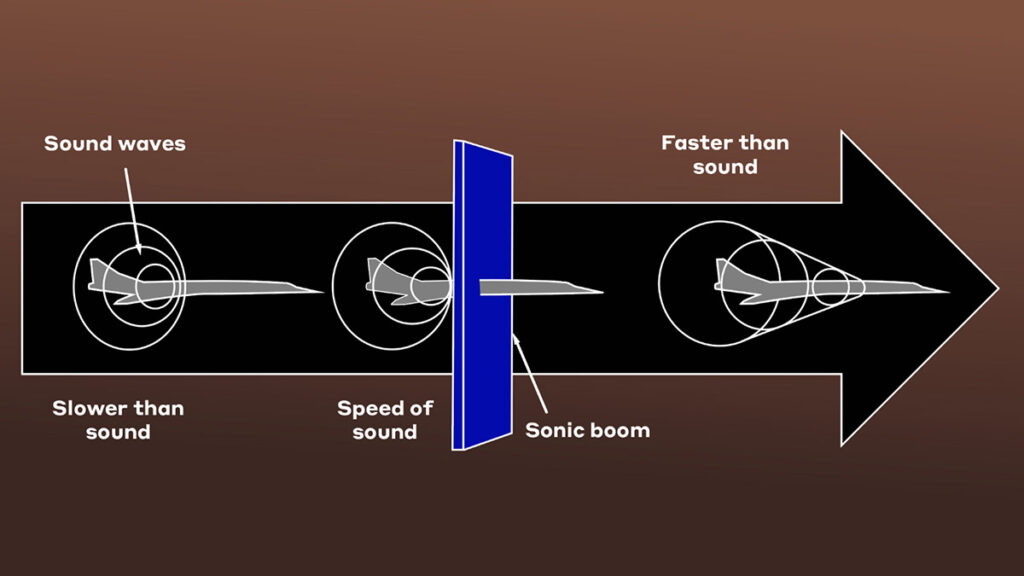
The primary reason commercial supersonic flight is banned over land is the “sonic boom”—the thunderous noise created by shock waves. NASA, in partnership with Lockheed Martin, is currently testing the X-59 QueSST (Quiet SuperSonic Technology).
The tech behind the X-59 involves a long, thin nose and a highly sculpted airframe designed to prevent shock waves from coalescing into a loud boom. Instead, the waves reach the ground as a soft “thump,” similar to a car door closing. This technological advancement could pave the way for a new generation of commercial jets that can fly from New York to Los Angeles in just over two hours.
The Leap Toward Hypersonic Technology
While the sound barrier is Mach 1, the new tech frontier is Mach 5—the threshold of “hypersonic” speed. At five times the speed of sound, the physics change again. Air behaves more like a plasma, and the heat generated is so intense that it can chemically change the air molecules surrounding the craft.
Current tech trends in this space involve “waverider” designs—vehicles that literally “ride” their own shock waves to generate lift. These developments in AI-driven guidance systems and ultra-high-temperature materials are not just about speed; they are about shrinking the globe, making any point on Earth accessible in under 90 minutes.
Conclusion
The speed to break the sound barrier is more than a numerical value of 761 mph; it is a complex technological ecosystem. It requires an intricate dance between hardware that can withstand extreme pressures, software that can calculate fluid dynamics in milliseconds, and engineering designs that turn air from an obstacle into a tool.
As we look toward the future, the technology that allowed us to break the sound barrier is being refined to make high-speed travel quieter, more efficient, and faster than ever before. We are no longer just breaking a barrier; we are mastering an environment, proving that with the right technology, the sky is no longer a limit, but a highway.
aViewFromTheCave is a participant in the Amazon Services LLC Associates Program, an affiliate advertising program designed to provide a means for sites to earn advertising fees by advertising and linking to Amazon.com. Amazon, the Amazon logo, AmazonSupply, and the AmazonSupply logo are trademarks of Amazon.com, Inc. or its affiliates. As an Amazon Associate we earn affiliate commissions from qualifying purchases.