
In the world of high-stakes investing, few assets possess the allure, historical gravity, and sheer density of value as the rare coin. While traditional investors look toward equities, real estate, or bonds, the “numismatic” market—the study and collection of currency—offers a unique intersection of history and wealth preservation. When we ask, “What is the most rarest coin in the world?” we are not just asking about a piece of metal; we are inquiring about the ultimate “blue-chip” asset.
For the modern investor, understanding the rarity and valuation of these coins is essential for diversifying a portfolio into alternative assets. These coins are more than currency; they are tangible relics of economic history that have consistently outperformed many traditional market indices over long-term horizons.
Numismatics as a High-Yield Alternative Investment Class
In the current financial climate, characterized by volatility and inflationary pressures, investors are increasingly seeking refuge in “hard assets.” Rare coins fall into a category of alternative investments that provide a hedge against currency devaluation. Unlike bullion, which is valued solely on its weight in gold or silver, rare coins derive their value from a combination of scarcity, historical significance, and condition.
The Shift from Traditional to Alternative Assets
Over the last two decades, the ultra-high-net-worth demographic has shifted a portion of their liquidity into “investments of passion.” According to various wealth reports, the luxury investment index—which includes rare coins, fine wine, and classic cars—often shows lower correlation with the stock market. This makes rare coins an excellent tool for portfolio diversification. When the S&P 500 experiences a downturn, the market for a 1794 Silver Dollar often remains insulated, driven by a global pool of private collectors and institutional investors who view these items as “portable wealth.”
Understanding Scarcity vs. Demand in Financial Valuation
In economics, price is a function of supply and demand. In numismatics, the “supply” is fixed and often shrinking as coins are lost to time or housed in permanent museum collections. When the supply is limited to a single known specimen, the “rarity premium” becomes exponential. However, rarity alone does not dictate price; it must be coupled with “numismatic demand.” A coin must be a “key date” or a legendary rarity that every major portfolio manager in the coin world desires to own.
Identifying the Pinnacle of Rarity: The Contenders for “World’s Rarest”
To identify the rarest coin in the world, one must look at auction records and the “population reports” provided by grading services. Several coins vie for the title, each representing a different peak in the market for historical financial assets.
The 1933 Saint-Gaudens Double Eagle: The Coin that Shouldn’t Exist
Perhaps the most famous rare coin in financial circles is the 1933 Double Eagle. While 445,500 units were minted, none were officially released into circulation due to Executive Order 6102, which effectively took the United States off the gold standard and ordered the melting of gold coins.
A few specimens escaped the furnace, leading to a decades-long legal battle between the U.S. Mint and private collectors. In 2021, a 1933 Double Eagle sold at Sotheby’s for $18.9 million. Its rarity is defined by its legal status: it is the only 1933 Double Eagle that a private individual can legally own. From an investment perspective, this coin represents the ultimate “trophy asset,” where the story of its survival adds millions to its price tag.
The 1794 Flowing Hair Silver Dollar: A Piece of Economic Foundation
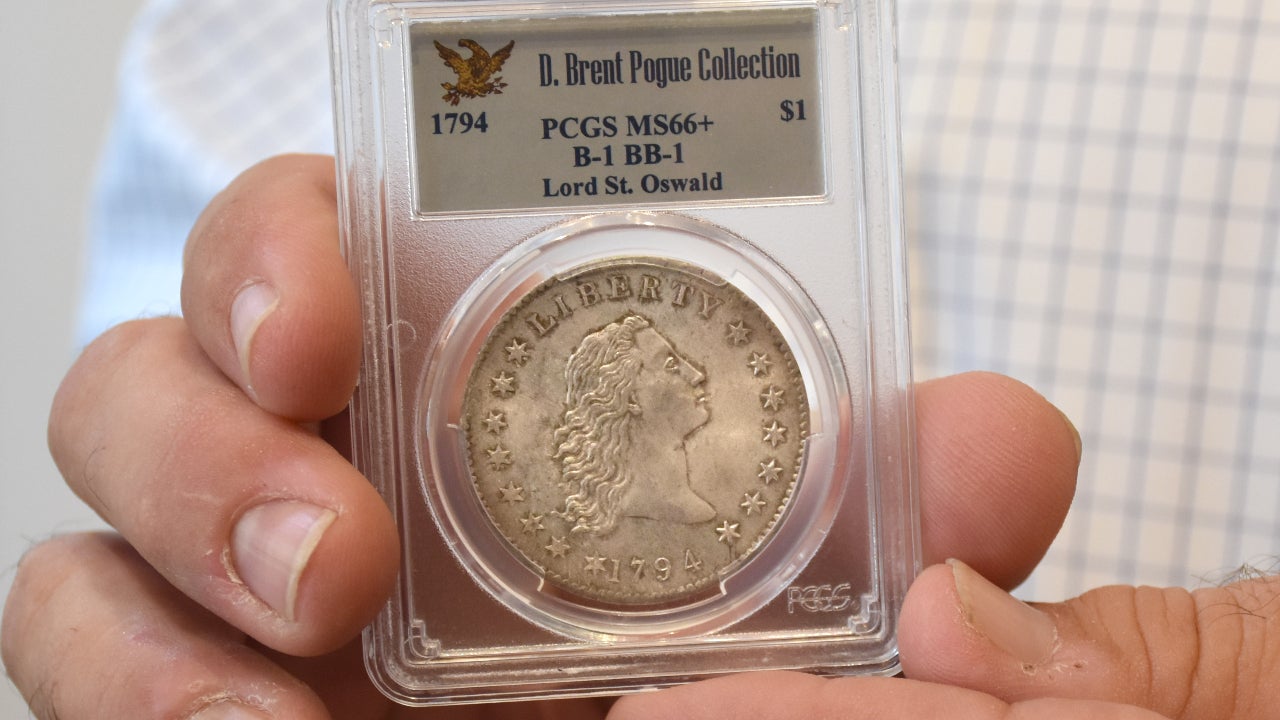
If the Double Eagle is about gold and legal drama, the 1794 Flowing Hair Silver Dollar is about the birth of a superpower’s economy. This coin is widely believed to be the first silver dollar ever struck by the United States Federal Mint. Experts believe only about 130 to 140 of these coins survive today out of the original 1,758 minted.
In 2013, a specimen graded Specimen-66 by the Professional Coin Grading Service (PCGS) sold for over $10 million. It held the record for the most expensive coin for nearly a decade. For a wealth manager, this coin is a “foundation asset,” representing the literal start of the U.S. dollar as a global reserve currency.
The 1343 Edward III Florin: Medieval Scarcity
While U.S. coins dominate the high-value auction market, European numismatics offer unparalleled age. The 1343 “Double Leopard” Florin of Edward III is one of the rarest gold coins in existence. Only three specimens are known to survive. While its last public sale was significantly lower than the American “Big Two,” its intrinsic rarity is higher. It represents a period where gold was transitioning into the primary medium of international trade in Europe, making it a critical asset for those specializing in medieval financial history.

The Financial Mechanics of Rare Coin Valuation
Investing in the rarest coins in the world requires more than just deep pockets; it requires an understanding of the technical mechanics that drive value. In the world of finance, we call this “due diligence.”
The Role of Grading Services (PCGS and NGC)
In the 1980s, the coin market was revolutionized by the introduction of third-party grading. The Professional Coin Grading Service (PCGS) and the Numismatic Guaranty Company (NGC) provide a standardized 1-to-70 scale (the Sheldon Scale) to assess a coin’s condition.
A coin graded “Mint State 65” (MS65) may be worth $50,000, while the exact same coin in MS66 might be worth $150,000. For an investor, the “slab” (the plastic holder containing the grade) acts as a certificate of authenticity and a guarantee of liquidity. Without a professional grade, a rare coin is a “blind” investment; with it, it becomes a tradable financial instrument.
Provenance and Historical Significance
In the art world and the coin market, “provenance”—the record of ownership—is a major value driver. If a coin was once part of the Eliasberg, Garrett, or Pogue collections, it carries a “pedigree.” This history of ownership by legendary financiers and numismatists adds a layer of prestige that can increase the hammer price at auction by 20% to 50%. It acts as a stamp of approval, assuring the next buyer that the asset has been vetted by the most discerning eyes in the industry.
Market Liquidity and Auction Dynamics
Investors must understand that the rarest coins are not “liquid” in the same way as stocks. You cannot sell a $10 million coin at the click of a button. Realizing value usually requires an auction house like Heritage Auctions or Stack’s Bowers. The “spread” (the difference between buying and selling price) can be significant due to commission fees. However, the most rarest coins often benefit from “auction fever,” where two ultra-wealthy individuals competing for a unique item can drive the price far beyond its estimated “book value.”
Building a Rare Coin Portfolio for Personal Wealth
For those looking to enter the world of coin investing, the “most rarest” coins may be out of reach, but the principles of their value can be applied to building a robust numismatic portfolio.
Starting Small: Bullion vs. Numismatics
A common mistake for beginners is confusing bullion with numismatics. Gold bullion (like a modern 1oz Krugerrand) follows the spot price of gold. It is a commodity. A rare coin (like a 1916-D Mercury Dime) is a numismatic asset. While the bullion coin provides a safety net based on metal content, the numismatic coin provides growth potential based on its collector value. A balanced financial strategy often involves holding 70% bullion for stability and 30% rare coins for capital appreciation.
Risk Management and Diversification
As with any investment, diversification is key. A savvy investor does not put all their capital into one “key date” coin. Instead, they diversify across different denominations (gold, silver, copper) and different eras (Early American, Morgan Dollars, 20th-century rarities). This protects the portfolio against shifts in collector tastes or changes in the “population” of a specific coin grade.
Storage, Insurance, and Long-Term Holding
Unlike digital assets or stocks, rare coins require physical security. High-value coins should be stored in bank vaults or specialized private depositories. Furthermore, specialized insurance riders are necessary, as standard homeowners’ insurance rarely covers high-value collectibles. Finally, the “money” in rare coins is made over decades. It is a “buy and hold” strategy. Historically, the best returns are seen by those who hold their assets for 10 to 20 years, allowing the market to mature and the scarcity to increase.

Conclusion: The Intersection of History and Finance
The quest to identify the most rarest coin in the world leads us to a fascinating intersection where history, art, and finance meet. Whether it is the 1933 Double Eagle or the 1794 Flowing Hair Dollar, these coins represent the pinnacle of tangible wealth.
For the serious investor, rare coins offer more than just a hobby; they provide a sophisticated avenue for wealth preservation and capital growth. By understanding the mechanics of grading, the importance of provenance, and the dynamics of the auction market, one can navigate the numismatic world not just as a collector, but as a strategic investor. In an era of digital dominance, there remains a profound financial power in holding a piece of history that is truly one of a kind.
aViewFromTheCave is a participant in the Amazon Services LLC Associates Program, an affiliate advertising program designed to provide a means for sites to earn advertising fees by advertising and linking to Amazon.com. Amazon, the Amazon logo, AmazonSupply, and the AmazonSupply logo are trademarks of Amazon.com, Inc. or its affiliates. As an Amazon Associate we earn affiliate commissions from qualifying purchases.