
The global shift toward sustainable transportation has transformed the electric vehicle (EV) from a niche novelty into a mainstream technological powerhouse. However, for many potential adopters, the transition from internal combustion engines to battery-powered motors hinges on a single, critical factor: charging speed. While traditional home charging provides a convenient way to “refuel” overnight, the backbone of long-distance travel and commercial EV viability is Direct Current (DC) Fast Charging.
DC fast charging represents the pinnacle of current EV power delivery, utilizing sophisticated hardware and software to bypass the limitations of a vehicle’s internal components. To understand the future of mobility, one must understand the engineering, the standards, and the digital infrastructure that make rapid energy transfer possible.
Understanding the Mechanics: How DC Fast Charging Works
To appreciate the “fast” in DC fast charging, one must first understand the fundamental physics of how electricity moves from the grid into a vehicle’s battery pack. All batteries, whether they are in your smartphone or a high-performance electric sedan, store energy as Direct Current (DC). However, the electrical grid—the power lines running through our neighborhoods—operates on Alternating Current (AC).
AC vs. DC: The Fundamental Difference
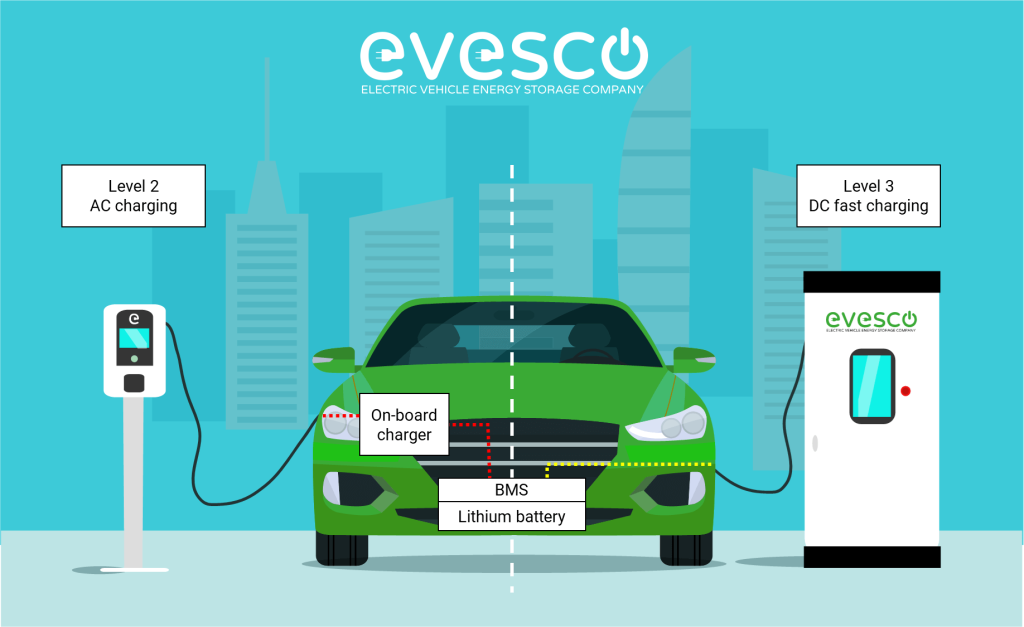
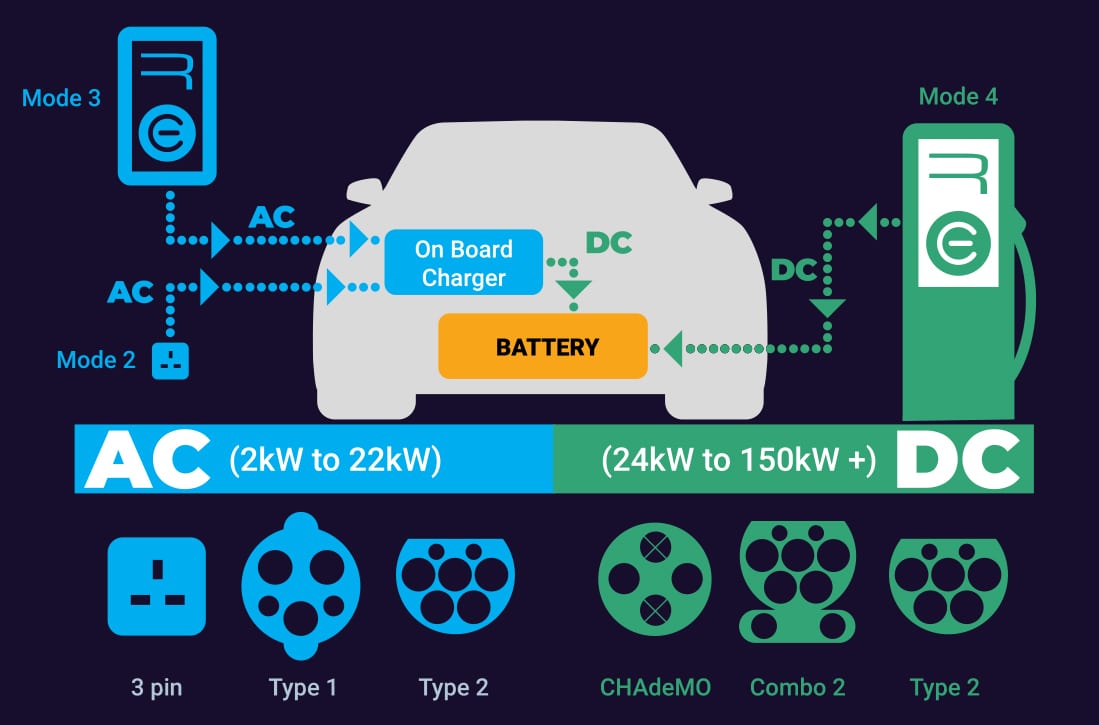
When you plug an EV into a standard Level 1 or Level 2 charger (like those found in homes or workplace parking lots), the car receives AC power. The vehicle must then use its “onboard charger”—a piece of internal hardware—to convert that AC power into the DC power the battery can actually store. The bottleneck here is the onboard charger’s capacity; because it must be small enough to fit inside the car, its conversion rate is relatively slow, usually topping out between 7 kW and 22 kW.
DC Fast Charging (often referred to as Level 3) moves the conversion process outside the vehicle. The massive charging station itself houses the heavy-duty rectifiers and cooling systems necessary to convert AC from the grid into DC at high voltages. By delivering DC power directly to the battery, the station bypasses the vehicle’s limited onboard converter, allowing for power delivery at rates ten to fifty times faster than home setups.
The Role of the Battery Management System (BMS)
While the charging station provides the power, the vehicle’s Battery Management System (BMS) acts as the “brain” of the operation. During a DC fast charging session, the car and the charger enter a digital handshake. The BMS monitors the battery’s temperature, voltage, and current state of charge (SoC). It dictates exactly how much power the station should send. If the battery gets too hot, the BMS instructs the station to throttle the speed to prevent hardware degradation. This constant communication is what makes high-speed charging safe for the chemistry of the cells.
Thermal Management and Power Curves
Charging a battery at high speeds generates significant heat due to internal resistance. To mitigate this, modern DC fast chargers and the EVs themselves utilize advanced thermal management systems. Many high-speed chargers use liquid-cooled cables to prevent the hardware from overheating, while the vehicle may engage its own refrigerant-based cooling loops to keep the battery cells within an optimal temperature window.
This thermal reality results in a “charging curve.” An EV does not charge at its maximum advertised rate (e.g., 250 kW) from 0% to 100%. Instead, it hits a peak speed when the battery is nearly empty and then slows down as the battery fills up—much like how it is harder to pack the final few items into a suitcase.
Hardware and Standards: The Landscape of High-Speed Connectors
The technology behind DC fast charging is not universal. Just as the early days of computing saw a battle between various data ports, the EV industry has navigated a complex landscape of hardware standards and connector types.
CCS (Combined Charging System)
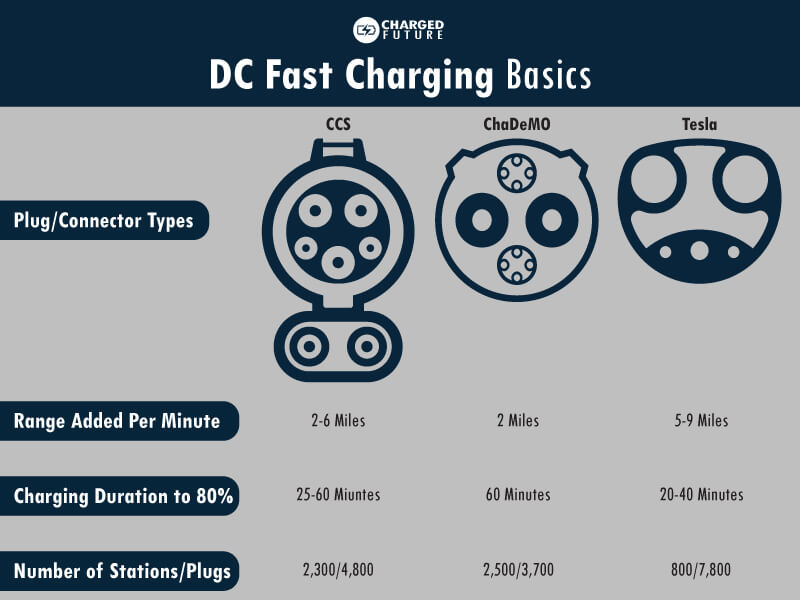
The Combined Charging System, or CCS, has been the dominant standard in Europe and, until recently, North America. It is called “combined” because it uses a standard AC plug (Type 1 or Type 2) and adds two large DC pins below it. This allows a single port on the car to handle both slow home charging and ultra-fast highway charging. CCS supports high voltages, with current iterations capable of delivering up to 350 kW or more.
CHAdeMO and the NACS (Tesla) Shift
CHAdeMO is a standard developed in Japan, primarily used by the Nissan LEAF. While it was a pioneer in bi-directional charging (allowing the car to send power back to the grid), it has largely been phased out in Western markets in favor of more streamlined designs.
Perhaps the most significant tech trend in the charging space is the rise of NACS (North American Charging Standard). Originally Tesla’s proprietary connector, NACS is significantly smaller and more ergonomic than CCS. In a massive industry shift, nearly every major automaker—including Ford, GM, and Rivian—has announced a transition to NACS. This move towards a unified hardware standard is critical for creating a seamless user experience across different vehicle brands and charging networks.
Power Output Tiers: From 50kW to 350kW+
Not all DC fast chargers are created equal. They are generally categorized by their power output:
- 50 kW to 100 kW: These are often found in urban areas or near shopping centers. They can add roughly 100–150 miles of range in about 30–40 minutes.
- 150 kW to 250 kW: The current “sweet spot” for long-distance travel. At these speeds, a 20-minute stop can often provide enough energy for another three hours of highway driving.
- 350 kW and Above: Known as “Ultra-Fast” chargers. Only a few vehicles, such as those with 800-volt architectures (like the Porsche Taycan or Hyundai IONIQ 5), can currently take full advantage of these speeds, potentially charging from 10% to 80% in under 18 minutes.
The Technological Evolution of EV Batteries
As DC fast charging hardware becomes more powerful, the limiting factor has shifted from the charger to the battery chemistry itself. The next decade of EV tech will be defined by how well batteries can withstand the “stress” of high-speed electron transfer.
800-Volt Architectures
Most early modern EVs operated on a 400-volt system. However, to achieve faster charging without requiring excessively thick, heavy cables, engineers are moving toward 800-volt architectures. Doubling the voltage allows for the same power delivery at half the amperage, reducing heat and increasing efficiency. This tech transition is a hallmark of high-end EV performance, signaling a future where “fill-up” times mirror those of gasoline vehicles.
Silicon Anodes and Solid-State Potential
Current lithium-ion batteries use graphite anodes, which can face “lithium plating” if charged too quickly, leading to battery failure. Researchers are now integrating silicon into the anodes to increase energy density and allow for faster charging. Looking further ahead, solid-state batteries—which replace the liquid electrolyte with a solid material—promise to revolutionize the sector. Solid-state technology could theoretically handle immense charging speeds with almost no risk of fire or degradation, though the tech remains in the laboratory and pilot-production stages.
Digital Infrastructure and the Software Behind the Plug
DC fast charging is as much a software challenge as it is a hardware one. A charging station is essentially an IoT (Internet of Things) device that must communicate with the vehicle, the grid, and the cloud simultaneously.
Smart Grid Integration and V2G
As more EVs hit the road, the strain on the electrical grid increases. Tech companies are developing “Smart Charging” algorithms that balance the load. For example, if ten cars are fast-charging at a single station, the software can distribute power intelligently to prevent a local blackout. Furthermore, Vehicle-to-Grid (V2G) technology is being trialed, allowing EVs to act as giant mobile batteries that can feed energy back into the grid during peak demand, stabilizing the tech-heavy infrastructure of modern cities.
The App Ecosystem and “Plug & Charge”
The user interface of charging has historically been a friction point, requiring multiple apps and RFID cards. The industry is now moving toward the ISO 15118 standard, commonly known as “Plug & Charge.” This technology allows the car to identify itself to the charger via the cable. The user simply plugs in, and the software handles the authentication and billing automatically. This integration of fintech and automotive hardware represents the maturation of the EV ecosystem into a user-centric digital platform.
Looking Ahead: The Next Frontier in Ultra-Fast Charging
The trajectory of DC fast charging suggests a future where the concept of “waiting to charge” becomes obsolete. We are already seeing the emergence of megawatt charging systems (MCS) designed for heavy-duty trucking, capable of delivering over 1,000 kW. As these industrial technologies trickle down to consumer vehicles, the hardware will continue to shrink while the power density grows.
Moreover, the integration of Artificial Intelligence in charging networks will soon allow for predictive maintenance. AI can analyze the health of a charging stall in real-time, identifying a failing component before it breaks, ensuring that the digital and physical infrastructure of our transportation network remains as reliable as the engines it is replacing. DC fast charging is not just a way to power a car; it is the high-speed data and power link that is driving the fourth industrial revolution on wheels.
aViewFromTheCave is a participant in the Amazon Services LLC Associates Program, an affiliate advertising program designed to provide a means for sites to earn advertising fees by advertising and linking to Amazon.com. Amazon, the Amazon logo, AmazonSupply, and the AmazonSupply logo are trademarks of Amazon.com, Inc. or its affiliates. As an Amazon Associate we earn affiliate commissions from qualifying purchases.