
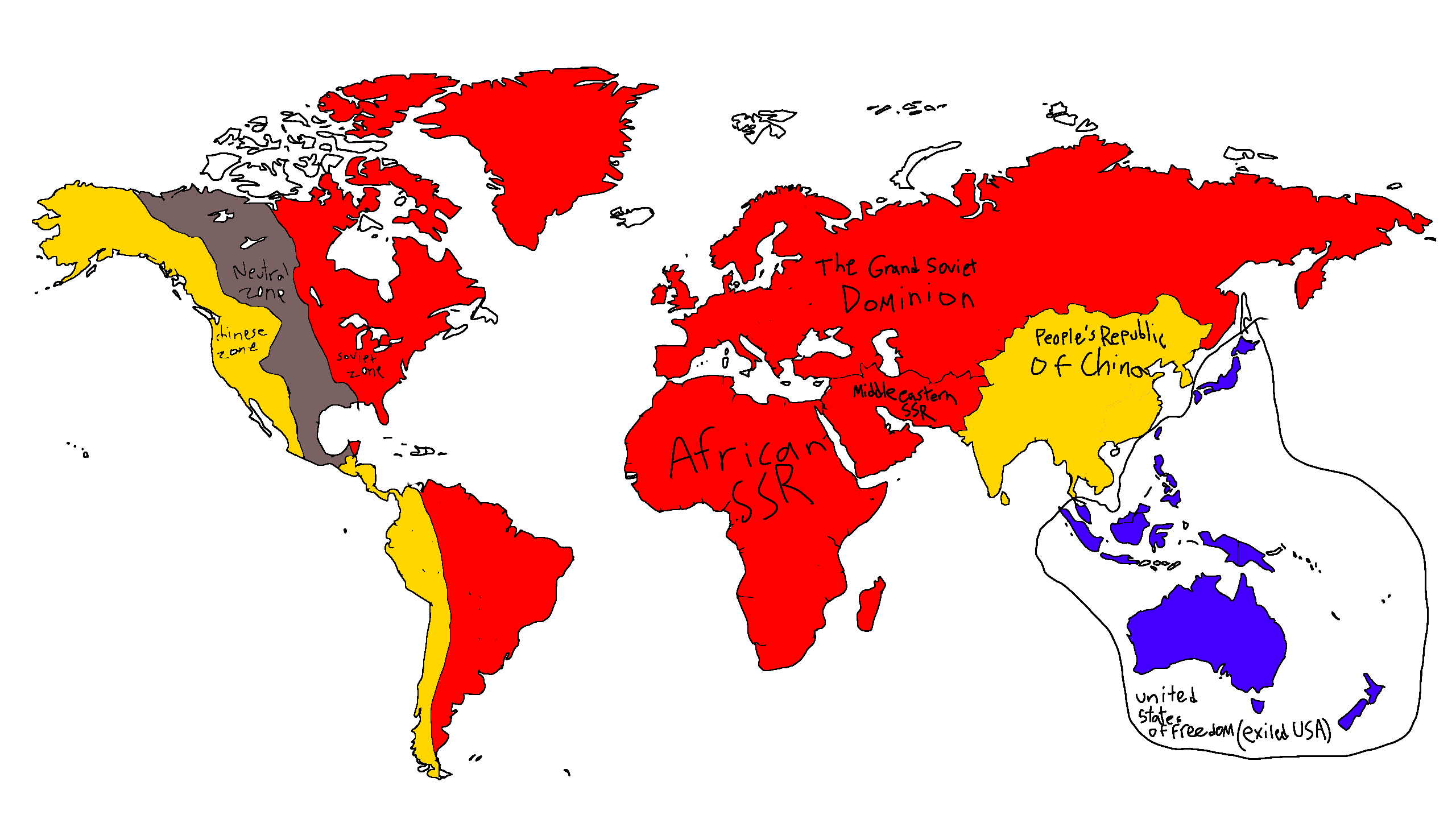
The trajectory of modern technology is often viewed as an inevitable march toward decentralization, consumer-focused portability, and market-driven innovation. However, this path was paved by the specific geopolitical and economic outcomes of the late 20th century. If the Soviet Union had emerged as the victor of the Cold War—perhaps by successfully digitizing its economy in the 1970s while the United States succumbed to stagflation and internal collapse—the digital landscape of the 21st century would be unrecognizable. In this alternative reality, technology is not a tool for individual empowerment or commercial profit, but the central nervous system of a global planned state.
The Dawn of OGAS: The Alternative Internet
In our timeline, the Internet grew from ARPANET, a decentralized network designed to survive nuclear strikes, which eventually blossomed into a commercial and social ecosystem. In a world where the Soviet Union won the Cold War, the global network would likely be based on the OGAS (All-State Automated System for Management). Proposed in the 1960s by Viktor Glushkov, OGAS was intended to be a national computer network that would manage the entire Soviet economy in real-time.
Centralized Data Management and Resource Allocation
The Soviet “Internet” would have functioned as a top-down hierarchy. Instead of millions of independent servers hosted by private companies, the global grid would be managed by massive regional data centers reporting directly to the State Planning Committee (Gosplan). The primary function of this network would not be social media or e-commerce, but the real-time calculation of supply and demand. Algorithms would process data from every factory and retail outlet across the globe, determining production quotas with mathematical precision. This would eliminate the “chaos of the market,” but it would also mean that the flow of information is strictly regulated by the necessity of the state.
The Absence of the World Wide Web and Decentralized Protocols
The World Wide Web, as envisioned by Tim Berners-Lee, relies on decentralized protocols (HTTP, HTML) where anyone can host a “site.” Under Soviet hegemony, the “Web” would likely be a series of state-sanctioned portals. Information would be structured as a utility rather than a marketplace. There would be no “browsing” in the modern sense; instead, users would access specific databases for educational, professional, or administrative purposes. Peer-to-peer file sharing or independent blogging would be technically impossible within the protocol’s architecture, as every packet of data would require a state-verified digital signature to move through the network.
Hardware in the Red Era: State-Driven Innovation
Without the competitive pressure of Silicon Valley, hardware development would follow a radically different philosophy. The drive for “planned obsolescence”—the capitalist practice of designing goods to fail so consumers buy more—would be replaced by the “Five-Year Plan for Durability.”
The Five-Year Plan for Microchips
In a Soviet-led tech world, the race for smaller, faster transistors would still exist, but the motivation would be different. Progress would be measured by the efficiency of the state’s massive mainframes rather than the processing power of a handheld device. Hardware would be standardized to an extreme degree. Instead of dozens of competing motherboard architectures and socket types, there would likely be one or two state-standard designs. This would make maintenance and repair incredibly simple, fostering a global culture of hardware “repairability” that modern environmentalists might envy, albeit at the cost of the rapid aesthetic and functional variety we see in consumer electronics today.
Military-Industrial Dominance in Consumer Electronics
Most of the hardware available to the public would be “spun off” from military research. In our timeline, the GPS and the microwave oven came from the military; in a Soviet-dominated world, this would be the only source of innovation. Consumer gadgets would be rugged, utilitarian, and built to last for decades. The “Smartphone” might exist, but it would look more like a military-grade radio—thick, shockproof, and prioritizing encrypted communication over screen resolution or camera quality. There would be no “iPhone vs. Android” rivalry; there would simply be the Elektronika Model 2025, the standard-issue personal communicator for the global proletariat.

Cyber-Sovereignty and Global Digital Security
The concept of digital security in a Soviet-won Cold War would revolve entirely around the concept of “Cyber-Sovereignty.” In a world without private corporations, the line between “service provider” and “government” vanishes. This creates a unique paradigm for both security and privacy.
State-Controlled Encryption and Privacy
In this scenario, the idea of “end-to-end encryption” available to the general public would be viewed as a counter-revolutionary threat. Encryption would be a tool used exclusively by the state to protect its administrative and military data. For the average citizen, the network would be transparent by design. Digital security would focus on protecting the system from external sabotage or “anti-social” hacking. The concept of a “data breach” involving millions of credit cards would be non-existent because the concept of private credit would be gone. However, the trade-off would be total state visibility into every digital interaction, managed by advanced surveillance algorithms that were precursors to modern AI.
The Hegemony of Soviet Software Standards
Software development would be a state-directed profession, not a freelance or startup-driven market. Operating systems would likely be derivatives of a centralized “Unified System” (similar to the real-world ES EVM). Programming languages would be standardized across the globe to ensure that a developer in Berlin could seamlessly work on a project in Hanoi. This would create an incredibly stable and bug-free software environment, as code would be audited by state committees for efficiency. However, it would also stifle the “garage developer” culture. There would be no “app stores”; if a piece of software didn’t serve a clear social or economic purpose defined by the state, it simply wouldn’t be funded or distributed.
AI and Automation in a Planned Economy
Perhaps the most profound difference in a Soviet-dominated tech world would be the application of Artificial Intelligence. In our world, AI is currently being leveraged for predictive marketing, generative art, and financial high-frequency trading. In a Soviet victory scenario, AI would be the ultimate tool of the planned economy.
Optimization Algorithms over Predictive Marketing
Instead of using machine learning to figure out which ad will make you click “buy,” the Soviet AI—often referred to in period literature as “Cybernetics”—would be tasked with solving the “Knowledge Problem.” It would analyze trillions of data points from the global supply chain to determine the most efficient way to distribute wheat, steel, and consumer goods. This would be a “Calculated Economy,” where AI is used to eliminate waste and ensure full employment. The “Stock Market” would be replaced by a massive, AI-driven dashboard that manages the world’s resources as if they were a single, giant corporation.
Robotics in the Socialist Labor Market
The goal of robotics in a Soviet context would be the “liberation of the proletariat.” While capitalist automation is often feared for creating unemployment, a victorious Soviet Union would frame robotics as a means to reduce the workweek to 20 or even 15 hours. The tech focus would be on industrial automation and heavy lifting, rather than “service bots” or “chatbots.” We would see a world filled with massive, automated factories and robotic agricultural communes. The technological “prestige” of the state would be tied to how much human labor has been replaced by machines, making the “Worker-Robot” a symbol of socialist achievement rather than a threat to one’s livelihood.

Conclusion: The Legacy of a Different Digital Path
If the Soviet Union had won the Cold War, the digital world would be a place of extreme order, standardization, and collective utility. We would have achieved a high level of sustainability and durability in our hardware, and our networks would be marvels of logistical efficiency. However, the cost would be the loss of the digital spontaneity, personal expression, and rapid-fire innovation that define our current era. The “Silicon Steppe” would be a world of powerful mainframes and rugged devices, where technology serves the state’s vision of a perfect society, and the individual is a single, optimized data point in a global cybernetic organism. This alternate history reminds us that technology is never neutral; it is always a reflection of the political and economic systems that give it life.
aViewFromTheCave is a participant in the Amazon Services LLC Associates Program, an affiliate advertising program designed to provide a means for sites to earn advertising fees by advertising and linking to Amazon.com. Amazon, the Amazon logo, AmazonSupply, and the AmazonSupply logo are trademarks of Amazon.com, Inc. or its affiliates. As an Amazon Associate we earn affiliate commissions from qualifying purchases.