
In the realm of modern gadgetry and precision engineering, few tools have revolutionized their respective fields as dramatically as the red dot sight. Once a niche piece of equipment reserved for specialized military units, the red dot sight has evolved into a ubiquitous piece of technology found in competitive sports, law enforcement, and recreational activities. At its core, a red dot sight is a non-magnifying reflex sight that provides the user with an illuminated point of aim—typically a red dot—to facilitate rapid target acquisition.
However, beneath the simple interface of a glowing dot lies a sophisticated interplay of optical physics, LED technology, and advanced material science. To understand what a red dot sight is, one must look past the housing and into the digital and physical architecture that makes these electronic gadgets possible.

The Fundamental Physics of Reflex Sights
The red dot sight is technically a “reflex sight,” a name derived from the fact that the reticle (the dot) is reflected off a curved glass surface back toward the user’s eye. Unlike traditional telescopic sights, which use a series of lenses to magnify an image, a red dot sight is designed for “both eyes open” shooting, maintaining the user’s situational awareness.
How LED Projection Works
The heart of a red dot sight is a light-emitting diode (LED). In a standard configuration, this LED is positioned deep within the housing, facing a specially coated objective lens. The LED emits a concentrated beam of light toward the lens. Because the lens is treated with a selective dichroic coating, it reflects only the specific wavelength of the red light (usually around 650 nanometers) back to the user’s eye while allowing all other light to pass through. This creates the illusion of a red dot floating in the air on the same plane as the target.
The Role of the Mangin Mirror and Lens Coatings
Achieving a crisp, clear dot requires a highly specialized lens known as a Mangin mirror. This is a meniscus lens where the rear surface is the reflecting surface. This design corrects for spherical aberration, ensuring that no matter where the user’s eye is positioned in relation to the lens, the dot remains centered on the target. The quality of the coatings on this glass is what separates entry-level gadgets from professional-grade tech; high-end optics use multi-layered coatings to maximize light transmission and minimize “ghosting” or “flaring” of the LED.
Understanding Parallax in Electronic Optics
One of the primary technological advantages of a red dot sight is its “parallax-free” nature. In traditional optics, if your eye is not perfectly aligned with the center of the scope, the reticle may shift relative to the target. Red dot technology utilizes the curvature of the reflecting lens to ensure that the reflected light travels in parallel paths (collimated light). While no optic is 100% parallax-free at extreme distances, high-quality red dots ensure that for all practical distances, the point of aim is the point of impact, regardless of head position.
Evolution of the Red Dot: From Prism to Holographic
As technology has progressed, the “red dot” category has branched into several distinct technological architectures. Each offers different benefits depending on the user’s visual needs and environmental demands.
Traditional Reflex Sights vs. Holographic Weapon Sights (HWS)
While often lumped together, reflex sights and holographic sights are fundamentally different technologies. While a reflex sight uses an LED and a reflected mirror, a Holographic Weapon Sight (HWS) uses a laser diode and a series of mirrors to reconstruct a 3D hologram of a reticle. This technology, pioneered by companies like EOTech, allows for much more complex reticles (such as circles with center dots) and remains functional even if the front glass is partially shattered. From a tech standpoint, HWS units are significantly more complex, requiring more power and sophisticated internal circuitry.
Prism Sights: The Solution for Astigmatism
For users with astigmatism, a standard LED red dot may appear blurry or shaped like a “comet.” This is a limitation of how the human eye perceives reflected LED light. To solve this, the tech industry developed “Prism Sights.” These gadgets use a physical glass-etched reticle and a prism system similar to a pair of binoculars. The reticle is illuminated by an LED, but because it is etched into the glass, it remains crisp and clear regardless of the user’s vision quality.
Closed Emitter vs. Open Emitter Designs
In recent years, the industry has seen a shift toward “Closed Emitter” technology. Most miniature red dots (common on handheld devices) are “open,” meaning the LED is exposed to the elements and projects onto a single pane of glass. If a drop of water or debris lands on the LED, the dot disappears. Closed emitters seal the LED inside a nitrogen-purged tube with two panes of glass, protecting the internal electronics and the light path from environmental interference—a significant leap in the durability of these electronic gadgets.
Key Technical Specifications and Features
When evaluating red dot technology, several technical metrics define the performance and reliability of the device.
MOA (Minutes of Angle) Explained
The size of the red dot is measured in MOA. One MOA equates to approximately one inch at 100 yards. A 2 MOA dot is small and precise, ideal for long-range accuracy as it doesn’t obscure the target. A 6 MOA dot is much larger and easier for the human eye to track during high-speed movement. This is a crucial specification for users to consider based on their intended application, balancing the “refresh rate” of their own visual processing with the precision required for the task.
Battery Life and Power Management Systems
Early red dot sights had battery lives measured in hours. Modern tech has pushed this to incredible lengths, with some units boasting 50,000 to 100,000 hours of continuous use on a single CR2032 battery. This is achieved through ultra-efficient LED circuitry and “Shake Awake” technology. “Shake Awake” uses high-sensitivity motion sensors (accelerometers) to put the device into a deep-sleep mode when it remains stationary for a set period, instantly re-powering the LED at the slightest movement.
Night Vision Compatibility and Light Transmission
High-end red dots are compatible with Night Vision Devices (NVD). This requires the electronics to have ultra-low brightness settings that are invisible to the naked eye but visible through infrared sensors. Achieving this requires precise control over the LED’s voltage to prevent “blooming” within the night vision sensor, showcasing the sophisticated software/firmware integration required in modern optics.
Integration and Compatibility: The Digital Transformation of Gear
The tech behind red dots isn’t just about the light; it’s about how these gadgets interface with other hardware. The standardization of “footprints” has become a major topic in the tech community.
Footprints and Mounting Standards
Just as software has operating systems, red dots have “footprints”—the physical pattern of screws and lugs that allow them to mount to a device. Standards like the RMR (Ruggedized Miniature Reflex), Shield, and Picatinny rail systems allow for cross-compatibility. The engineering challenge here is maintaining a “zero” (alignment) under extreme force; a red dot sight on a reciprocating slide must withstand thousands of G-forces without the internal electronics or the mounting screws failing.
Co-witnessing with Iron Sights
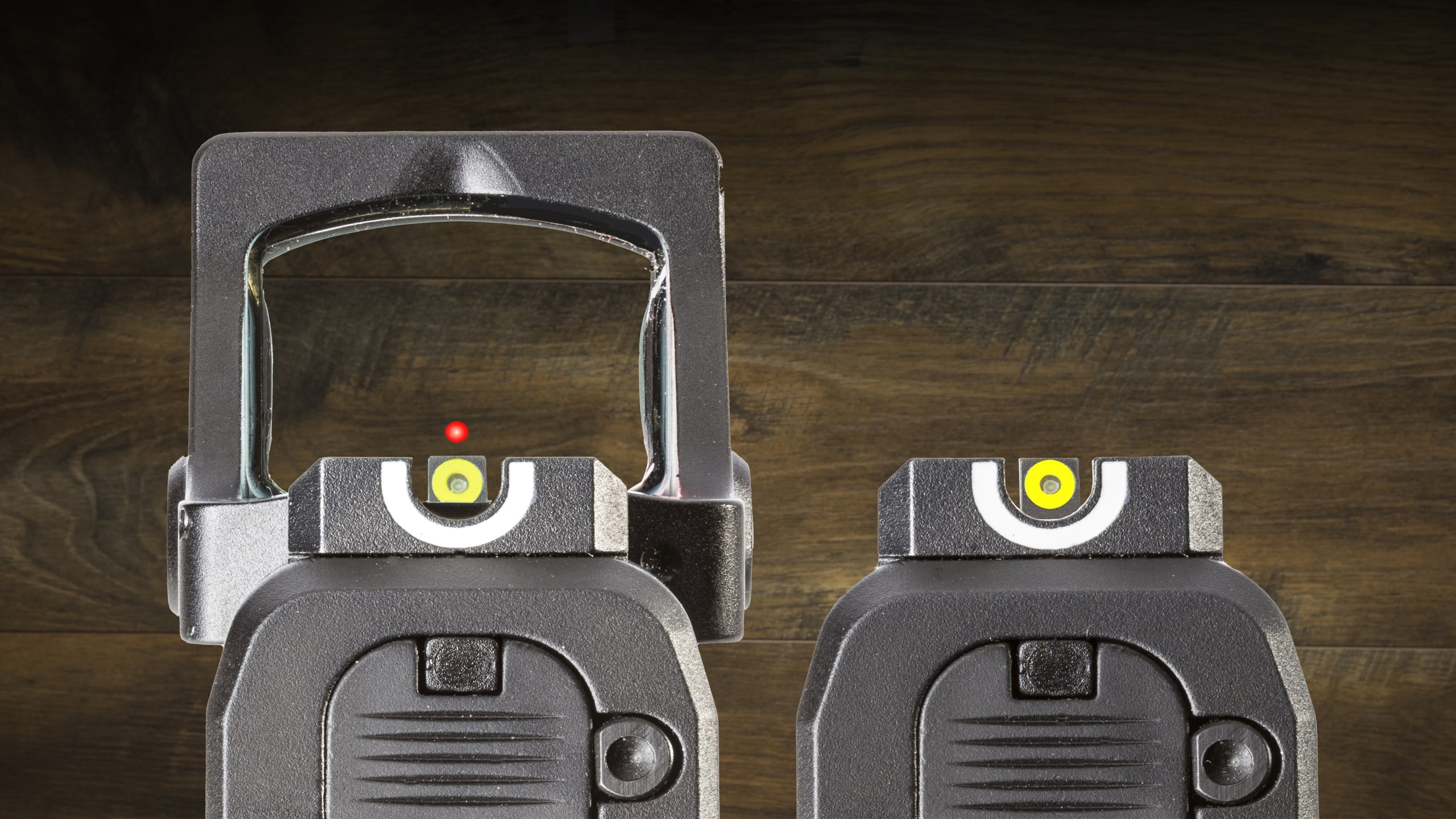
In technical terms, “co-witnessing” is the alignment of the electronic dot with traditional mechanical sights. This provides a hardware redundancy. Technology has advanced to allow for “lower third” or “absolute” co-witnessing, where the height of the optic’s base is precisely engineered to sit at specific millimeter increments above the mounting surface, allowing the user to switch between digital and analog aiming systems seamlessly.
The Future of Precision Optics: AI and Smart Sights
As we look toward the future, the “red dot” is becoming a platform for even more advanced technology. The integration of digital displays and micro-computers is the next frontier.
Rangefinding and Automatic Reticle Adjustment
New “Smart Sights” are beginning to incorporate laser rangefinders and onboard ballistic computers. These devices can measure the distance to a target and automatically adjust the position or color of the red dot to compensate for environmental factors like wind and gravity. This transforms the red dot from a simple reflex mirror into an active data-processing unit.

Heads-Up Displays (HUDs) and Augmented Reality
The ultimate trajectory for red dot technology is the integration of Augmented Reality (AR). Future iterations may sync with wearable tech or helmets to project data—such as compass headings, battery life, or even thermal signatures—directly into the optic’s field of view. By merging the physical world with digital data overlays, the red dot sight is transitioning from a basic gadget into a comprehensive heads-up display.
In conclusion, a red dot sight is far more than just a light in a tube. It is a pinnacle of optical engineering and electronic efficiency. From the precision of the Mangin mirror to the power-saving logic of motion sensors, these devices represent a significant achievement in modern technology, providing users with unprecedented speed and accuracy through the elegant application of physics and digital design.
aViewFromTheCave is a participant in the Amazon Services LLC Associates Program, an affiliate advertising program designed to provide a means for sites to earn advertising fees by advertising and linking to Amazon.com. Amazon, the Amazon logo, AmazonSupply, and the AmazonSupply logo are trademarks of Amazon.com, Inc. or its affiliates. As an Amazon Associate we earn affiliate commissions from qualifying purchases.