
In the rapidly evolving landscape of data science, artificial intelligence, and software engineering, the integrity of an analytical model is only as strong as its foundational architecture. At the heart of this architecture lies a fundamental concept that often dictates the success or failure of a technical project: the observational unit. Whether you are training a deep learning model, optimizing a distributed system, or architecting a database, identifying and defining the observational unit is the critical first step in transforming raw data into actionable technological intelligence.
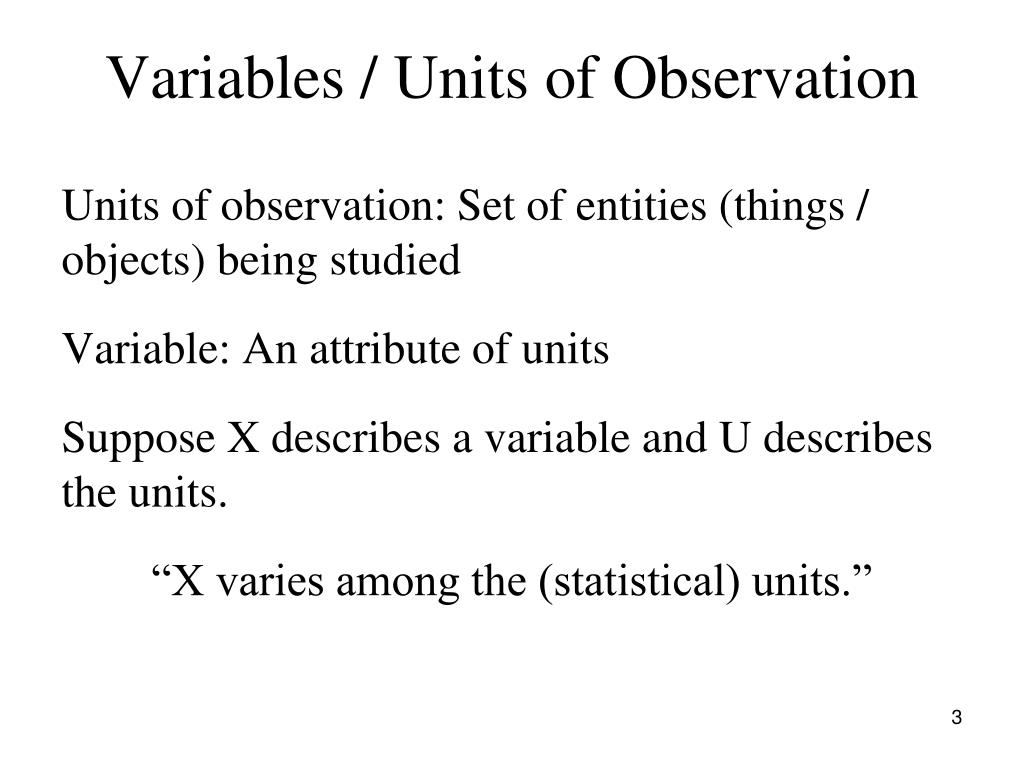
To the uninitiated, the term might sound like academic jargon. However, in the tech sector, it represents the specific entity about which information is collected and analyzed. It is the “who” or “what” at the center of a data point. As we move deeper into the era of Big Data and the Internet of Things (IoT), understanding how to define, isolate, and utilize these units has become a core competency for data engineers and software architects alike.

Defining the Observational Unit in the Digital Landscape
In technical terms, an observational unit (often referred to as a “unit of observation”) is the smallest entity that constitutes a single row in a dataset. While this sounds simple, the complexity arises when dealing with high-dimensional data across various tech stacks. In a database, it is the primary object being measured; in a software telemetry report, it is the specific instance being monitored.
The Distinction Between Observational Units and Variables
A common point of confusion for junior developers and data analysts is the distinction between an observational unit and a variable. If we think of a spreadsheet or a SQL table, the observational unit is the row, while the variable is the column.
For instance, if a DevOps team is monitoring server performance, the observational unit might be a “unique server instance.” The variables associated with that unit would be CPU usage, RAM latency, and uptime. You cannot accurately perform a regression analysis or anomaly detection if you conflate the unit (the server) with the attributes (the metrics). Mistaking one for the other leads to “ecological fallacy” in data science, where inferences about individuals are incorrectly drawn from inference about the group.
Why Granularity Matters in Big Data
In the world of Big Data, the granularity of your observational unit determines the resolution of your insights. High-resolution tech environments—such as high-frequency trading platforms or real-time cybersecurity monitors—require very “fine” observational units.
If your unit is too broad (e.g., “daily network traffic”), you lose the ability to detect a micro-spike that could indicate a localized DDoS attack. Conversely, if the unit is too granular (e.g., “every packet sent”), the sheer volume of data might overwhelm your processing engine (like Apache Spark or Flink). Tech leaders must find the “Goldilocks zone” of granularity—units that are small enough to provide detail but large enough to remain computationally efficient.
The Role of Observational Units in Machine Learning and AI
Machine learning is fundamentally a process of identifying patterns across multiple observational units. When building a supervised learning model, the quality of your training data depends entirely on how well these units are defined. If the units are inconsistent, the model will struggle with “noise,” leading to poor generalization and “overfitting.”
Feature Engineering and the Unit of Analysis
Feature engineering—the process of using domain knowledge to extract features from raw data—is tethered to the observational unit. In a predictive maintenance AI for a fleet of autonomous vehicles, is the observational unit the “vehicle,” the “trip,” or the “engine component”?
If you choose the “vehicle,” you might miss the fact that a specific “engine component” is failing across multiple vehicles. By refining the observational unit to the component level, the engineer can create more accurate features, such as “hours since last service” or “thermal cycles,” which are specific to that unit. This alignment ensures that the input vectors for the neural network are logically consistent with the real-world problem the tech is trying to solve.
Avoiding Data Leakage through Proper Identification
Data leakage is one of the most common pitfalls in AI development, where information from outside the training dataset is used to create the model. This often happens due to a misunderstanding of the observational unit.
For example, if a developer is building a model to predict user churn on a SaaS platform, and they mistakenly include data points from the “future” relative to the unit’s timeline, the model will appear highly accurate during testing but fail in production. By strictly defining the observational unit as a “user-month” or a “unique session,” developers can implement “temporal barriers” that ensure the model only learns from data available at the specific time of observation.
Observational Units in Software Engineering and Systems Monitoring
Beyond data science, the concept of the observational unit is vital in Software Reliability Engineering (SRE) and systems architecture. As we shift from monolithic architectures to microservices, the “unit” we observe has shifted from the “application” to the “service” or “container.”
Microservices and Distributed Tracing
In a microservices architecture, a single user request might pass through dozens of different services. Here, the observational unit for performance debugging is often the “Trace ID.” By treating the entire lifecycle of a request as the unit of observation, engineers can use distributed tracing tools (like Jaeger or Honeycomb) to identify bottlenecks.
If an engineer only looked at individual services as units, they might see that every service is “green” (functioning correctly), yet the user experiences a “red” (slow) result because the latency is compounded across the chain. Identifying the request as the primary observational unit allows for a holistic view of system health.
Real-Time Performance Metrics
In cloud computing, the “instance” or “pod” (in Kubernetes) serves as the primary observational unit for scaling. Auto-scaling algorithms observe these units to determine when to spin up new resources. If the logic is flawed—for example, if the system observes the “cluster” as a single unit rather than individual “pods”—it might fail to scale a specific service that is under heavy load while other services in the cluster remain idle. Precision in identifying the unit of observation directly impacts the cost-efficiency and uptime of cloud-native applications.
IoT and Edge Computing: The Hardware as an Observational Unit
The Internet of Things (IoT) presents a unique challenge: the observational unit is often a physical piece of hardware. In smart factories or connected cities, millions of sensors generate streams of data. Managing these units requires a sophisticated understanding of data aggregation and edge processing.
Sensor Fusion and Data Aggregation
In complex IoT setups, such as an automated warehouse, a single robot might have 50 different sensors. Engineers must decide if the observational unit is the “individual sensor” or the “integrated robot.”
Through a process called “sensor fusion,” tech teams aggregate data from multiple sensors to create a more reliable observational unit. For instance, a GPS sensor and an IMU (Inertial Measurement Unit) might provide conflicting data about a robot’s position. By treating the “robot” as the unit and fusing the sensor data, the system produces a singular, high-confidence data point. This prevents the “jitter” that would occur if the system tried to react to every individual sensor’s raw output.
Smart Infrastructure and Network Nodes
In the context of 5G and smart infrastructure, the observational unit often shifts to the “network node” or “edge gateway.” As data is processed closer to the source (Edge Computing), the unit of observation becomes a localized cluster. This reduces latency by allowing the system to make decisions based on units of “local traffic” rather than sending every byte to a centralized cloud unit. Understanding the hierarchy of these units—from the individual IoT device to the local gateway to the central cloud—is essential for designing resilient, low-latency networks.
Implementing Best Practices for Data-Driven Architecture
Identifying the correct observational unit is not a one-time task; it is an iterative process that requires alignment between data scientists, developers, and product managers. To build robust tech solutions, organizations must prioritize “unit clarity” in their documentation and data schemas.
Scalability and Normalization
When designing databases, normalization is the practice of organizing data to reduce redundancy. This is fundamentally an exercise in identifying observational units. A well-normalized database ensures that each table represents a single type of unit (e.g., “Users,” “Orders,” “Products”).
When tech stacks scale, clear unit definition prevents “data bloat.” If you store user information inside an “orders” table, you are conflating two different units. This leads to massive storage overhead and makes complex queries (like calculating a user’s lifetime value) computationally expensive. By keeping units distinct, you ensure that your SQL or NoSQL architecture can scale horizontally without losing data integrity.

The Future of Observability in Tech
As we move toward “AIOps” and self-healing systems, the definition of an observational unit will become even more dynamic. We are seeing the rise of “digital twins”—virtual replicas of physical systems—where the observational unit is a complex, multi-layered digital entity that mirrors a real-world asset.
In this future, the ability to track, analyze, and predict the behavior of these units will be the hallmark of advanced technology. Whether you are coding the next breakthrough app or managing a global server network, always start by asking: “What is my observational unit?” The answer to that question will define the limits and the potential of your technology.
aViewFromTheCave is a participant in the Amazon Services LLC Associates Program, an affiliate advertising program designed to provide a means for sites to earn advertising fees by advertising and linking to Amazon.com. Amazon, the Amazon logo, AmazonSupply, and the AmazonSupply logo are trademarks of Amazon.com, Inc. or its affiliates. As an Amazon Associate we earn affiliate commissions from qualifying purchases.