
In the modern landscape of digital entertainment, competition is no longer confined to local high scores or arcade leaderboards. The rise of esports and multiplayer online gaming has necessitated a sophisticated method for measuring player skill and ensuring fair competition. Central to this technological evolution is the “Elo” system. While many gamers use the term to describe their rank or standing, from a technical perspective, Elo represents a complex mathematical algorithm that has redefined how software handles competitive matchmaking.
Understanding Elo requires looking beyond the screen and into the world of data science and software engineering. It is a system designed to predict the outcome of an interaction between two entities based on their past performance. Today, this algorithm serves as the foundational architecture for the matchmaking engines used by tech giants like Riot Games, Valve, and Blizzard.

The Mathematical Foundation: From Chess to Digital Software
To understand why Elo is such a critical piece of technology in gaming, one must first understand its origin and the logic that drives it. Unlike many ranking systems that simply award points for a win, Elo is a probability-based model.
The Origin of the Arpad Elo System
The system is named after its creator, Arpad Elo, a physics professor and chess master who sought to improve the rating system for the World Chess Federation (FIDE) in the 1960s. Before his intervention, rating systems were often arbitrary or failed to account for the relative skill of opponents. Arpad Elo’s breakthrough was treating a player’s performance as a random variable that follows a bell curve (normal distribution).
In technical terms, the Elo system assumes that a player’s “true skill” is a constant, but their performance in any given game may fluctuate. By aggregating these performances over time, the software can determine a numerical value that represents the player’s statistical probability of winning against any other rated player.
How the Algorithm Calculates Skill Differentials
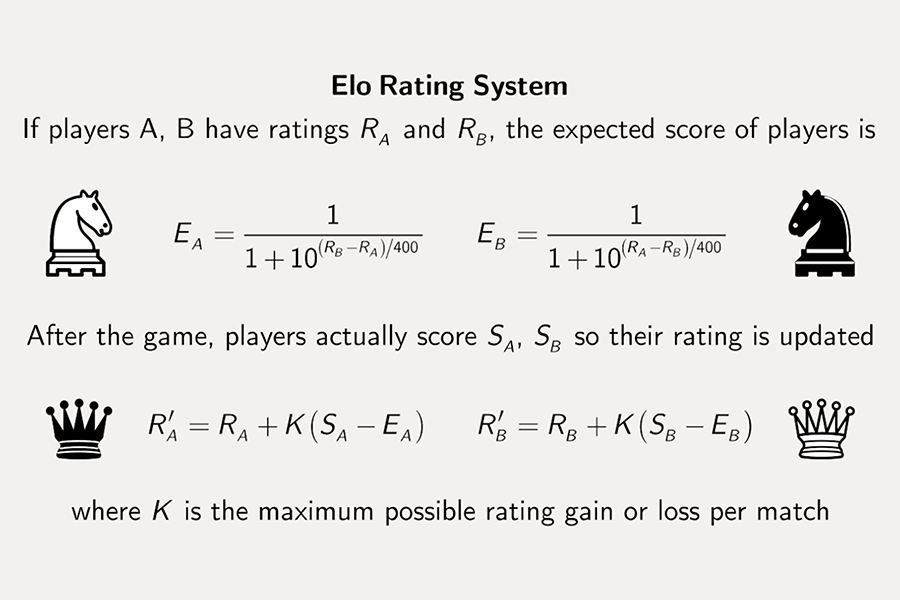
The core of the Elo rating system is the formula used to update ratings after a match. When two players compete, the software calculates an “expected score” for each. If a player with a rating of 2000 plays against someone rated 1000, the algorithm predicts a near-certain victory for the higher-rated player.
If the high-rated player wins, the system adjusts their rating only slightly because the outcome was expected. However, if the lower-rated player pulls off an upset, the software recognizes a significant discrepancy between the predicted and actual performance. Consequently, the winner gains a large number of points, and the loser drops significantly. This self-correcting nature is what makes Elo a robust piece of software logic; it constantly recalibrates itself to move players toward their “true” skill level.
Implementation in Modern Game Development
In the context of modern software development, Elo is rarely used in its purest 1960s form. Instead, it has been adapted into highly scalable matchmaking engines capable of processing millions of data points in real-time.
Backend Architectures and Matchmaking Engines
For a developer building a competitive game, the “matchmaker” is a critical piece of backend infrastructure. This service must query a database of active players, filter them by geographic region (to minimize latency), and then apply the Elo algorithm to find ten players of similar skill levels—all within a matter of seconds.
From a DevOps perspective, this requires high-performance computing. Matchmaking services must handle thousands of requests per second, often utilizing distributed systems and in-memory databases like Redis to store transient player data. The algorithm doesn’t just look at a single number; it looks at a “confidence interval.” When a player is new to a platform, the software has low confidence in their rank, leading to high volatility in point gains and losses. As more games are played, the software’s confidence increases, and the rating becomes more stable.
Adjusting Elo for Team-Based Environments
One of the greatest challenges in adapting the Elo system for modern tech is the transition from 1v1 formats (like chess) to team-based formats (like League of Legends or Overwatch). In a 5v5 environment, the software must calculate the “average” Elo of a team while accounting for outliers.
If four high-skill players are grouped with one low-skill player, does the team perform at the average level, or is it hindered by the weakest link? Software engineers use “weighting” to solve this. Modern matchmaking algorithms often weigh the highest-rated player more heavily to prevent “boosting”—a scenario where a high-skill player carries lower-skill players into ranks they haven’t earned. This technical nuance ensures that the competitive integrity of the software ecosystem remains intact.
The Evolution of Elo: MMR and Advanced Ranking Systems
As the gaming industry has grown, the limitations of the original Elo system have led to the development of more sophisticated iterations. Today, many games use a “Hidden Matchmaking Rating” (MMR) system, which functions as a more complex version of the Elo algorithm.
From Static Numbers to Hidden Matchmaking Ratings (MMR)
In many modern apps, the rank you see (Gold, Platinum, Diamond) is merely a cosmetic layer. Under the hood, the server tracks a “hidden” MMR. This separation allows developers to create a more engaging user interface while the actual matchmaking is handled by a cold, hard mathematical value.
The reason for this dual-layer system is largely psychological and technical. A visible Elo number can cause “ladder anxiety,” where players stop using the software for fear of seeing their number go down. By using a tiered ranking system supported by a hidden Elo/MMR, developers can implement “demotion protection” and other features that improve user retention without compromising the accuracy of the matchmaking data.
Beyond Elo: Glicko-2 and TrueSkill Systems
Technology never stands still, and several successors to the Elo system have gained popularity in the tech space:
- Glicko-2: Created by Mark Glickman, this system introduces the concept of “ratings volatility.” It measures how much a player’s skill is expected to change. If a player hasn’t used the software in months, the Glicko-2 algorithm increases their volatility, allowing their rank to change more rapidly until they reach a new equilibrium. This is used in games like Counter-Strike.
- TrueSkill: Developed by Microsoft Research, TrueSkill is a proprietary system that uses Bayesian inference. It is designed specifically for multi-team and multi-player environments, calculating the probability of every possible outcome in a match. It is widely considered one of the most advanced matchmaking technologies in the industry.
The Impact of Ranking Algorithms on User Experience and Retention
While Elo and its successors are mathematical tools, their implementation has profound effects on the success of a digital product. In the software world, user experience (UX) is king, and a poorly tuned matchmaking algorithm can lead to a “toxic” environment or a mass exodus of users.
Balancing Fairness and Engagement
The goal of a matchmaking algorithm is often to provide a 50% win rate for every player. From a data science perspective, if every player has a 50% chance of winning, the matches are perfectly balanced. However, from a UX perspective, this can feel like a “grind.”
Tech companies often have to decide whether to prioritize “pure fairness” or “engagement.” For example, some algorithms may slightly favor faster queue times over perfect skill parity to keep users from closing the app. This trade-off between algorithmic precision and real-world latency is a constant debate in the field of game engineering.
Preventing “Elo Hell” and Algorithmic Bias
A common term in the gaming community is “Elo Hell”—the feeling that a player is trapped in a low rank due to the mistakes of their teammates, despite their personal skill. While often a matter of perception, this presents a real technical challenge: how does an algorithm identify individual contributions in a collective effort?
Modern AI and machine learning are beginning to play a role here. Some developers are experimenting with performance-based matchmaking, where the software analyzes specific telemetry data—such as accuracy, objective participation, or utility usage—to adjust a player’s Elo independently of the match outcome. This move toward “Big Data” in matchmaking allows for a more granular understanding of player skill, moving beyond the simple “win/loss” binary of the original Elo system.
Conclusion: The Future of Skill-Based Algorithms
The Elo system is a testament to the power of mathematics in the digital age. What started as a way to rank chess players on paper has evolved into a global standard for competitive software. As we look toward the future, the integration of Artificial Intelligence and Neural Networks will likely push these systems even further.
For tech professionals and developers, Elo is more than just a gaming term; it is a masterclass in how to model human behavior using data. It proves that with the right algorithm, software can create order out of the chaos of millions of global interactions, ensuring that every time a user clicks “Play,” they are met with a challenge that is both fair and engaging. Whether it is through Glicko-2, TrueSkill, or future AI-driven models, the legacy of Arpad Elo continues to be the invisible hand guiding the competitive world of technology.
aViewFromTheCave is a participant in the Amazon Services LLC Associates Program, an affiliate advertising program designed to provide a means for sites to earn advertising fees by advertising and linking to Amazon.com. Amazon, the Amazon logo, AmazonSupply, and the AmazonSupply logo are trademarks of Amazon.com, Inc. or its affiliates. As an Amazon Associate we earn affiliate commissions from qualifying purchases.