
In the landscape of personal finance, housing is typically the largest recurring expense an individual or family will face. Whether you are a first-time renter or a seasoned professional relocating to a high-cost urban center, navigating the “income restrictions” attached to rental properties is a critical component of financial planning. These restrictions are not arbitrary; they are calculated risk-management tools used by landlords and government agencies to ensure fiscal stability for both the property owner and the tenant.
Understanding the nuances of these restrictions—ranging from the standard “40x rent” rule in private markets to the complex Area Median Income (AMI) brackets in affordable housing—is essential for securing a lease that aligns with your long-term financial health.

The Mechanics of Private Market Income Requirements
In the private sector, landlords and property management firms use income restrictions to mitigate the risk of default. From a financial perspective, a tenant who spends too high a percentage of their gross income on rent is statistically more likely to miss payments when faced with unexpected expenses, such as medical bills or car repairs.
The “3x Monthly Rent” Rule
The most common benchmark in the United States is the “3x rule.” This guideline dictates that a tenant’s gross monthly income should be at least three times the monthly rent. For example, if an apartment costs $2,000 per month, the landlord will typically require the household to earn at least $6,000 per month before taxes. This ensures that the remaining $4,000 can cover taxes, food, utilities, insurance, and savings.
The “40x Annual Rent” Standard
In competitive markets like New York City or San Francisco, the math shifts to an annual perspective. Landlords often require that a tenant’s annual gross salary be at least 40 times the monthly rent. If the rent is $3,000, the required annual income would be $120,000 ($3,000 x 40). This more stringent requirement accounts for the higher cost of living in these areas, ensuring that the tenant has a significant financial cushion.
Gross vs. Net Income: Which One Matters?
One of the most frequent points of confusion in rental finance is the difference between gross and net income. Almost all formal income restrictions are based on gross income—your total earnings before taxes, 401(k) contributions, or health insurance premiums are deducted. While this makes it easier to qualify on paper, savvy renters must calculate their “net” or take-home pay to ensure the apartment is actually affordable within their specific personal budget.
Navigating Affordable Housing and Government Income Limits
While private landlords set income “floors” (minimums), affordable housing programs set income “ceilings” (maximums). These programs are designed to provide housing for individuals who might otherwise be priced out of the market. Understanding these restrictions requires an immersion into the terminology of federal and state housing finance.
What is Area Median Income (AMI)?
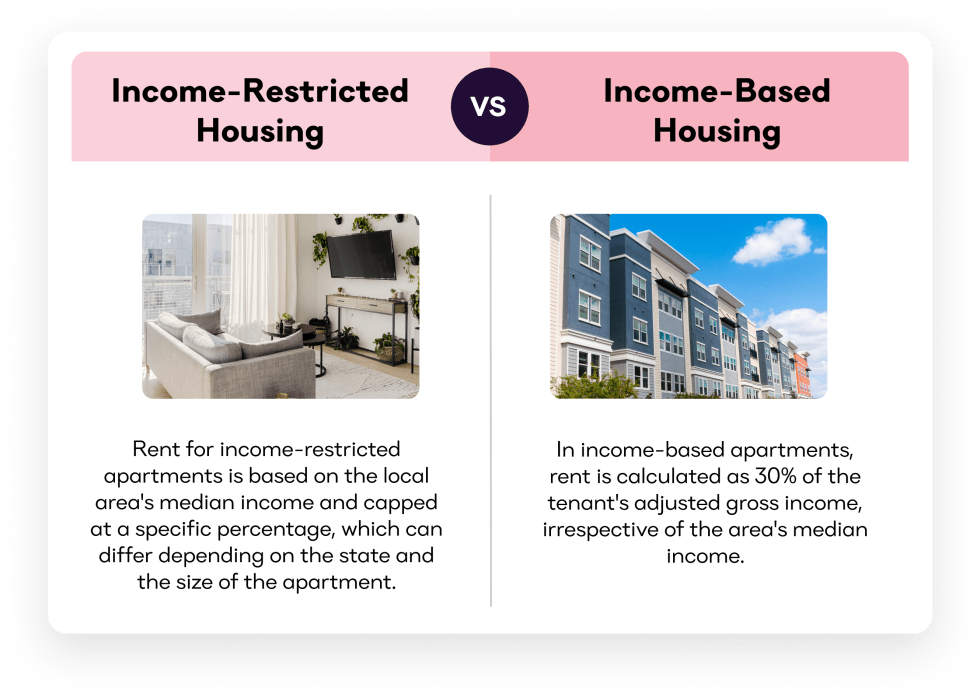
The cornerstone of government-restricted housing is the Area Median Income (AMI). This figure is calculated annually by the Department of Housing and Urban Development (HUD) for different regions. It represents the midpoint of a region’s income distribution—half the families in the area earn more than this amount, and half earn less. Income restrictions for “affordable” units are almost always expressed as a percentage of the AMI (e.g., “units available for those at 60% AMI”).
Low-Income vs. Very Low-Income Tiers
Financial eligibility for subsidized housing is typically categorized into three tiers:
- Low-Income: Households earning 80% of the AMI.
- Very Low-Income: Households earning 50% of the AMI.
- Extremely Low-Income: Households earning 30% of the AMI.
If you are applying for an apartment in a building financed through the Low-Income Housing Tax Credit (LIHTC), your total household income must fall below these specific thresholds to qualify. Furthermore, these limits are adjusted based on household size; a family of four will have a higher income ceiling than a single individual.
The Low-Income Housing Tax Credit (LIHTC) Program
The LIHTC is the most important tool for creating affordable rental housing in the U.S. From an investment and personal finance standpoint, these properties offer high-quality living at below-market rates. However, the income certification process is rigorous. Applicants must provide tax returns, pay stubs, and asset statements (including checking, savings, and investment accounts) to prove they do not exceed the income cap. Once you are in, some programs allow your income to grow to a certain point (often 140% of the initial limit) before you lose eligibility.
How Debt-to-Income Ratio Affects Your Eligibility
Simply meeting the minimum income requirement does not guarantee approval. Landlords increasingly look at a tenant’s broader financial profile, specifically the Debt-to-Income (DTI) ratio. This is a metric used by lenders and landlords to determine how much of your income is already committed to other financial obligations.
Defining DTI in a Rental Context
Your DTI is calculated by dividing your total monthly debt payments by your gross monthly income. Common debts include student loans, car payments, minimum credit card payments, and personal loans. While a renter might earn $5,000 a month (meeting a $1,500 rent requirement), if they have $2,500 in monthly debt payments, their DTI is 50%.
Why Landlords Care About Your Debt
A high DTI ratio is a red flag for property managers. Even if you earn enough to cover the rent, a high debt load suggests that your cash flow is restricted. Most financial experts recommend keeping your total DTI—including your future rent—below 43%. If your existing debt plus your potential rent exceeds 50% of your income, many institutional landlords will view you as a high-risk candidate, even if your income technically meets their “3x” threshold.
Managing Recurring Monthly Obligations
To improve your chances of passing an income check, it is often wise to reduce revolving debt (like credit cards) before applying for a new lease. Paying down a high-interest credit card not only improves your DTI ratio but also boosts your credit score, which is the secondary metric landlords use to verify financial reliability.
Creative Financial Solutions for Meeting Income Thresholds
In many cases, an applicant’s base salary may not satisfy the strict requirements of a high-end apartment or a competitive rental market. However, there are several financial strategies and tools available to bridge the gap between your current earnings and the landlord’s requirements.
Leveraging Personal Guarantors and Co-signers
If your income falls short of the 40x or 3x requirement, you can use a guarantor. A guarantor is a third party (often a parent or relative) who signs the lease and takes on the financial legal obligation to pay the rent if you default. Landlords usually require guarantors to meet much higher income standards—often 80x the monthly rent—and have a pristine credit history. This provides the landlord with an additional layer of financial security.
Utilizing Passive Income and Alternative Assets
Income isn’t just a paycheck. When verifying your financial standing, you should include all sources of cash flow. This includes:
- Investment Dividends: Regular payouts from stocks or mutual funds.
- Court-Ordered Payments: Alimony or child support.
- Government Benefits: Social Security, disability, or veteran benefits.
- Liquid Assets: Some landlords will “waive” or lower income requirements if you can show a significant balance in a savings or brokerage account (often 12–24 months of rent in liquid cash).
Negotiating with Larger Security Deposits
In certain jurisdictions (though laws vary by state), you may be able to offset a lower income by offering a larger security deposit or paying several months of rent upfront. From a business finance perspective, this reduces the landlord’s “time-to-recovery” if you were to stop paying. However, many states now cap security deposits at one or two months’ rent, so this strategy is becoming less common in regulated markets.
Long-Term Budgeting for Housing Sustainability
Meeting the income restrictions for an apartment is merely the first step. The ultimate goal of understanding these financial metrics is to ensure that your housing choice supports your overall wealth-building goals rather than hindering them.
The 30% Budgeting Rule
A foundational principle of personal finance is the 30% rule, which suggests that you should spend no more than 30% of your gross income on housing. This rule is the basis for most government income restrictions. By adhering to this limit, you ensure that you have sufficient “discretionary income” to invest in the stock market, build an emergency fund, and save for a future home purchase.

Planning for Annual Rent Escalations
Income restrictions are often static at the time of lease signing, but your financial reality is dynamic. Most private-market leases include annual rent increases, often ranging from 3% to 10% depending on inflation and local market demand. When evaluating your income against a potential apartment, you must ask: “If my salary stays the same, can I still afford this apartment if the rent goes up $200 next year?”
In conclusion, income restrictions for apartments serve as a vital filter in the rental ecosystem. For the landlord, they are a safeguard for the property’s cash flow. For the tenant, they serve as a reality check for personal affordability. By understanding the math behind the “3x rule,” the complexities of AMI, and the impact of DTI ratios, you can approach the rental market not just as a seeker of shelter, but as a savvy manager of your personal financial future. Successful renting is not about finding the most expensive place you qualify for; it is about finding a place where the income restrictions and your personal budget coexist to allow for financial growth.
aViewFromTheCave is a participant in the Amazon Services LLC Associates Program, an affiliate advertising program designed to provide a means for sites to earn advertising fees by advertising and linking to Amazon.com. Amazon, the Amazon logo, AmazonSupply, and the AmazonSupply logo are trademarks of Amazon.com, Inc. or its affiliates. As an Amazon Associate we earn affiliate commissions from qualifying purchases.