
In the rapidly evolving landscape of digital communication, the way we transmit information is constantly being reshaped by the platforms we use. One of the most ubiquitous terms currently circulating through instant messaging apps, social media comments, and mobile interfaces is “alr.” To the uninitiated, these three letters might seem like a typo, but in the context of modern tech culture, they represent a significant shift in linguistic efficiency. Understanding what “alr” means—and why it has become a staple of digital discourse—requires an exploration of user interface (UI) constraints, the psychology of mobile messaging, and the underlying algorithms that drive internet trends.
The Definition and Linguistic Mechanics of “ALR”
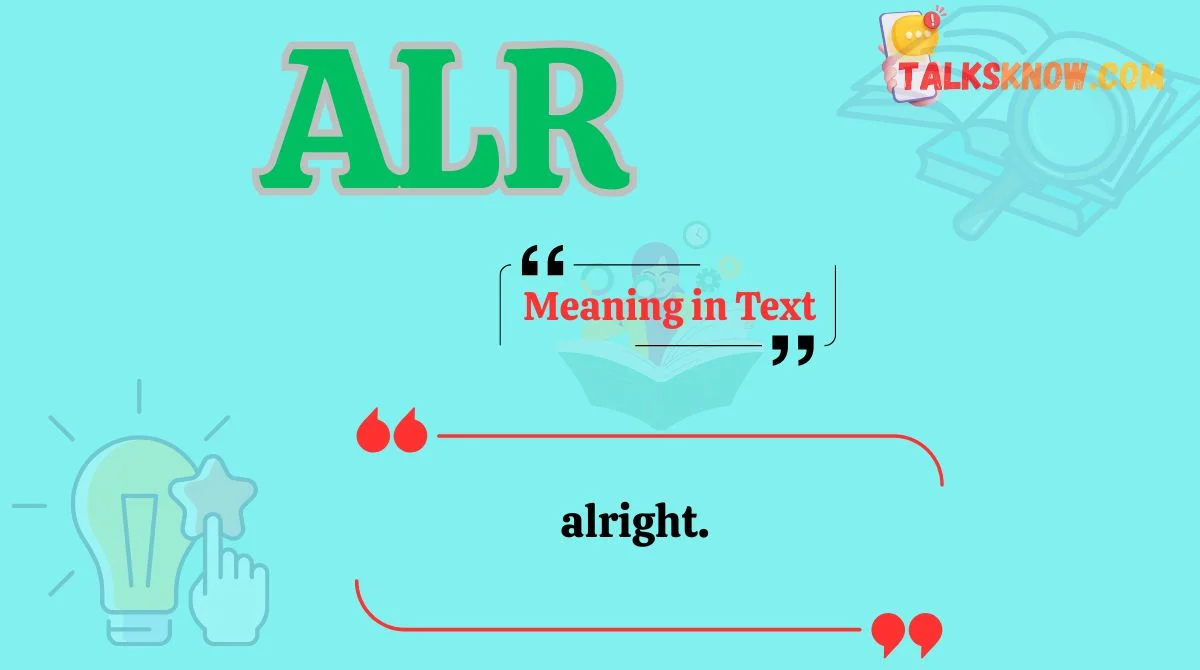
At its most fundamental level, “alr” is a shorthand abbreviation for the word “alright.” While the word “alright” is already a common variant of “all right,” the digital age has further compressed it to satisfy the demand for rapid-fire communication. In the ecosystem of mobile keyboards and touchscreens, reducing a seven-letter word to three characters significantly decreases the cognitive and physical load on the user.
From “Alright” to “ALR”: The Compression of Language
The evolution of “alr” follows a predictable pattern in digital linguistics known as “least effort” principle. Users naturally gravitate toward the shortest path to convey a message. In professional or semi-professional digital spaces, “alr” serves as a minimalist acknowledgment. It signals that a message has been received and understood without requiring the formality of a full sentence. This compression is particularly prevalent in asynchronous communication, where the speed of the “ping-pong” exchange defines the flow of the conversation.
Contextual Variations: Agreement vs. Acknowledgment
Technically, “alr” functions in two primary capacities. First, it acts as a form of affirmative agreement—essentially a digital “yes.” Second, it serves as a conversational transition or a “filler” word, much like “okay” or “so.” On platforms like Discord or Slack, where technical discussions often move at high speeds, “alr” allows developers and team members to acknowledge instructions or updates instantaneously. However, the tone of “alr” is highly dependent on the software environment; in a casual text thread, it might feel dismissive, whereas in a fast-paced gaming chat, it is the peak of efficiency.
The Technological Drivers of Texting Slang
The rise of terms like “alr” is not an accidental cultural quirk; it is a direct byproduct of the hardware and software we use daily. The shift from physical QWERTY keyboards on laptops to glass-surface touchscreens on smartphones has fundamentally altered our “typing economy.”
Mobile UI and the Thumbs-First Economy
The physical act of typing on a smartphone is inherently more prone to friction than typing on a traditional keyboard. Despite advancements in haptic feedback and screen sensitivity, “thumb-typing” remains a relatively slow process. Consequently, the mobile UI environment encourages the use of acronyms and abbreviations. Software developers have noticed this trend, leading to the integration of more sophisticated predictive text engines and autocorrect features. Interestingly, as more users adopt “alr,” machine learning models within mobile operating systems like iOS and Android begin to recognize it as a valid entry rather than a misspelling, further cementing its place in the digital lexicon.
Character Limits and the Legacy of SMS
While modern messaging apps like WhatsApp and Telegram do not impose the strict 160-character limits of legacy SMS (Short Message Service), the “character-count mindset” persists. The legacy of 2G and 3G networking, where every byte of data was precious and every character counted toward a billing limit, trained a generation of users to be linguistically frugal. Even in the era of 5G and unlimited data, the cultural DNA of brevity remains. “Alr” is a modern iteration of this technical legacy—a way to maximize information density in the smallest possible data packet.
How Social Media Algorithms Shape Digital Slang

The adoption of “alr” is not just about typing convenience; it is also about visibility and engagement within social media ecosystems. Platforms like TikTok, Instagram, and X (formerly Twitter) use complex algorithms to determine which content reaches a wider audience, and the language used in captions and comments plays a vital role.
The Role of TikTok and Instagram in Rapid Adoption
Slang terms now go viral at the same speed as software patches. When a high-profile influencer or a viral video uses “alr” in a caption, the platform’s algorithm notes the engagement levels associated with that term. As users mimic the language to gain traction within the same niche, the term spreads globally in a matter of days. This “algorithmic mimicry” is a key component of how digital dialects are formed. In the tech world, this is known as a network effect: the value and usage of the term increase as more people within the digital network adopt it.
Algorithmic Favoritism: Why Shorthand Boosts Engagement
From a technical standpoint, shorter comments like “alr” or “fire” emojis are easier for users to post quickly, which inflates the “comment count” metric of a post. Social media algorithms prioritize posts with high velocity—meaning many interactions in a short period. By lowering the barrier to entry for a comment, shorthand like “alr” facilitates higher engagement rates. For creators and brands, understanding this “slang-driven engagement” is essential for optimizing their presence on these platforms.
Digital Security and the Risks of Ambiguous Communication
While “alr” is generally harmless, the rise of ambiguous shorthand in digital communication introduces unique challenges in the realms of cybersecurity and data privacy. In an era of sophisticated social engineering, the way we interpret text can have real-world security implications.
Social Engineering and Slang Manipulation
Cybercriminals often use the informal tone of digital slang to bypass a target’s natural defenses. By using terms like “alr” or “bet,” a bad actor can mimic the “voice” of a trusted friend or colleague in a phishing attack. This technique, known as “linguistic mirroring,” makes the fraudulent message appear more authentic. Security professionals now have to train employees not only to look for suspicious links but also to be wary of sudden shifts in the “digital register” or slang usage of their contacts.
AI and NLP: How Modern Software Decodes Your Texts
The tech industry’s reliance on Natural Language Processing (NLP) has made the decoding of terms like “alr” a priority for software engineers. Modern AI models, such as those used in sentiment analysis for brand monitoring, must be programmed to understand that “alr” carries a neutral-to-positive sentiment. If a software tool fails to recognize “alr” as “alright,” it might categorize customer feedback as “unknown” or “error-prone,” leading to skewed data. Consequently, the maintenance of “slang dictionaries” within AI training sets is a massive, ongoing task for tech companies aiming to bridge the gap between human intent and machine understanding.
The Future of Digital Lexicons in the Age of AI
As we look toward the future of technology, the way we use shorthand like “alr” is likely to transform yet again. With the rise of Generative AI and advanced predictive text, the line between human-generated slang and machine-suggested responses is blurring.
Predictive Text and the Formalization of Slang
We are entering an era where our devices “think” for us. When you type “a-l,” your phone might automatically suggest “alr” if it recognizes your conversation partner is a peer, or “Alright,” if it detects you are emailing a supervisor. This context-aware software is formalizing slang, turning what was once a rebellious linguistic shortcut into a standardized UI element. As AI becomes more integrated into our keyboards, we may see a decrease in original slang creation, as users simply select the “suggested” shortcut provided by the algorithm.
Beyond Text: Is Slang Moving to Visual Media?
Finally, we must consider whether text-based shorthand like “alr” will eventually be replaced by visual or haptic communication. With the integration of “reactions” (like the “thumbs up” on iMessage or Slack), the need to type even three letters is diminishing. In many professional tech environments, a simple emoji reaction has already replaced “alr” as the primary form of acknowledgment. However, for the time being, “alr” remains a vital bridge—a linguistic tool that balances the speed of a gesture with the clarity of a word, perfectly suited for the high-velocity world of modern technology.
aViewFromTheCave is a participant in the Amazon Services LLC Associates Program, an affiliate advertising program designed to provide a means for sites to earn advertising fees by advertising and linking to Amazon.com. Amazon, the Amazon logo, AmazonSupply, and the AmazonSupply logo are trademarks of Amazon.com, Inc. or its affiliates. As an Amazon Associate we earn affiliate commissions from qualifying purchases.