
For decades, the six-figure salary has served as the ultimate benchmark of American financial success. Earning $100,000 a year was once synonymous with “making it”—a gateway to homeownership, luxury travel, and a secure retirement. However, as the economic landscape shifts under the weight of inflation, changing labor markets, and geographic cost-of-living disparities, the significance of this number has evolved. Understanding what percentage of Americans actually reach this threshold requires a nuanced look at the data, the demographics, and the current purchasing power of the dollar.
Breaking Down the Numbers: The Current Landscape of American Incomes
To determine how many Americans earn $100,000 or more, we must first distinguish between individual earners and household income. These two metrics offer vastly different perspectives on the distribution of wealth in the United States.
Individual Earners vs. Household Income
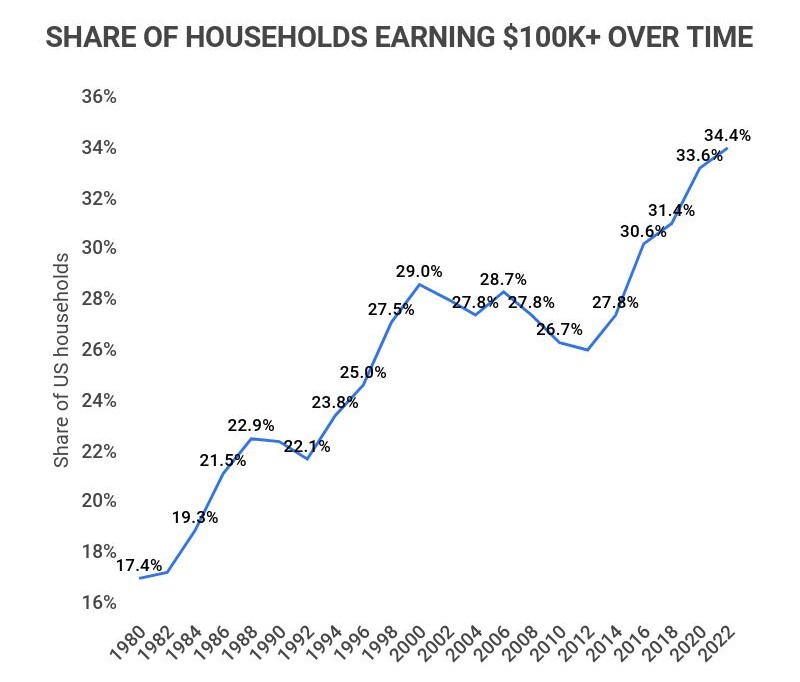
According to the most recent data from the U.S. Census Bureau and the Bureau of Labor Statistics (BLS), approximately 18% to 20% of individual American workers earn an annual salary of $100,000 or more. When we look at households, the numbers shift significantly. Roughly 34% to 37% of American households bring in more than $100,000 annually. This discrepancy is largely due to the rise of dual-income households, where two partners earning moderate salaries combine to cross the six-figure threshold.
Historical Context: The Expansion of the Six-Figure Club
The percentage of Americans earning $100,000 has grown steadily over the last twenty years. In the early 2000s, hitting this mark placed an individual in the top 5% of earners. Today, while still a significant achievement, it is a more common reality for mid-to-senior level professionals in specialized fields. This growth isn’t just a result of rising productivity or higher wages; it is also heavily influenced by nominal wage increases that track with the rising costs of goods and services.
Demographic and Geographic Influences on High Earnings
Earning potential in America is not distributed evenly. Where you live, what you studied, and how much experience you have play decisive roles in whether or not you will see $100,000 on your W-2.
The Role of Education and Experience
Statistics consistently show a strong correlation between educational attainment and the likelihood of earning a six-figure income. Workers with professional degrees (MDs, JDs) or advanced degrees (Master’s, PhDs) are significantly more likely to be in the top quintile of earners. Furthermore, the “mid-career surge” is a real phenomenon; most individuals do not hit the $100,000 mark until they have 10 to 15 years of experience in their respective industries, typically placing them in the 35-to-54 age bracket.
Geography Matters: Where $100k is the Norm vs. an Outlier
The “value” of $100,000 varies wildly depending on geography. In states like Mississippi or West Virginia, an individual earning $100,000 is often in the top 10% of earners and enjoys a high standard of living. Conversely, in major metropolitan hubs like San Francisco, New York City, or Washington D.C., a $100,000 salary is often considered the baseline for a middle-class lifestyle. In these “high-cost-of-living” (HCOL) areas, the percentage of the population making six figures is much higher—sometimes exceeding 40% of the local workforce—yet their discretionary income may be lower than someone making $70,000 in a rural area.
The “Six-Figure” Psychological Barrier vs. Economic Reality
While $100,000 remains a psychological milestone for many, the economic reality of 2024 suggests that the “gold standard” may be losing its luster. The phenomenon of “lifestyle creep” and the rising costs of essentials have changed the math for high earners.
Inflation’s Impact: Is $100k the New $70k?
Inflation has a compounding effect on the value of a salary. When adjusted for inflation, $100,000 today has the purchasing power that roughly $70,000 had just a decade and a half ago. For many Americans, reaching the six-figure mark doesn’t result in the “luxury” life they imagined because the costs of housing, healthcare, and education have outpaced general wage growth. This has led to the rise of the “HENRY” demographic—High Earners, Not Rich Yet. These are individuals making over $100,000 who still feel financial pressure due to debt and high living expenses.
The Cost of Living Adjustment
When analyzing what percent of Americans make $100k, we must also look at “real income.” If a worker moves from a low-tax state to a high-tax city for a $100,000 job, they might find that their take-home pay after state taxes, local taxes, and increased rent leaves them with less “fun money” than they had previously. This has sparked a trend of “geo-arbitrage,” where high earners use remote work to maintain their $100,000+ salaries while living in areas where that money goes much further.
Strategies to Reach the $100k Threshold
For those looking to join the top 20% of individual earners, the path is rarely linear. It requires a combination of strategic career moves, skill acquisition, and financial literacy.
High-Income Skills and Career Paths
The quickest way to a six-figure income in the current economy is through specialized high-income skills. This isn’t limited to traditional roles like doctors or lawyers. Fields such as data science, cybersecurity, specialized engineering, and high-ticket sales (like SaaS or medical devices) often offer starting salaries near or above $100,000. Additionally, the “trades” are seeing a resurgence; specialized electricians, elevator mechanics, and commercial pilots are increasingly entering the six-figure bracket without the traditional four-year degree.
Leveraging Side Hustles and Diversified Income Streams
Many Americans reach the $100,000 mark not through a single salary, but through a combination of income streams. This is particularly true for the “creator economy” and the “gig economy.” A professional might earn $75,000 at their day job while generating an additional $25,000 through consulting, freelance writing, or e-commerce. Diversification not only helps reach the numerical goal of $100k but also provides a safety net against industry-specific layoffs.
Financial Management Beyond the Six-Figure Mark
Crossing the $100,000 threshold is a significant achievement, but it is only the beginning of a larger financial journey. Without proper management, a six-figure income can disappear just as quickly as a five-figure one.
Avoiding Lifestyle Creep
One of the biggest traps for new six-figure earners is lifestyle creep—the tendency to increase spending as income rises. When a salary jumps from $80,000 to $110,000, many people immediately upgrade their vehicle, move into a more expensive apartment, or begin eating at high-end restaurants. To truly build wealth at this income level, financial experts recommend “living as if you still make $80,000” and funneling the surplus into investments and debt repayment.

Long-term Wealth Building and Tax Efficiency
At the $100,000 level, taxes become a more significant concern. Individuals in this bracket move into higher federal tax tiers, making tax-advantaged accounts like 401(k)s, IRAs, and HSAs essential tools for wealth preservation. Understanding how to lower taxable income through these vehicles can be the difference between just “making $100k” and actually “keeping $100k.” Furthermore, this income level provides the surplus capital necessary to begin investing in brokerage accounts or real estate, which are the true drivers of long-term net worth.
In conclusion, while roughly one-fifth of individual Americans earn $100,000 or more, the figure is more than just a number—it is a reflection of education, geography, and economic shifts. Reaching this milestone is an undeniable sign of career progress, but in today’s economy, the real success lies in how that income is managed, invested, and utilized to create lasting financial freedom.
aViewFromTheCave is a participant in the Amazon Services LLC Associates Program, an affiliate advertising program designed to provide a means for sites to earn advertising fees by advertising and linking to Amazon.com. Amazon, the Amazon logo, AmazonSupply, and the AmazonSupply logo are trademarks of Amazon.com, Inc. or its affiliates. As an Amazon Associate we earn affiliate commissions from qualifying purchases.