
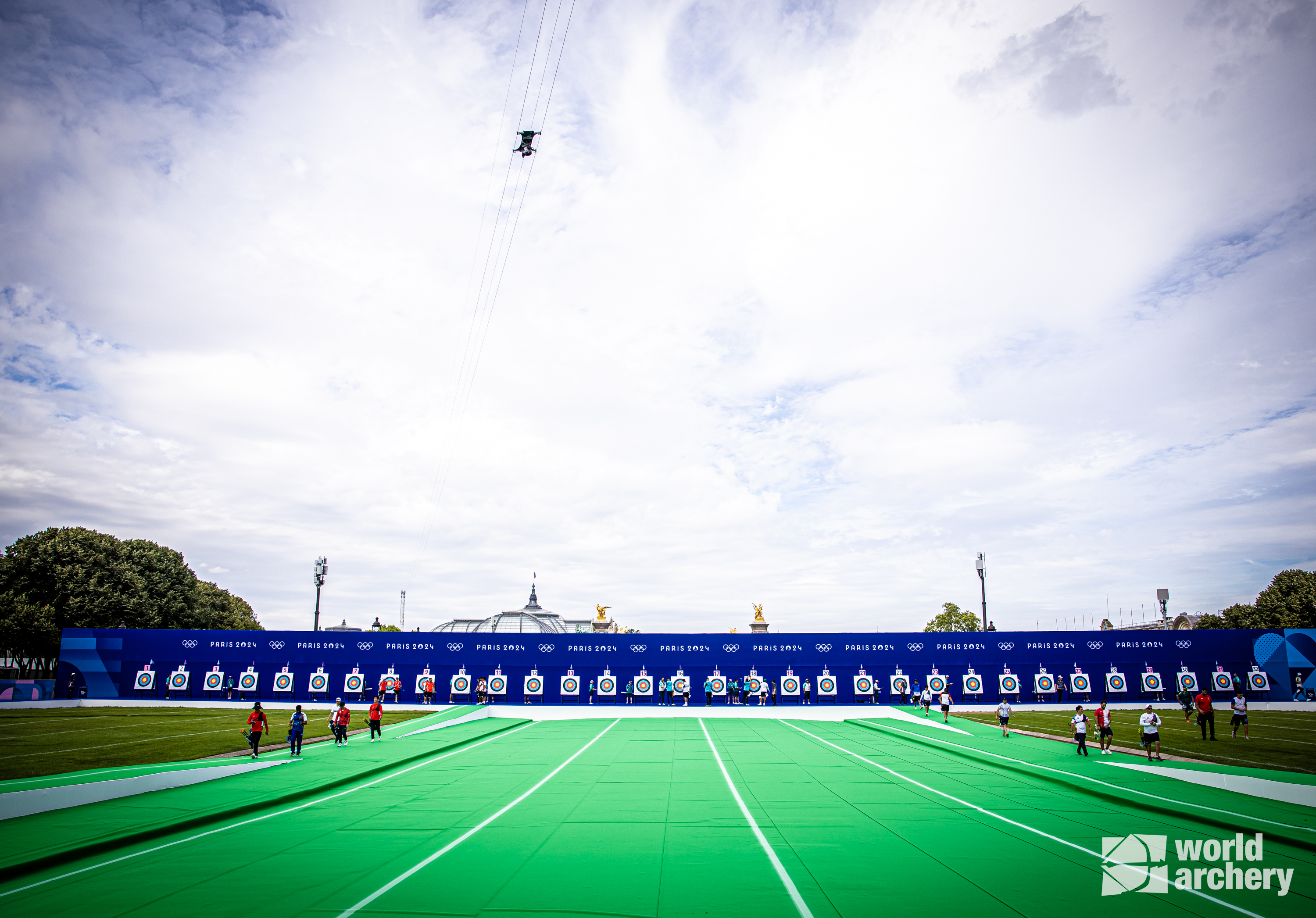
In the world of professional sports, few metrics are as iconic yet demanding as the 70-meter distance in Olympic archery. To the uninitiated, it is simply a stretch of grass between an athlete and a target. To the technologist, engineer, and data scientist, however, this distance represents a complex laboratory of ballistics, material science, and high-frequency data analysis. While the human element—the archer’s focus and steady hand—is vital, modern Olympic archery has evolved into a high-tech arms race where equipment and software are tuned to mitigate the chaotic variables of a 70-meter flight path.
The Material Science of the Recurve Bow: Engineering the Perfect Launch
At the 70-meter distance, the margin for error is non-existent. A deviation of just one millimeter at the point of release can result in a complete miss of the “10-ring” at the target. To combat this, the technology behind the modern Olympic recurve bow has shifted from traditional craftsmanship to advanced aerospace engineering.
High-Modulus Carbon Fiber and Nano-Technology
The limbs of a modern Olympic bow are masterpieces of composite engineering. Unlike the wooden bows of the past, contemporary limbs utilize layers of high-modulus carbon fiber interspersed with syntactic foam or cross-carbon weaves. The goal is to maximize the “coefficient of restitution”—the efficiency with which the energy stored in the limbs is transferred to the arrow. Tech manufacturers now utilize carbon nanotubes to increase the stiffness-to-weight ratio, ensuring that the limbs remain stable even under varying thermal conditions. This technological consistency is crucial because a slight change in ambient temperature can alter the elasticity of the material, which at 70 meters, would drastically change the arrow’s impact point.
The Physics of Vibration Dampening and Stabilization
When an archer releases the string, the bow undergoes a violent transformation of energy, resulting in significant structural vibration. To manage this, engineers have developed sophisticated stabilization systems. These “V-bar” systems are not merely weights; they are tuned harmonic dampers. Using computational fluid dynamics and vibration analysis software, designers create stabilizers that oscillate at specific frequencies to cancel out the bow’s natural resonance. By absorbing these micro-vibrations through internal silicone gels or high-density tungsten weights, the tech ensures that the bow remains perfectly still during the milliseconds the arrow is still in contact with the rest.
Arrow Ballistics and Aerodynamic Optimization
The arrow is the only part of the equipment that must survive the 70-meter journey through unpredictable outdoor environments. The technology used to manufacture these projectiles is as precise as that used in satellite components.
Micro-Diameter Shafts and Kinetic Consistency
At a distance of 70 meters, wind drift is the archer’s greatest enemy. To minimize this, tech companies like Easton and Win&Win have developed ultra-slim, micro-diameter shafts. These arrows often feature an aluminum core wrapped in high-strength carbon fiber. This hybrid construction allows the arrow to be incredibly thin—reducing its surface area and “drag coefficient”—while maintaining the structural integrity needed to withstand the immense force of the bow’s draw weight. The manufacturing tolerances are staggering; top-tier Olympic arrows are sorted by digital sensors to ensure that a dozen arrows vary by no more than a fraction of a grain in weight.
The Geometry of Fletching and Spin Rates
The “vanes” or fletching at the back of the arrow are no longer simple plastic flaps. They are aerodynamic stabilizers designed using wind-tunnel testing. At the Olympic distance, the spin rate of the arrow is critical for gyroscopic stability. New polymer materials allow for “shield cut” or “wing” shapes that create a specific amount of drag to stabilize the arrow’s “paradox”—the horizontal flexing it undergoes upon release—without sacrificing too much forward velocity. Engineers use high-speed cameras filming at 10,000 frames per second to analyze how these vanes interact with the air, ensuring the arrow recovers from its initial flex as quickly as possible.
Digital Training Ecosystems and Biomechanical Analysis
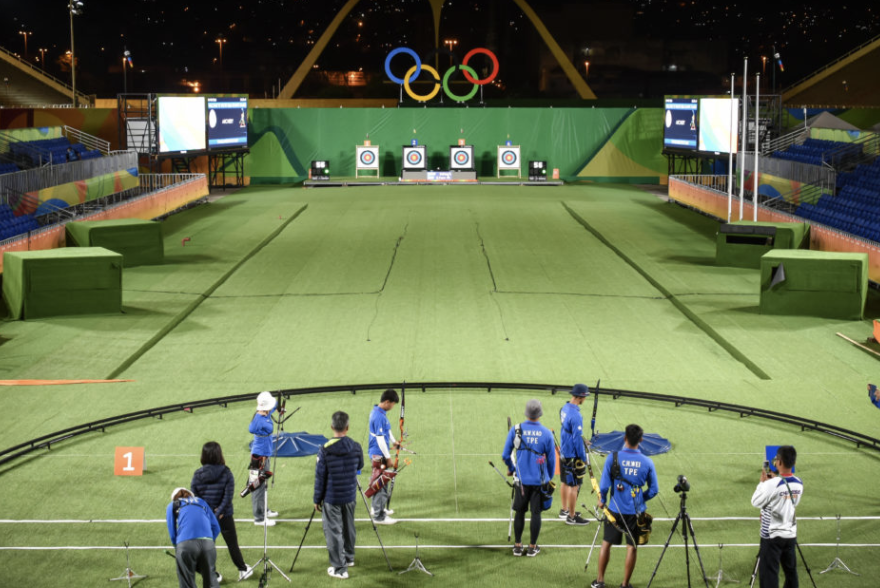
The journey to mastering the 70-meter shot is now guided by an array of digital tools and AI-driven software. The days of simply “feeling the shot” have been augmented by “quantified-self” technology.
AI-Powered Biomechanical Feedback
Elite archers now utilize motion-capture technology similar to that used in Hollywood VFX. Systems like Dartfish or specialized AI posture-analysis apps allow coaches to overlay a “perfect” shot frame over an athlete’s current performance. These tools measure the exact angle of the draw arm, the stability of the riser, and the timing of the clicker release. By processing this data through machine learning algorithms, the software can identify “micro-flinches”—involuntary muscle movements—that are invisible to the human eye but result in a 2-centimeter drift at the 70-meter target.
Integrated Sensor Tech: The “Smart” Bow
Recent innovations have seen the introduction of Bluetooth-enabled sensors that clip onto the bow’s riser. These gadgets, such as the Mantis or specialized accelerometers, track the bow’s movement in three dimensions during the aiming process. This data is synced to a smartphone, providing a “stability score.” For an archer shooting at 70 meters, these sensors provide a digital footprint of their “steadiness.” If the tech detects a specific pattern of jitter, it can signal to the archer or coach that fatigue is setting in, or that the bow’s draw weight needs a technical adjustment.
Environmental Data and Predictive Algorithmic Tools
Because Olympic archery is an outdoor sport, the 70-meter distance is subject to the whims of nature. Technology has stepped in to help athletes turn environmental variables into predictable data points.
Advanced Weather Telemetry
In professional competition, “reading the wind” is no longer about watching a ribbon tied to a pole. Teams now use handheld ultrasonic anemometers that provide real-time wind speed and direction data with pinpoint accuracy. This tech often integrates with ballistics calculators. While archers aren’t allowed to use active electronics on the line during some phases of competition, their training involves using these “wind-mapping” tools to build a mental database of how a 5 mph crosswind at 70 meters affects their specific arrow setup.
High-Definition Optics and Digital Scoring
The technology at the target end of the 70-meter range has also seen a digital overhaul. Spectators and judges now rely on laser-based scoring systems and high-definition “spotting” scopes that utilize digital sensors to transmit the exact location of the arrow hit to a central server instantly. These scopes use ED (Extra-low Dispersion) glass and multi-coated lenses to provide a crisp image of a target that is nearly a football field away. In some high-tech training facilities, targets are equipped with acoustic sensors that triangulate the sound of the arrow hitting the paper to provide an automated, digital score with 0.1mm precision.

The Future: Augmented Reality and Material Evolution
As we look toward the future of the 70-meter Olympic standard, the intersection of technology and sport will only deepen. We are already seeing the prototyping of Augmented Reality (AR) glasses that can project a “virtual” wind-tunnel path for the archer during practice sessions. Furthermore, the development of “smart materials” for bow limbs—materials that can change their density or stiffness in response to an electric charge—could one day allow for a bow that automatically compensates for atmospheric pressure changes.
The 70-meter distance in Olympic archery is a testament to human skill, but it is the technology that allows that skill to be expressed with such breathtaking consistency. From the molecular structure of the carbon-fiber limbs to the AI-driven analysis of the archer’s heartbeat, every millimeter of that 70-meter gap is governed by the cutting edge of modern tech. In this arena, the bow is no longer a primitive tool; it is a sophisticated instrument of digital and mechanical precision.
aViewFromTheCave is a participant in the Amazon Services LLC Associates Program, an affiliate advertising program designed to provide a means for sites to earn advertising fees by advertising and linking to Amazon.com. Amazon, the Amazon logo, AmazonSupply, and the AmazonSupply logo are trademarks of Amazon.com, Inc. or its affiliates. As an Amazon Associate we earn affiliate commissions from qualifying purchases.