
The diminished seventh chord is a fascinating and potent harmonic device that has captivated musicians and composers for centuries. Its unique sound, often described as dissonant, suspenseful, or unsettling, makes it a powerful tool for creating tension, driving harmonic movement, and adding a touch of dramatic flair to musical compositions. While it might sound complex, understanding the diminished seventh chord is surprisingly accessible, and its application extends across a wide range of musical genres.
This exploration delves into the fundamental nature of the diminished seventh chord, its construction, its characteristic sound, and its various applications within the realm of music technology and digital composition. We will uncover how this seemingly simple four-note chord can evoke such profound emotional responses and how contemporary technological tools allow for its creative manipulation and integration into modern soundscapes.

The Anatomy of the Diminished 7th Chord
At its core, any chord is built upon intervals – the distance between notes. The diminished seventh chord is no exception. Understanding these intervals is key to grasping its unique character.
Building Blocks: Intervals and Structure
A diminished seventh chord is a seventh chord, meaning it consists of four notes played simultaneously. It is built upon a diminished triad, to which a diminished seventh interval is added. Let’s break this down:
- Root: The foundational note of the chord.
- Minor Third: The interval above the root, consisting of three half steps.
- Diminished Fifth: The interval above the root, consisting of six half steps (a tritone). This is what makes the underlying triad a diminished triad.
- Diminished Seventh: The interval above the root, consisting of nine half steps. This is the defining characteristic of the diminished seventh chord.
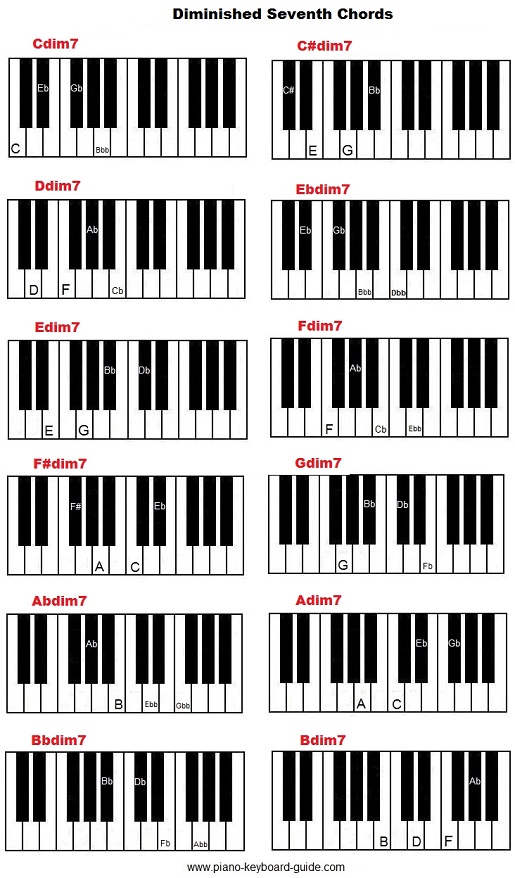
To visualize this, let’s consider the C diminished seventh chord (Cdim7).
- Root: C
- Minor Third: Eb (C to Eb is 3 half steps)
- Diminished Fifth: Gb (C to Gb is 6 half steps)
- Diminished Seventh: Bbb (C to Bbb is 9 half steps). Note that Bbb is enharmonically equivalent to A, but in the context of the chord structure, it’s understood as a diminished seventh.
The resulting notes are C, Eb, Gb, and Bbb. This combination of intervals creates the chord’s signature tension. The most striking interval within the chord is the tritone between the root and the diminished fifth (C to Gb), and also between the minor third and the diminished seventh (Eb to Bbb). These tritones are crucial to the chord’s dissonant quality.
Enharmonic Equivalence and Its Implications
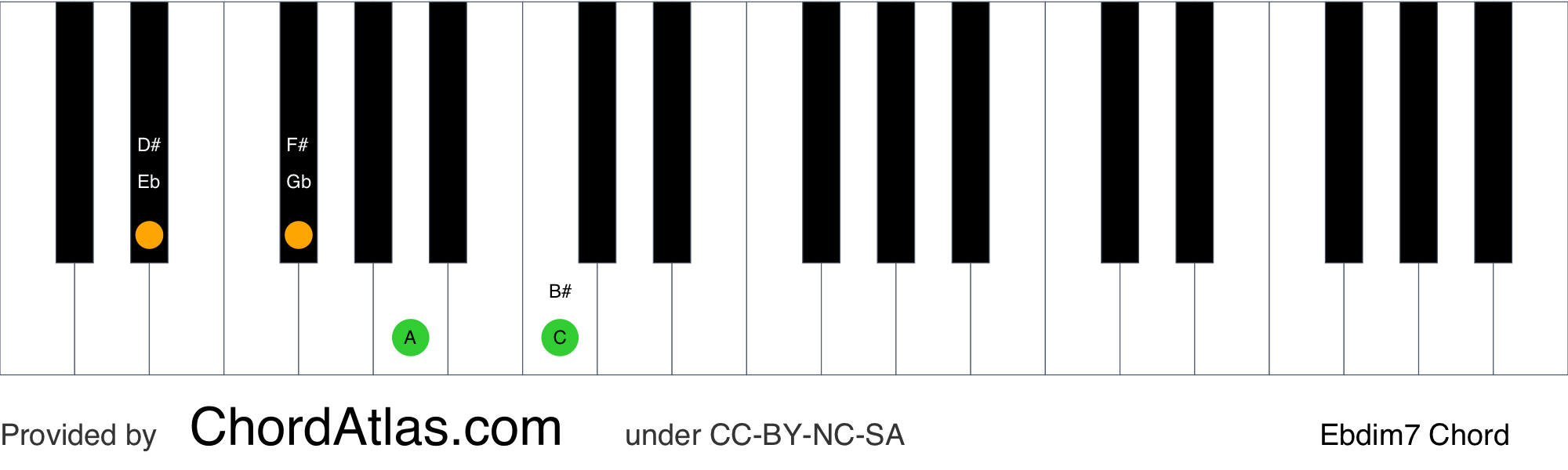
A fascinating aspect of the diminished seventh chord is its enharmonic equivalence. This means that the same set of pitches can be spelled in different ways, leading to different theoretical interpretations but the same sonic outcome. For instance, a Cdim7 chord (C, Eb, Gb, Bbb) contains the same pitches as a G#dim7 chord (G#, B, D, F), or an Edim7 chord (E, G, Bb, Db).
This enharmonic nature makes the diminished seventh chord incredibly versatile. It can function as a passing chord, seamlessly connecting seemingly unrelated chords. Because it contains multiple tritones that can resolve in various ways, it offers a multitude of harmonic possibilities. In a digital audio workstation (DAW), this means that a single diminished seventh chord can be easily transposed and re-spelled to fit different harmonic contexts without requiring the input of entirely new notes.
The Sonic Character of the Diminished 7th
The distinctive sound of the diminished seventh chord is what makes it so impactful in music. It’s a sound that can stir emotions and create a sense of anticipation.
Tension, Suspense, and Release
The inherent dissonance of the diminished seventh chord, primarily due to the presence of two tritones, creates a strong sense of tension. This tension naturally pulls towards resolution. When placed in a musical context, it begs to be resolved to a more consonant chord. This push and pull between tension and release is a fundamental element of musical expression.
Composers use this characteristic to:
- Create suspense: In film scores, a diminished seventh chord can signal danger, mystery, or an impending dramatic event.
- Drive harmonic progression: It acts as a pivot, allowing for unexpected yet logical transitions between chords. For example, a Cdim7 chord can resolve to a Fmaj7 chord, or a G7 chord, among many other possibilities.
- Add emotional depth: The melancholic or unsettling quality can evoke a range of emotions, from unease to profound introspection.
The diminished seventh chord’s ambiguity also contributes to its power. Because it can be interpreted in multiple ways (due to its enharmonic nature), it offers a rich palette for exploration. In digital music production, this ambiguity can be harnessed to create unique and evolving soundscapes.
Timbre and Texture in Digital Music
While the fundamental structure of a diminished seventh chord remains constant, its sonic character can be greatly influenced by timbre and texture, especially in digital music production.
- Instrumentation: The instrument playing the chord significantly alters its perception. A diminished seventh played on a distorted electric guitar will sound very different from one played on a shimmering synth pad or a sparse piano.
- Effects Processing: Digital effects such as reverb, delay, chorus, and distortion can further shape the sound. Reverb can make the chord sound vast and ethereal, while distortion can amplify its gritty, dissonant qualities.
- Arrangement: The way the diminished seventh chord is integrated into the overall arrangement – its density, its placement in the mix, and its relationship with other musical elements – will profoundly impact its perceived emotional weight. A single, sustained diminished seventh chord in an otherwise sparse arrangement will have a far greater dramatic impact than if it were buried within a dense orchestral texture.
In DAWs, producers have precise control over these elements, allowing them to sculpt the diminished seventh chord’s sound to perfectly suit their artistic vision. This level of control over timbre and texture is a hallmark of modern music production.
Applications in Digital Music Production
The diminished seventh chord, with its rich harmonic possibilities and evocative sound, finds numerous applications within the realm of digital music production and technology.
Harmonic Exploration and Chord Progressions
The versatility of the diminished seventh chord makes it a favorite for composers and producers looking to move beyond conventional harmonic structures.
Passing Chords and Modulation
Diminished seventh chords are frequently used as passing chords. These are chords inserted between two other chords to create a smoother or more interesting transition. Due to their symmetrical structure and enharmonic properties, diminished seventh chords can act as bridges between any two chords, allowing for seamless modulation (changing keys).
For instance, a diminished seventh chord built on the leading tone of a key can resolve to the tonic chord of that key. However, its diminished nature allows it to also function as a secondary dominant or to lead to chords in distant keys. This makes it an invaluable tool for creating harmonic surprise and complexity without sounding chaotic. In a DAW, this can be achieved by selecting a diminished seventh chord from a chord library, placing it strategically in a MIDI editor, and experimenting with its resolutions.
Creating Tension and Release in Electronic Music
In genres like electronic dance music (EDM), ambient, and cinematic electronic scores, the diminished seventh chord is used to build anticipation and create dramatic tension. A producer might use a sustained, filtered diminished seventh chord to introduce a new section of a track, with the tension gradually increasing as other elements are added or as the chord itself evolves through filtering or automation.
The release from this tension can be sudden and impactful, often leading into a more consonant and driving section of the track. This use of tension and release is a fundamental aspect of creating compelling sonic narratives, and the diminished seventh chord is a prime candidate for generating that crucial tension.
Advanced Chord Voicings and Sound Design
Beyond its traditional harmonic function, the diminished seventh chord can be a foundation for creative sound design in digital environments.
Cluster Chords and Dissonant Textures
By stacking additional notes onto a diminished seventh chord, or by subtly detuning its components, producers can create complex cluster chords and highly dissonant textures. These can be used for atmospheric pads, unsettling sound effects, or even as percussive elements in experimental electronic music.
DAWs provide tools for precise note manipulation, allowing producers to create microtonal variations or to build chords that extend beyond the traditional diatonic framework. A diminished seventh chord can be the starting point for exploring these avant-garde sonic territories.
Algorithmic Composition and Generative Music
The symmetrical and enharmonically rich nature of the diminished seventh chord makes it a prime candidate for algorithmic composition and generative music. Algorithms can be programmed to explore the various inversions and enharmonic spellings of diminished seventh chords, generating unique and evolving musical passages.
Software applications designed for algorithmic composition often utilize parameters that can be set to favor or explore specific harmonic structures, including the diminished seventh. This allows for the creation of music that is both structured and unpredictable, pushing the boundaries of musical creativity with technological assistance.
In conclusion, the diminished seventh chord, far from being merely a theoretical curiosity, is a vital and dynamic element in the modern musician’s toolkit, especially within the context of digital music production. Its ability to create tension, facilitate harmonic movement, and serve as a basis for innovative sound design ensures its continued relevance and exploration in the ever-evolving landscape of music technology.
aViewFromTheCave is a participant in the Amazon Services LLC Associates Program, an affiliate advertising program designed to provide a means for sites to earn advertising fees by advertising and linking to Amazon.com. Amazon, the Amazon logo, AmazonSupply, and the AmazonSupply logo are trademarks of Amazon.com, Inc. or its affiliates. As an Amazon Associate we earn affiliate commissions from qualifying purchases.