
The realm of physics, particularly the foundational principles of motion, hinges on understanding the concept of forces. While forces can exist in equilibrium, often the most dynamic and consequential interactions occur when an unbalanced force is applied to an object. This imbalance is the catalyst for change, the initiator of motion, and the determinant of how that motion evolves. In essence, an unbalanced force is the fundamental trigger for altering an object’s state of motion, a principle that resonates deeply within technological applications, from the intricate movements of robotics to the sophisticated navigation of autonomous systems.

The Fundamental Principle: Newton’s Laws in Action
At the heart of this phenomenon lies Isaac Newton’s second law of motion. This law, perhaps the most crucial in classical mechanics, directly addresses the relationship between force, mass, and acceleration. It states that the acceleration of an object is directly proportional to the net force acting on it and inversely proportional to its mass. Mathematically, this is expressed as $F{net} = ma$, where $F{net}$ is the net force, $m$ is the mass, and $a$ is the acceleration. This equation is not merely a theoretical construct; it forms the bedrock of countless technological designs and operational parameters. When an unbalanced force acts on an object, it inherently possesses a net force greater than zero, leading to a change in its velocity, which is acceleration.
Inertia and the Resistance to Change
Before delving into the direct effects of unbalanced forces, it’s crucial to acknowledge the inherent property of an object that resists changes in its state of motion: inertia. Newton’s first law of motion, often referred to as the law of inertia, posits that an object at rest will stay at rest, and an object in motion will continue in motion with the same speed and in the same direction unless acted upon by an unbalanced force. Inertia is directly proportional to an object’s mass; the more massive an object, the greater its inertia and the more difficult it is to change its state of motion. This resistance is a fundamental consideration in any technological system involving moving parts. For instance, engineers designing a high-speed train must account for its immense inertia, which necessitates powerful braking systems to decelerate it effectively. Conversely, to accelerate such a massive object requires a substantial unbalanced force.
Defining Net Force and Equilibrium
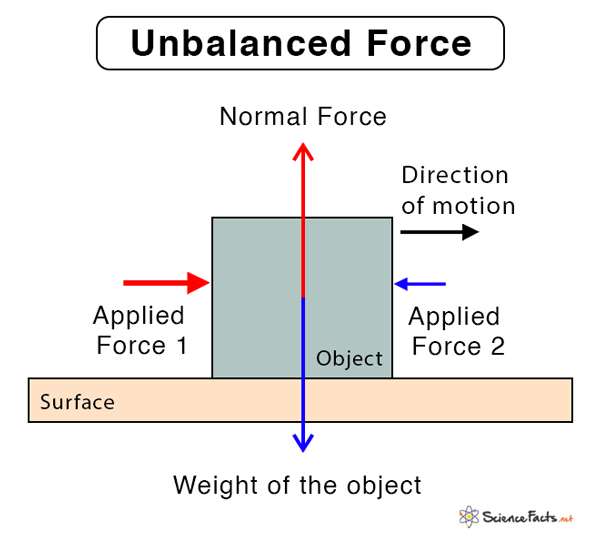
The term “unbalanced force” is intrinsically linked to the concept of “net force.” When multiple forces act on an object, the net force is the vector sum of all these forces. If the vector sum of all forces acting on an object is zero, the forces are said to be in equilibrium. In this state, the object’s velocity remains constant (which could be zero, meaning it’s at rest). However, when the net force is not zero, meaning the forces are not balanced, an unbalanced force exists. This imbalance dictates the direction and magnitude of the object’s acceleration. In technological contexts, understanding and manipulating net forces is paramount. Consider a drone: its rotors generate upward forces, counteracting gravity. To ascend, the upward force from the rotors must exceed the downward force of gravity, creating an unbalanced upward force. To hover, these forces must be balanced.
The Manifestation of Motion: Acceleration and Velocity Change
The most immediate and defining consequence of an unbalanced force is acceleration. This acceleration manifests as a change in the object’s velocity, which encompasses both its speed and its direction. This principle is the driving force behind virtually every moving component in technology.
Changes in Speed
When an unbalanced force acts in the same direction as an object’s motion, its speed increases. Conversely, if the unbalanced force acts in the opposite direction of motion, the object slows down, or decelerates. This is fundamental to control systems. For example, in an automated manufacturing line, robotic arms accelerate to pick up components and decelerate to place them precisely. The forces applied by the motors and actuators are carefully calibrated to achieve these controlled changes in speed. In autonomous vehicles, braking systems apply an unbalanced force to reduce speed, and engines provide an unbalanced force to increase it, all precisely managed by complex algorithms.
Changes in Direction
An unbalanced force acting perpendicular to an object’s direction of motion will cause it to change direction without necessarily changing its speed. This is the principle behind centripetal force, which is the force that keeps an object moving in a circular path. In technology, this is evident in systems like orbital mechanics for satellites, where the gravitational pull acts as an unbalanced force causing continuous change in direction, keeping them in orbit. Similarly, in high-performance vehicles, turning involves an unbalanced force (provided by friction between the tires and the road) acting perpendicular to the direction of travel, causing the vehicle to curve. The design of gyroscopes, crucial for stabilization in many devices from smartphones to aircraft, relies heavily on managing rotational forces that induce changes in direction of spinning components.
Beyond Simple Motion: Momentum and Energy Transfer
The impact of an unbalanced force extends beyond just altering an object’s velocity. It also plays a critical role in the transfer of momentum and energy, concepts that are central to understanding the dynamic interactions within technological systems.
Momentum: The Quantity of Motion
Momentum ($p$) is defined as the product of an object’s mass and its velocity ($p = mv$). According to Newton’s second law, a net force acting over a period of time (an impulse) causes a change in momentum. This is often expressed as $F{net} = Delta p / Delta t$, or $F{net} Delta t = Delta p$. This means an unbalanced force applied for a duration imparts momentum to an object or alters its existing momentum. In the context of technology, this is vital for understanding collisions and impacts. For instance, in the development of safety features like airbags in vehicles, the understanding of impulse and momentum transfer is crucial. The airbag deploys to increase the time over which the person’s momentum changes, thus reducing the peak force they experience. In sports technology, analyzing the momentum transfer during ball strikes (e.g., tennis rackets, baseball bats) informs the design of equipment for optimal performance.
Energy Transformation and Work
When an unbalanced force acts on an object and causes displacement, it does work ($W$). Work is defined as force multiplied by the distance over which the force is applied ($W = F cdot d$). This work results in a change in the object’s kinetic energy, the energy of motion. The work-energy theorem states that the net work done on an object is equal to the change in its kinetic energy ($Delta KE = W$). In technological applications, this is the principle behind engines and motors. The chemical energy in fuel is converted into mechanical work by an engine, which then applies an unbalanced force to propel a vehicle, increasing its kinetic energy. Similarly, electric motors use electromagnetic forces to do work, driving everything from electric car wheels to robotic manipulators. Understanding energy transfer is key to designing efficient systems, minimizing energy loss, and maximizing output.
Practical Implications and Technological Applications
The principles governing unbalanced forces are not abstract academic concepts; they are the practical underpinnings of countless technological advancements that shape our modern world.
Robotics and Automation
In robotics, the precise movement and manipulation of objects are entirely dependent on the controlled application of unbalanced forces. Robotic arms are designed with actuators that generate specific forces to accelerate, decelerate, and change the direction of their end-effectors. For a robotic arm to pick up a delicate component, it must apply just enough force to grip it without crushing it, and then an unbalanced force to lift and move it to its destination. Path planning algorithms for robots constantly calculate the forces required to navigate complex environments and perform tasks efficiently, all while respecting the object’s inertia and the limitations of the robotic system.
Aerospace and Transportation
The design and operation of aircraft, spacecraft, and vehicles are fundamentally dictated by unbalanced forces. A rocket’s ascent is powered by the unbalanced upward thrust from its engines overcoming gravity and air resistance. Maintaining an aircraft’s altitude involves balancing lift and drag with gravity and thrust. Braking systems in cars and trains rely on friction to generate an unbalanced force that slows them down. The trajectory of a spacecraft is meticulously calculated by considering the gravitational forces of celestial bodies, which act as unbalanced forces guiding its path through the cosmos. Even the simple act of steering a bicycle involves an unbalanced force applied by the rider to turn the handlebars, which in turn causes the wheels to change direction.

Material Science and Structural Engineering
Understanding how materials behave under stress, which is essentially the application of forces, is crucial in material science and structural engineering. When a material is subjected to a load, internal forces develop within it. If these internal forces are unbalanced, they can lead to deformation, fracture, or failure. Engineers use principles of mechanics, including the behavior of unbalanced forces, to design bridges, buildings, and manufactured goods that can withstand the expected loads. The study of stress and strain, and how materials yield or break, is directly related to how unbalanced forces overcome the material’s internal cohesive forces. For instance, designing a bridge requires calculating the maximum unbalanced forces the structure will experience due to traffic, wind, and its own weight, and ensuring its components can withstand these forces without succumbing to material fatigue or catastrophic failure.
In conclusion, the simple yet profound concept of an unbalanced force acting on an object is a cornerstone of physics and a vital principle in technological innovation. It is the fundamental driver of all non-uniform motion, enabling everything from the smallest micro-robot to the grandest interstellar spacecraft. By understanding and harnessing these forces, engineers and scientists continue to push the boundaries of what is possible, creating technologies that enhance our lives and expand our understanding of the universe.
aViewFromTheCave is a participant in the Amazon Services LLC Associates Program, an affiliate advertising program designed to provide a means for sites to earn advertising fees by advertising and linking to Amazon.com. Amazon, the Amazon logo, AmazonSupply, and the AmazonSupply logo are trademarks of Amazon.com, Inc. or its affiliates. As an Amazon Associate we earn affiliate commissions from qualifying purchases.