
The Earth’s rotation is a fundamental constant, a silent choreographer of our daily lives and the very fabric of our planet’s systems. We take it for granted, much like the air we breathe. But what if this constant were to abruptly cease? The implications are, to put it mildly, catastrophic. While the scientific community generally agrees that a sudden stop is astronomically improbable, exploring this hypothetical scenario allows us to delve into the profound interconnectedness of our planet’s systems and, importantly, to highlight the critical role of technology in mitigating even the most extreme of imagined disasters. This article will explore the technological fallout of a non-rotating Earth, focusing on the immediate and long-term challenges and the hypothetical technological interventions that might be conceived, however fantastical, to address them.
The Immediate Technological Apocalypse: Inertia and Atmospheric Fury
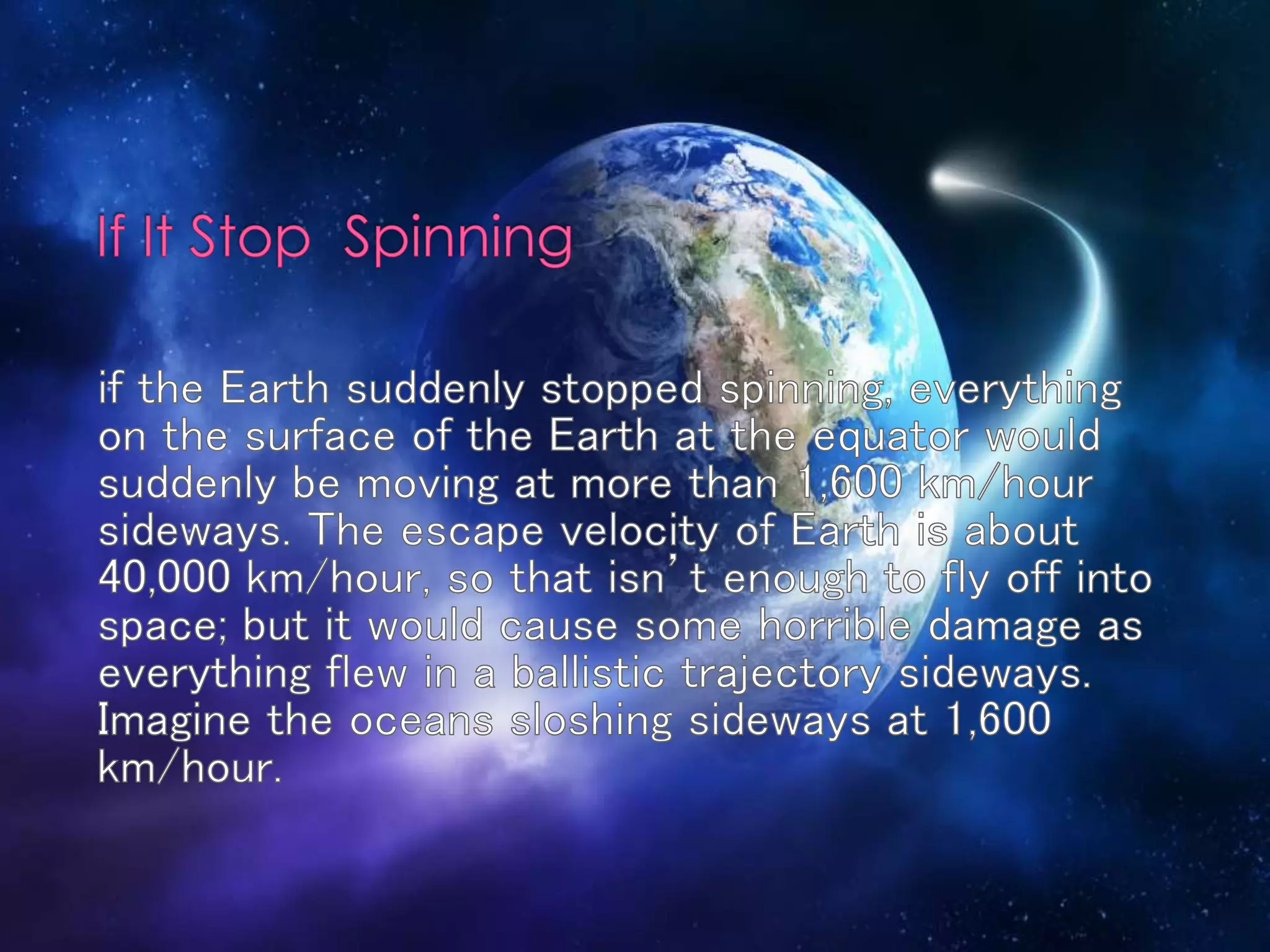
The most immediate and devastating consequence of Earth halting its rotation would be the staggering inertia. Everything not firmly anchored to the planet’s core would continue moving at the speed Earth was previously rotating. At the equator, this speed is approximately 1,670 kilometers per hour (1,038 miles per hour). The kinetic energy involved is immense, and its sudden release would be an unparalleled disaster for human civilization and the natural world.
The Great Scouring: Infrastructure Obliteration and Survival Systems
Imagine the effect of this sudden deceleration on our meticulously built infrastructure. Buildings, bridges, roads, and vehicles would be ripped from their foundations and flung eastward at supersonic speeds. Any structure not designed to withstand such forces, which is virtually all of them, would be instantly pulverized.
From a technological perspective, this means the complete annihilation of our existing power grids, communication networks, and transportation systems. Satellites in low Earth orbit, while not directly subjected to the planet’s surface inertia, would experience significant orbital perturbations due to the change in Earth’s gravitational field and potential atmospheric effects. This would render GPS systems useless and disrupt satellite communications.
Survival would hinge on the existence of highly resilient, deeply buried, or self-sufficient technological enclaves. Think of advanced subterranean shelters, akin to hyper-fortified bunkers, equipped with independent power generation (geothermal, nuclear), closed-loop life support systems, and robust communication arrays capable of penetrating the devastated surface environment. These hypothetical havens would need to be designed with materials science breakthroughs far beyond our current capabilities to withstand the immense seismic shocks and atmospheric turbulence. Robotic systems, pre-programmed for autonomous operation and repair, would be crucial for any attempt to clear debris or assess external conditions.
The Atmospheric Cataclysm: Wind, Debris, and the Sky’s Demise
The atmosphere, also possessing significant inertia, would continue to move at its previous velocity relative to the now-stationary ground. This would generate winds of unimaginable speed, far exceeding any hurricane or tornado ever recorded. These super-winds would scour the Earth’s surface, stripping away soil, vegetation, and anything else not firmly embedded in bedrock. The friction generated by this atmospheric torrent would also lead to widespread fires and a dramatic increase in global temperatures, at least temporarily.
Technologically, this presents an insurmountable challenge for conventional weather forecasting and disaster management. Our current meteorological instruments would be destroyed instantly. The only hope for any form of atmospheric monitoring would be through extremely high-altitude, hardened sensor platforms, perhaps deployed from the few remaining operational satellites or advanced stratospheric balloons. Data transmission from these platforms would require highly robust, encrypted, and redundant communication channels, resilient to the electromagnetic chaos likely to ensue. The development of atmospheric shielding technologies, perhaps utilizing advanced magnetic fields or localized atmospheric containment, would be the ultimate, albeit highly speculative, technological dream in such a scenario.
The Long Sleep: Climate Chaos and the Dawn of New Technologies
Assuming humanity, or at least a fragment of it, survived the initial cataclysm, the long-term consequences of a non-rotating Earth would reshape the planet in profound and terrifying ways, necessitating entirely new technological paradigms for survival and adaptation.
The Perpetual Day and Night: Thermal Extremes and Energy Solutions
Without rotation, one hemisphere would perpetually face the sun, leading to an unimaginable rise in temperature, boiling oceans, and desiccated landscapes. The opposite hemisphere would be plunged into perpetual darkness and extreme cold, freezing oceans and creating vast ice sheets. The terminator, the line between day and night, would become a zone of extreme temperature gradients and violent weather phenomena.
This stark division would render most of the planet uninhabitable. However, it also presents unique, albeit challenging, energy opportunities. The sun-drenched side would receive constant solar radiation, offering an inexhaustible energy source. Advanced solar energy capture and transmission technologies would be paramount. Imagine vast orbital solar farms beaming power wirelessly to subterranean or polar settlements. Conversely, the dark side might offer opportunities for advanced geothermal energy extraction, tapping into the Earth’s internal heat in areas where the surface is not entirely frozen.

The challenge lies in distributing this energy. Massive, ultra-efficient, and highly resilient energy transmission grids, perhaps employing superconducting materials and shielded conduits, would be required to bridge the immense temperature and geographical divides. Novel energy storage solutions, capable of handling the immense surpluses generated on the sunlit side and the constant demand on the dark side, would be indispensable. This could involve advanced battery technologies, hydrogen storage, or even the hypothetical creation of artificial energy sinks.
The Reimagined Atmosphere: Habitable Bubbles and Climate Control Technologies
The atmosphere, once scoured clean by inertia, would eventually settle into a new, albeit radically different, equilibrium. However, the perpetual temperature extremes would make widespread atmospheric habitation impossible. Life would likely be confined to technologically engineered, climate-controlled environments.
This could manifest as massive, sealed biomes or habitats, perhaps built into existing geological formations or constructed from advanced, self-repairing materials. These “habitable bubbles” would require sophisticated life support systems, capable of precisely controlling temperature, humidity, atmospheric composition, and pressure. AI-driven environmental management systems would be essential, constantly monitoring and adjusting conditions to maintain habitability.
The creation of artificial magnetospheres or localized atmospheric containment fields might become necessary to protect these habitats from the increased solar and cosmic radiation that would bombard the planet without the dynamic protection offered by a rotating, magnetic field-generating Earth. Furthermore, advanced water purification and recycling technologies would be crucial, as traditional sources would be either frozen solid or evaporated.
The Unforeseen: The Technological Arms Race of a Stationary Earth
The cessation of Earth’s rotation would not just be an environmental and infrastructural crisis; it would likely trigger a profound shift in human society and, by extension, our technological priorities. Survival would become the singular focus, potentially leading to a race for technological dominance among surviving factions.
Resource Scarcity and the Rise of Autonomous Systems
With vast swathes of the planet rendered uninhabitable and traditional resource extraction methods destroyed, competition for remaining habitable zones and vital resources would intensify. This would drive the development of highly efficient, autonomous resource acquisition technologies.
Robotic mining operations, capable of operating in extreme conditions, would become commonplace. Advanced AI would be essential for planning and executing these operations, optimizing resource extraction, and managing supply chains in a fragmented and dangerous world. Drones and unmanned vehicles would be the primary means of exploration, reconnaissance, and transportation, navigating treacherous terrains and atmospheric conditions.
The development of closed-loop manufacturing and recycling systems would be critical, minimizing waste and maximizing the utilization of every available atom. 3D printing and additive manufacturing, capable of creating complex tools and components on demand from raw materials or recycled components, would be indispensable for maintaining and expanding technological infrastructure.
Communication in the Void: Interstellar Aspirations and Existential Networks
The communication challenges would be immense. Traditional radio waves might be severely disrupted by atmospheric and electromagnetic phenomena. This could spur the development of entirely new communication modalities, perhaps leveraging quantum entanglement for instantaneous, secure communication across vast distances.
With the Earth’s surface effectively hostile, surviving human populations might turn their gaze outwards, not just for resources but for a new home. This would accelerate the development of advanced propulsion systems and life support technologies for interstellar travel, driven by the existential threat of being confined to a dying planet. The development of robust, long-term interstellar communication networks would also become a priority, connecting any nascent off-world colonies.
Conversely, within surviving Earth-bound communities, the need for secure and resilient communication would lead to the creation of highly decentralized and hardened networks. These “existential networks” would be designed to withstand extreme damage and maintain connectivity even in the most chaotic environments, prioritizing redundancy and survivability above all else.

Conclusion: A Technological Thought Experiment in Resilience
The hypothetical scenario of Earth ceasing to rotate serves as a stark reminder of our planet’s delicate balance and our profound dependence on its predictable rhythms. While the immediate aftermath would be an almost incomprehensible technological apocalypse, the long-term implications would force humanity to innovate at an unprecedented pace. The challenges posed by perpetual day and night, extreme temperatures, and a devastated environment would necessitate the development of technologies that currently exist only in the realm of science fiction. From self-sustaining biospheres and advanced energy transmission to autonomous resource management and interstellar communication, the survival of humanity on a non-rotating Earth would depend on our ability to engineer solutions to problems of unimaginable scale. This thought experiment, while rooted in a highly improbable event, underscores the vital importance of technological advancement, not just for progress, but for the ultimate resilience of our species in the face of even the most extreme hypothetical adversities. It highlights that in the face of planetary catastrophe, our ingenuity and our capacity for technological adaptation are our greatest, and perhaps only, hope.
aViewFromTheCave is a participant in the Amazon Services LLC Associates Program, an affiliate advertising program designed to provide a means for sites to earn advertising fees by advertising and linking to Amazon.com. Amazon, the Amazon logo, AmazonSupply, and the AmazonSupply logo are trademarks of Amazon.com, Inc. or its affiliates. As an Amazon Associate we earn affiliate commissions from qualifying purchases.