
The world of electronics and digital systems often relies on clever solutions to manage complexity and optimize resource utilization. At the heart of many such systems lies a fundamental component known as the multiplexer, or MUX. While its name might sound technical, its function is elegantly simple and remarkably impactful. A multiplexer acts as a data selector, allowing multiple input signals to share a single output line. Think of it as a sophisticated switchboard operator for data, directing the right information to the right destination at the right time. This ability to consolidate and route signals makes multiplexers indispensable in a vast array of technological applications, from the microprocessors within your smartphone to the complex networks that power the internet.

The Fundamental Role of Data Selection
At its core, a multiplexer is designed to solve the problem of limited communication channels. Imagine a scenario where you have several devices that need to send data, but you only have one wire or communication path available. Without a multiplexer, you would either need to have a dedicated wire for each device, which would be incredibly inefficient and costly, or you would have to constantly switch the single wire between devices, a process that is slow and prone to errors. The multiplexer elegantly bypasses these limitations by acting as a dynamic selector.
Input and Output Channels: The Core Mechanics
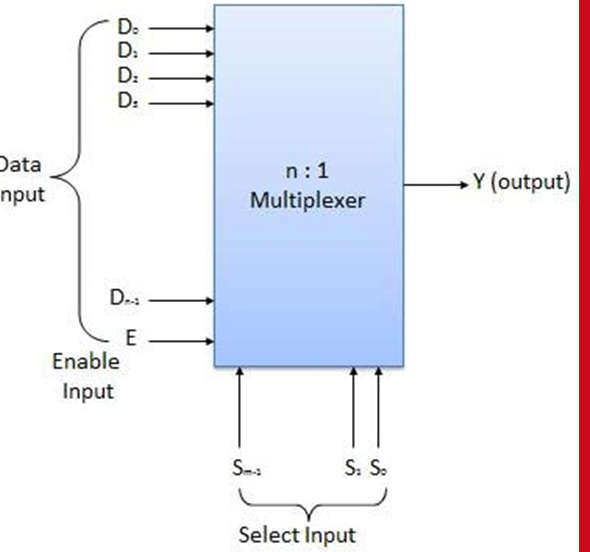
A multiplexer fundamentally consists of multiple input lines, a single output line, and a set of select lines. The select lines are crucial; they determine which of the input lines is currently connected to the output line. The number of select lines dictates how many input lines the multiplexer can handle. For instance, a multiplexer with one select line can choose between two input lines (2^1 = 2). A multiplexer with two select lines can choose between four input lines (2^2 = 4), and so on. The relationship is described by the formula: Number of Inputs = 2^n, where ‘n’ is the number of select lines.
When a specific combination of binary signals is applied to the select lines, the multiplexer internally activates a switch, connecting the corresponding input line to the output. All other input lines are effectively disconnected. This allows a single output channel to carry data from any of the multiple input sources, but only one at a time. The speed at which this switching can occur is incredibly high, often measured in nanoseconds, making it seamless for digital systems.
The Analogy of a Rotary Switch
A helpful analogy for understanding a multiplexer is a rotary switch. Imagine a central output terminal and several input terminals arranged in a circle. A movable pointer, controlled by a separate mechanism, can be positioned to connect the central output terminal to any one of the input terminals. In this analogy, the input terminals are the multiplexer’s data inputs, the output terminal is the multiplexer’s single output, and the mechanism that moves the pointer is analogous to the select lines. The rotary switch allows you to select one of many inputs to be connected to a single output.
Enabling Resource Sharing and Efficiency
The primary benefit of this data selection capability is efficient resource sharing. In digital circuits, wires and communication pathways represent physical resources. By using multiplexers, designers can significantly reduce the number of wires required, leading to smaller, less expensive, and more power-efficient circuits. Instead of dedicating separate communication lines to every potential data source, a single line can be time-shared amongst them. This is especially critical in integrated circuits (ICs) where space is at a premium.
Applications Across the Digital Landscape
The fundamental principle of data selection makes multiplexers vital components in a wide spectrum of digital systems. Their ability to consolidate and route information is not just a theoretical concept; it’s a practical necessity that underpins many of the technologies we rely on daily.
Within Microprocessors and CPUs
Inside the complex architecture of a modern microprocessor or Central Processing Unit (CPU), multiplexers play a critical role in managing the flow of data. CPUs have numerous functional units, registers, and memory interfaces. Data needs to be moved between these components for processing. Multiplexers are used extensively to select the correct data to be fed into an Arithmetic Logic Unit (ALU), to route data from different registers to the bus, or to select the appropriate instruction from a program counter. For example, when the CPU needs to perform an addition, a multiplexer might select the values from two different registers to be sent to the ALU. Similarly, after the ALU performs an operation, a multiplexer can direct the result to the correct destination register.
Memory Systems and Data Buses
Memory systems, including RAM (Random Access Memory) and ROM (Read-Only Memory), also heavily utilize multiplexers. When data is read from or written to a specific memory location, the address of that location needs to be communicated to the memory controller. The address bus, which carries this information, can be shared by multiple devices or components. Multiplexers are used to select the appropriate address to be sent to the memory. Furthermore, within the memory chip itself, multiplexers are employed to select which memory cells will be accessed for a given read or write operation. The data bus, which carries the actual data, also benefits from multiplexer-based routing to efficiently move data between the CPU, memory, and other peripherals.
Communication Networks and Switching
In the realm of telecommunications and computer networking, multiplexers are foundational to efficient data transmission. In broadband communication systems, different data streams from multiple users are combined by a multiplexer at one end of a transmission line and then separated by a corresponding demultiplexer at the other end. This technique, known as multiplexing, allows a single physical communication channel to carry multiple independent signals simultaneously, vastly increasing the capacity and efficiency of the network. This is how multiple phone calls can travel over a single fiber optic cable or how various internet data packets are routed through shared infrastructure.
Types of Multiplexers: Tailoring Functionality
While the core concept of selecting one input from many remains constant, multiplexers come in various forms, each optimized for specific applications and levels of complexity. These variations are primarily distinguished by their internal construction and how they handle the selection process.
The 2-to-1, 4-to-1, and 8-to-1 Architectures
The simplest multiplexers are often described by their input-to-output ratio. A 2-to-1 multiplexer has two data inputs and one output, controlled by a single select line. A 4-to-1 multiplexer has four data inputs and one output, requiring two select lines (since 2^2 = 4). An 8-to-1 multiplexer has eight data inputs and one output, requiring three select lines (since 2^3 = 8). These basic building blocks are often combined to create larger multiplexers or to implement more complex logic functions. The internal circuitry of these multiplexers is typically constructed using logic gates like AND, OR, and NOT gates, or more advanced structures like transmission gates, to achieve the desired switching behavior.
Integrated vs. Discrete Multiplexers
Multiplexers can be implemented in two primary ways: as discrete components or as part of integrated circuits (ICs). Discrete multiplexers are individual electronic components that can be purchased and soldered onto a circuit board. These are often used in prototyping, educational settings, or in applications where only a few multiplexing functions are needed. In contrast, integrated multiplexers are built directly into ICs, such as microprocessors, FPGAs (Field-Programmable Gate Arrays), and ASICs (Application-Specific Integrated Circuits). This integration allows for much higher densities, lower power consumption, and faster operation, making them essential for modern electronic devices.
Analog vs. Digital Multiplexers
While the discussion so far has primarily focused on digital multiplexers, which handle binary signals, there are also analog multiplexers. Analog multiplexers are designed to switch and route continuous analog signals, such as audio or sensor readings. They are used in applications where the signals are not quantized into discrete digital values. For instance, in an oscilloscope, an analog multiplexer might be used to select which of several input signals is displayed on the screen at any given time. The underlying principle of selecting one input for a single output remains the same, but the internal components and signal handling differ significantly from their digital counterparts.
Beyond Basic Selection: Advanced Multiplexing Techniques
The versatility of multiplexers extends beyond simple data selection. By combining multiplexers with other logic elements or employing them in specific configurations, engineers can achieve more sophisticated functionalities, further enhancing the efficiency and capability of digital systems.
Implementing Logic Functions with Multiplexers
A fascinating aspect of multiplexers is their ability to implement arbitrary Boolean logic functions. Given a sufficient number of inputs and select lines, a multiplexer can be configured to perform the same function as a complex arrangement of AND, OR, and NOT gates. This is achieved by carefully mapping the truth table of the desired logic function to the inputs of the multiplexer. This capability allows designers to create highly integrated and efficient logic circuits, sometimes simplifying the overall design process. For example, a 4-to-1 multiplexer can be used to implement any three-variable logic function by appropriately connecting the inputs and select lines to the variables and their complements.
The Role in Data Acquisition Systems
In data acquisition systems, where analog signals from sensors are converted into digital data for processing, multiplexers are indispensable. A typical data acquisition system might have multiple sensors (e.g., temperature, pressure, humidity) providing analog inputs. A multiplexer is used to sequentially select each sensor’s output and route it to an Analog-to-Digital Converter (ADC). This allows a single, high-resolution ADC to be shared among multiple analog input channels, significantly reducing cost and complexity. The multiplexer is controlled by a microcontroller or a dedicated sequencer that cycles through the sensors at a predetermined rate, ensuring that all data points are captured.

Demultiplexers: The Complementary Component
To fully appreciate the function of a multiplexer, it’s important to understand its counterpart: the demultiplexer (DEMUX). While a multiplexer takes multiple inputs and outputs a single stream, a demultiplexer takes a single input and distributes it to one of multiple output lines. The select lines function in the same way, determining which output line receives the input data. Essentially, a demultiplexer is a data distributor. In communication systems, a multiplexer at the transmitting end combines multiple signals, and a demultiplexer at the receiving end separates them back into their original streams. They work in tandem to enable efficient and organized data transmission.
In conclusion, the multiplexer, a seemingly simple data selector, is a cornerstone of modern digital electronics. Its ability to efficiently manage and route data across shared resources is fundamental to the design and operation of everything from the smallest integrated circuits to the vast networks that connect our world. Understanding what a multiplexer does provides a crucial insight into the ingenious engineering that powers our technological landscape.
aViewFromTheCave is a participant in the Amazon Services LLC Associates Program, an affiliate advertising program designed to provide a means for sites to earn advertising fees by advertising and linking to Amazon.com. Amazon, the Amazon logo, AmazonSupply, and the AmazonSupply logo are trademarks of Amazon.com, Inc. or its affiliates. As an Amazon Associate we earn affiliate commissions from qualifying purchases.