
In the dynamic world of consumerism, where sales, promotions, and special offers are a constant, understanding and accurately calculating percent discounts is not just a handy skill—it’s a critical component of sound personal finance. From daily grocery runs to significant investment purchases, the ability to quickly determine the true value of a deal can translate into substantial savings over time. This article delves into the indispensable role of percent discount calculators, unpacks the underlying mathematics, guides you through finding the best tools, and illustrates how to leverage this knowledge for a more robust financial future.

The Core of Smart Spending: Understanding Percent Discounts
At its heart, a percent discount calculator is a gateway to financial empowerment. It’s more than just a tool; it represents a fundamental principle of effective money management: maximizing value and minimizing outflow. In an age of information overload, deciphering complex pricing structures and promotional jargon can be daunting. A reliable method for calculating discounts cuts through this noise, offering clarity and control.
Why Every Savvy Shopper Needs This Skill
For the financially astute individual, every purchase is an opportunity to make a smart decision. Without a clear understanding of percent discounts, even the most attractive “50% off!” banner can be misleading. Is a 30% discount on an item that was recently inflated truly a better deal than a 15% discount on a consistently priced competitor? The ability to accurately assess these scenarios, often in real-time, empowers consumers to distinguish genuine savings from marketing ploys. It shifts the power dynamic from seller to buyer, allowing you to make informed choices based on actual value rather than perceived urgency or flashy advertising.
Moreover, the psychological aspect of saving money cannot be overstated. Each successful discount calculation reinforces positive financial habits, fostering a sense of accomplishment and encouraging further diligence in spending. This isn’t just about saving a few dollars on a single item; it’s about cultivating a mindset that values every dollar and seeks to optimize its purchasing power.
The Financial Impact of Small Savings
Many might dismiss the impact of a small discount, thinking a few dollars here and there won’t move the needle significantly. However, this perspective overlooks the cumulative power of consistent, smart spending. Imagine saving an average of $5 per week on groceries by strategically leveraging discounts, or $20 a month on recurring subscriptions after reviewing offers. Over a year, these “small” savings amount to $260 and $240 respectively, totaling $500. This seemingly modest sum could cover a utility bill, contribute to an emergency fund, or even be invested, potentially growing further.
The true financial impact often becomes visible when applying this principle to larger purchases. A 10% discount on a $1,000 appliance saves $100. A 15% discount on a $30,000 car saves $4,500. These are not trivial amounts; they are funds that can be reallocated towards debt reduction, investment, or other financial goals. The percent discount calculator isn’t just about the immediate transaction; it’s a tool for long-term financial health, enabling better budgeting, fostering investment opportunities, and providing peace of mind.
Deconstructing the Math: How Percent Discounts are Calculated
Before diving into finding tools, it’s crucial to grasp the fundamental mathematics behind percent discounts. Understanding the calculation process demystifies the figures and builds a stronger foundation for financial literacy, ensuring you can verify any calculator’s output or even perform calculations mentally when a tool isn’t available.
The Fundamental Formula: Price, Discount, and Final Cost
The core of any percent discount calculation involves three key components:
- Original Price (P): The starting price of the item before any discount.
- Discount Percentage (D%): The percentage off the original price.
- Final Price (F): The price you pay after the discount is applied.
The calculation typically follows these steps:
Step 1: Calculate the Discount Amount.
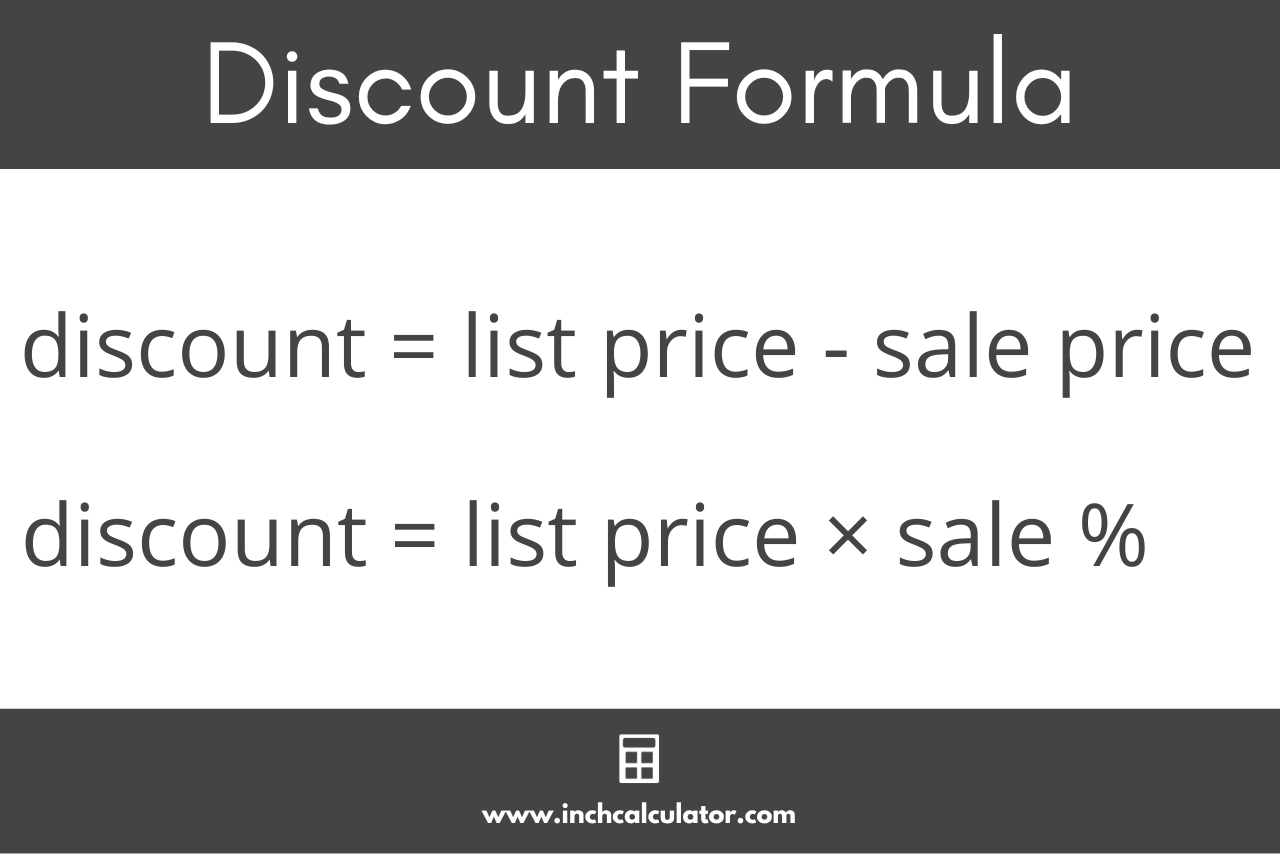
Discount Amount = Original Price × (Discount Percentage / 100)
For example, if an item is $100 with a 20% discount:
Discount Amount = $100 × (20 / 100) = $100 × 0.20 = $20
Step 2: Calculate the Final Price.
Final Price = Original Price – Discount Amount
Continuing the example:
Final Price = $100 – $20 = $80
Alternatively, you can calculate the final price directly by finding the percentage you do pay:
Final Price = Original Price × (100 – Discount Percentage) / 100
Using the same example:
Final Price = $100 × (100 – 20) / 100 = $100 × (80 / 100) = $100 × 0.80 = $80
This direct method is often quicker for mental calculations or when using a simple calculator.
Real-World Examples: From Groceries to Gadgets
Let’s put this into practice with everyday scenarios:
-
Grocery Shopping: You see a special offer: your favorite cereal, originally $4.50, is 25% off.
- Discount Amount = $4.50 × 0.25 = $1.125 (round to $1.13)
- Final Price = $4.50 – $1.13 = $3.37
- Alternatively (direct): $4.50 × 0.75 = $3.375 (round to $3.38)
Knowing this helps you compare if buying two at 25% off is better than one at full price, or if a different brand on sale is a better value.
-
Appliance Purchase: A new refrigerator costs $1,200, and there’s a 15% off sale this weekend.
- Discount Amount = $1,200 × 0.15 = $180
- Final Price = $1,200 – $180 = $1,020
This calculation immediately shows your savings and the actual cash outlay, helping you budget or compare with other stores.
-
Clothing Sale: A designer jacket, originally $300, is marked down by 40%.
- Discount Amount = $300 × 0.40 = $120
- Final Price = $300 – $120 = $180
This knowledge is crucial for understanding if the perceived ‘luxury’ item is now within your ‘value’ budget.
Understanding these calculations manually empowers you, even when a sophisticated tool isn’t immediately available, reinforcing your financial intelligence.
Your Digital Arsenal: Finding the Right Percent Discount Calculator Tool
While manual calculation is a valuable skill, digital tools offer speed, accuracy, and convenience, especially for complex scenarios or on-the-go decision-making. The “how to find” aspect of the original title largely refers to locating and choosing these digital aids.
Online Calculators: Convenience at Your Fingertips
The internet is brimming with free, web-based percent discount calculators. A quick search for “percent discount calculator” will yield numerous results. These tools are typically straightforward: you input the original price and the discount percentage, and it instantly provides the discount amount and final price.
Pros:
- Accessibility: Available on any device with an internet connection.
- Simplicity: User-friendly interfaces, often requiring minimal input.
- No Installation: No need to download software or apps.
Cons:
- Internet Dependent: Requires an active connection.
- Ad-Supported: Many free sites display ads, which can be distracting.
- Limited Features: Most are basic, not suitable for complex calculations (e.g., multiple discounts, tax inclusion).
How to Choose: Look for calculators on reputable financial websites (e.g., bank sites, personal finance blogs) to ensure accuracy and minimize ad intrusion. Test a few to find one with an interface you prefer.

Mobile Apps: Discounts on the Go
For smartphone users, dedicated discount calculator apps offer the ultimate convenience. These apps often go beyond basic percentage calculations, providing additional features valuable to savvy shoppers.
Pros:
- Offline Functionality: Many apps work without an internet connection.
- Quick Access: Always available on your phone, perfect for in-store shopping.
- Advanced Features: Some offer features like calculating sales tax, tip calculation, comparing multiple discounts, or even scanning barcodes.
- User Experience: Designed for mobile use, often intuitive and fast.
Cons:
- App Store Overload: Hundreds of options can make choosing difficult.
- Permissions: Some apps might request unnecessary device permissions.
- Potential Cost: While many are free, some premium apps offer more features for a fee.
How to Choose: Read reviews and check ratings in your device’s app store. Look for apps that are regularly updated, have a clean interface, and offer features that align with your specific shopping habits (e.g., tax calculation if you frequently shop across state lines).
Spreadsheet Solutions: Customization for Complex Scenarios
For those comfortable with tools like Microsoft Excel, Google Sheets, or Apple Numbers, creating your own discount calculator offers unparalleled flexibility and customization. This is particularly useful for tracking recurring expenses, managing inventory for a small business, or planning large purchases with multiple variables.
Pros:
- Full Customization: Design it exactly how you need it, adding columns for categories, dates, specific stores, etc.
- Integration: Easily integrate with budgeting spreadsheets or financial trackers.
- Complex Calculations: Handle scenarios with multiple discounts, sales tax, shipping costs, or even compare different pricing models.
- Learning Opportunity: Enhances spreadsheet skills, a valuable asset in personal and professional life.
Cons:
- Initial Setup Time: Requires some effort to create and configure.
- Learning Curve: Assumes basic knowledge of spreadsheet functions and formulas.
- Less Portable: Not as quick for on-the-spot calculations as an app, unless accessed via a cloud service.
How to Create: Use a simple formula: =Original_Price * (1 - Discount_Percentage/100). Expand on this by adding columns for tax, shipping, and total cost, allowing you to dynamically input values and see immediate results.
The Power of Mental Math: Quick Estimates for Everyday Deals
Sometimes, a digital tool isn’t necessary or feasible. Developing mental math skills for discounts is incredibly empowering. It allows for quick, on-the-fly estimations, preventing buyer’s remorse and enabling rapid decision-making.
Strategies:
- Find 10%: To find 10%, move the decimal one place to the left. For example, 10% of $75 is $7.50.
- Build from 10%:
- 20% off: Double the 10% amount (2 x $7.50 = $15).
- 5% off: Halve the 10% amount ($7.50 / 2 = $3.75).
- 15% off: 10% + 5% ($7.50 + $3.75 = $11.25).
- 25% off: Find 10%, then another 10%, then 5%. Or, simply divide by 4.
- 50% off: Halve the original price.
- Round and Estimate: For odd numbers, round the original price or the percentage to make mental calculation easier, then adjust. For example, 28% off $67 might be approximated as 30% off $70, which is $21. Then adjust slightly.
This mental agility not only saves time but also builds confidence in your financial decision-making process, making you a more discerning consumer.
Strategic Application: Maximizing Your Savings Beyond the Calculator
Having a percent discount calculator is one thing; using it strategically to genuinely maximize your savings is another. It’s about moving beyond the simple calculation and integrating discount awareness into your broader financial planning.
Comparing Deals: When is a Discount Truly a Bargain?
The presence of a discount doesn’t automatically equate to a good deal. Smart shoppers use their calculators to compare across multiple dimensions:
- Different Retailers: Is 20% off at Store A better than 15% off at Store B if Store B’s original price is lower? Always calculate the final price to compare apples to apples.
- Timing: Sometimes waiting for a bigger sale (e.g., Black Friday vs. a random mid-month promotion) can yield greater savings, but this needs to be weighed against urgency or stock availability.
- Multiple Discounts: Be wary of stacked discounts (e.g., “20% off store-wide, plus an extra 10% off if you use our card”). Understand if these are additive (30% off) or multiplicative (20% off, then 10% off the reduced price, which is slightly less than 30% off the original). Most retailers use multiplicative. *Example: $100 item, 20% off then 10% off. First, $100 – $20 = $80. Then, $80 – ($80 * 0.10) = $80 – $8 = $72. An additive discount would be $70.*
- Unit Price: For bulk items, calculate the per-unit price after discount to truly compare value, especially for groceries or household goods.
Avoiding Common Discount Traps
The retail world is adept at creating urgency and perceived value. Your discount calculator is your shield against these traps:
- Inflated Original Prices: Always cross-reference prices. Has the “original price” been artificially inflated just before the sale to make the discount seem larger? Use historical pricing tools if available (e.g., price trackers for online shopping).
- “Buy More, Save More”: While sometimes beneficial, ensure you genuinely need the extra items. Buying two for 30% off each when you only need one, still means you’ve spent money you might not have.
- Expiry Dates/Limited Stock: Don’t let fear of missing out (FOMO) push you into an unnecessary purchase. Calculate the actual savings and decide if it’s worth it for you, rather than for the retailer’s bottom line.
- Discounted Returns: Be aware of return policies for discounted items. Sometimes, deeply discounted items are final sale.
Integrating Discount Awareness into Your Budgeting
A percent discount calculator isn’t just for spontaneous shopping; it’s a powerful tool for proactive budgeting.
- Anticipate Savings: When planning a budget for a large purchase, factor in potential discounts you might seek out. This can reduce the target savings amount or free up funds for other categories.
- Track Actual Savings: Keep a running tally of the money you save through discounts. Seeing these figures grow can be incredibly motivating and helps visualize the tangible impact of your savvy shopping habits on your financial goals.
- Prioritize Spending: By accurately calculating discounts, you can better allocate your budget. Perhaps a deeply discounted essential item frees up funds to indulge in a small, guilt-free splurge, or contributes more significantly to your savings account.
Cultivating a Savvy Consumer Mindset: Long-Term Financial Benefits
The journey to mastering percent discount calculations culminates in a broader transformation: cultivating a perpetually savvy consumer mindset. This isn’t just about individual transactions; it’s about embedding a financially intelligent approach into your everyday life.
From Transactional Savings to Lifestyle Changes
Initially, using a percent discount calculator might feel like a tactical maneuver for each purchase. However, with consistent practice, it evolves into an intuitive part of your decision-making process. You begin to see the underlying value in every price, train yourself to question assumptions, and develop an eye for genuine opportunities. This shift can influence larger lifestyle choices:
- Delayed Gratification: Knowing that patience can yield greater savings on desirable items.
- Sustainable Consumption: Investing in higher-quality items at a discount that last longer, rather than cheap, disposable full-price purchases.
- Resourcefulness: Finding creative ways to source items at better prices, even if it means waiting or exploring different vendors.
This financial discipline extends beyond shopping, fostering a mindset of optimization and value across all areas of personal finance, from managing investments to negotiating bills.
Empowering Financial Literacy for All Ages
Teaching yourself and others how to effectively use a percent discount calculator is a vital step in promoting financial literacy. It’s a practical, relatable way to understand fundamental mathematical concepts and their direct impact on money.
- For Children and Teens: It demystifies money and math, showing tangible benefits of learning percentages and budgeting. It teaches them about value, consumerism, and responsible spending from an early age.
- For Adults: It reinforces budgeting skills, enhances confidence in financial decisions, and provides a clear pathway to achieving savings goals. It encourages a proactive approach to managing money, rather than a reactive one.
In conclusion, the simple act of “how to find a percent discount calculator” unlocks a world of financial opportunity. Whether you prefer online tools, mobile apps, custom spreadsheets, or the power of mental math, equipping yourself with this essential financial skill transforms you from a passive consumer into an empowered, strategic saver. It’s an investment in your financial future, one smart purchase at a time.
aViewFromTheCave is a participant in the Amazon Services LLC Associates Program, an affiliate advertising program designed to provide a means for sites to earn advertising fees by advertising and linking to Amazon.com. Amazon, the Amazon logo, AmazonSupply, and the AmazonSupply logo are trademarks of Amazon.com, Inc. or its affiliates. As an Amazon Associate we earn affiliate commissions from qualifying purchases.