
Understanding how interest is calculated on your savings account is a fundamental aspect of personal finance. It’s not just about seeing a number appear in your statement; it’s about comprehending the mechanics that allow your money to grow over time. This knowledge empowers you to make smarter decisions about where to keep your funds, helping you maximize your returns and accelerate your financial goals. While banks often handle these calculations automatically, a clear grasp of the underlying principles equips you to scrutinize statements, compare different savings products effectively, and truly appreciate the power of compound interest.

This guide will demystify the process, breaking down the essential concepts, walking you through manual calculation methods, and exploring the various factors that influence your earnings. By the end, you’ll not only know how to calculate interest but also how to think strategically about your savings to foster significant growth.
Understanding the Fundamentals of Savings Account Interest
Before diving into the numbers, it’s crucial to establish a solid foundation of what interest is and the various forms it takes in the context of savings accounts. This basic understanding is the bedrock upon which all calculations and financial decisions are built.
What is Interest?
At its core, interest is the cost of borrowing money or the reward for lending it. When you deposit money into a savings account, you are essentially lending your money to the bank. In return, the bank pays you interest as compensation for using your funds. This payment is typically expressed as a percentage of your deposited amount and is usually calculated over a year, though it can be applied more frequently. For savers, interest is the primary mechanism through which their principal investment generates additional wealth without active intervention.
Types of Interest: Simple vs. Compound
The distinction between simple and compound interest is perhaps the most critical concept for any saver to grasp. The long-term impact on your wealth can be dramatically different.
-
Simple Interest: Simple interest is calculated only on the initial principal amount. It remains constant over the investment period, assuming no additional deposits or withdrawals. While easier to calculate, it’s rarely used for standard savings accounts due to its limited growth potential. For example, if you deposit $1,000 at a 5% simple annual interest rate, you’d earn $50 each year, regardless of how long the money stays in the account.
-
Compound Interest: Compound interest is the interest calculated on the initial principal and also on all the accumulated interest from previous periods. This “interest on interest” effect is what makes compound interest so powerful over time. It means your money grows at an accelerating rate. Most modern savings accounts, especially high-yield ones, utilize compound interest, as do investments like stocks and bonds.
Key Terms: Principal, Interest Rate, Compounding Frequency
To accurately calculate interest, you need to understand these fundamental terms:
- Principal (P): This is the initial amount of money you deposit into your savings account, or the balance on which interest is being calculated.
- Interest Rate (r): Expressed as a percentage, this is the rate at which your principal will grow annually. It’s often referred to as the Annual Interest Rate (AIR) or Nominal Interest Rate. For calculations, you typically convert the percentage to a decimal (e.g., 2% becomes 0.02).
- Compounding Frequency (n): This refers to how often the interest is calculated and added back to your principal. Common frequencies include annually, semi-annually, quarterly, monthly, daily, or even continuously. The more frequent the compounding, the faster your money grows, assuming the same nominal interest rate.
- Time (t): This is the duration, in years, over which the interest is calculated.
Step-by-Step Guide to Manual Interest Calculation
While banks automate the process, understanding the manual calculation gives you crucial insight. Let’s explore how to calculate both simple and compound interest.
Simple Interest Calculation
The formula for simple interest is straightforward:
Simple Interest = P × r × t
Where:
- P = Principal
- r = Annual Interest Rate (as a decimal)
- t = Time (in years)
Example: You deposit $5,000 into an account offering a 3% simple annual interest rate.
Simple Interest = $5,000 × 0.03 × 1 = $150
After one year, your balance would be $5,000 + $150 = $5,150.
If the money stayed for 2 years, the interest would be $5,000 × 0.03 × 2 = $300, and the balance $5,300.
Compound Interest Calculation (Annual Compounding)
When interest is compounded annually, the process is slightly more involved than simple interest, as the interest earned each year is added to the principal for the next year’s calculation.
The formula for annually compounded interest is:
A = P × (1 + r)^t
Where:
- A = Future Value of the investment/loan, including interest
- P = Principal
- r = Annual Interest Rate (as a decimal)
- t = Time (in years)
To find just the interest earned, subtract the principal from A: Compound Interest = A – P.
Example: You deposit $5,000 into an account offering a 3% annual interest rate, compounded annually for 2 years.
Year 1:
- Interest = $5,000 × 0.03 = $150
- New Balance = $5,000 + $150 = $5,150
Year 2:
- Interest = $5,150 × 0.03 = $154.50
- New Balance = $5,150 + $154.50 = $5,304.50
Using the formula:
A = $5,000 × (1 + 0.03)^2
A = $5,000 × (1.03)^2
A = $5,000 × 1.0609
A = $5,304.50
Total Compound Interest = $5,304.50 – $5,000 = $304.50. Notice how this is slightly higher than the simple interest over the same period ($300).
Compound Interest Calculation (More Frequent Compounding)
Most savings accounts compound interest more frequently than annually (e.g., monthly or daily). This requires a slightly modified formula:
A = P × (1 + r/n)^(nt)
Where:
- A = Future Value
- P = Principal
- r = Annual Interest Rate (as a decimal)
- n = Number of times interest is compounded per year
- t = Time (in years)
Example: You deposit $5,000 into an account offering a 3% annual interest rate, compounded monthly for 2 years.
Here, r = 0.03, n = 12 (monthly compounding), t = 2.
A = $5,000 × (1 + 0.03/12)^(12*2)
A = $5,000 × (1 + 0.0025)^24
A = $5,000 × (1.0025)^24
A = $5,000 × 1.061757
A = $5,308.79
Total Compound Interest = $5,308.79 – $5,000 = $308.79.
This demonstrates that with the same annual rate, more frequent compounding leads to slightly higher earnings.
Factors Influencing Your Savings Account Interest Earnings
Beyond the basic formulas, several practical factors can significantly impact the actual interest you earn on your savings account. Being aware of these nuances allows you to compare products more effectively and choose the best fit for your financial strategy.
The Stated Annual Percentage Yield (APY)
When comparing savings accounts, you’ll often see the Annual Percentage Yield (APY) advertised. The APY is a standardized measure that reflects the actual annual rate of return, taking into account the effect of compound interest. This makes it a much more accurate comparison tool than the simple Annual Interest Rate (AIR) or Nominal Rate, especially when different accounts have varying compounding frequencies. Always compare APYs, not just interest rates, to get a true sense of which account offers a better return.
The Impact of Compounding Frequency
As demonstrated in the calculations above, the more frequently interest is compounded, the more you earn over time, given the same nominal interest rate. Daily compounding will yield slightly more than monthly compounding, which in turn yields more than quarterly or annual compounding. While the differences might seem small for modest sums over short periods, they become significant for larger principal amounts and longer durations, showcasing the true power of compounding.
Account Minimums and Tiered Rates
Some savings accounts, particularly high-yield options, may require a minimum balance to earn the advertised interest rate or to avoid monthly fees. Furthermore, certain accounts utilize tiered interest rates, where different balance ranges earn different rates. For instance, an account might offer 0.10% for balances under $10,000, but 0.50% for balances between $10,000 and $50,000. It’s crucial to read the fine print to understand how these thresholds affect your actual earnings.
Inflation and Real Interest Rates
While you’re earning nominal interest on your savings, it’s also important to consider inflation. Inflation is the rate at which the general level of prices for goods and services is rising, and subsequently, the purchasing power of currency is falling. Your real interest rate is your nominal interest rate minus the rate of inflation. If your savings account earns 0.50% APY but inflation is running at 2%, you are actually losing purchasing power (a real interest rate of -1.5%). This highlights the importance of seeking out accounts with competitive APYs that at least keep pace with or ideally exceed inflation.
Leveraging Tools and Strategies for Optimal Interest Growth
Understanding the calculations is one thing; actively using that knowledge to maximize your earnings is another. Modern financial tools and smart strategies can significantly amplify your savings growth.
Online Calculators and Financial Software
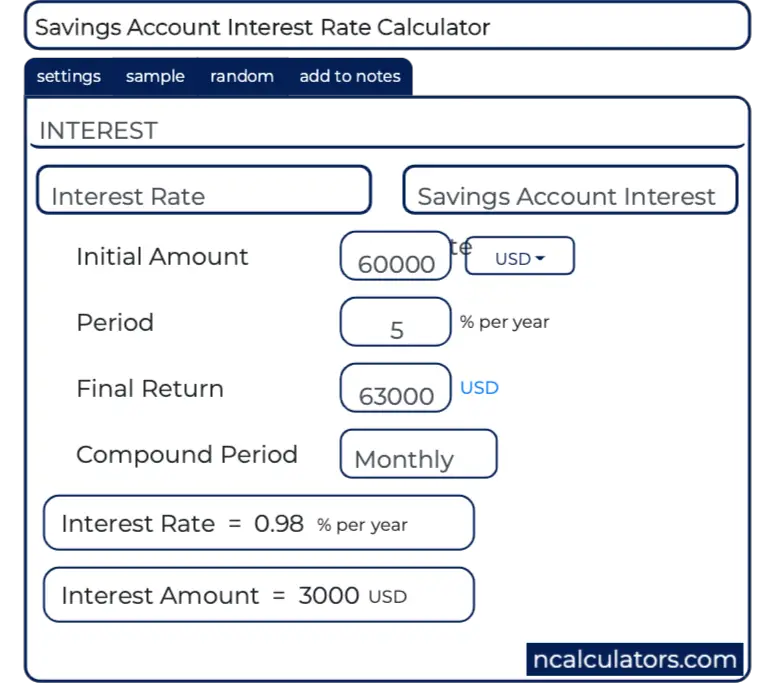
You don’t always need to perform manual calculations. Numerous free online interest calculators can quickly determine future values based on different principals, rates, compounding frequencies, and durations. Many personal finance apps and budgeting software also include features to project savings growth, compare accounts, and even track your interest earnings in real-time. Leveraging these tools can save time and provide immediate insights into the potential of your savings.
Comparing Savings Account Offers
Actively comparing savings accounts across different financial institutions is paramount. Don’t settle for the default low-interest rate offered by your primary checking account provider. Online-only banks and credit unions often provide significantly higher APYs on their savings accounts due to lower overheads. Use comparison websites and review the APY, minimum balance requirements, fees, and compounding frequency for various options to find the best fit for your money.
Automating Savings and Contributions
Consistency is key to leveraging compound interest effectively. Setting up automatic transfers from your checking account to your savings account on a regular basis (e.g., weekly, bi-weekly, or monthly) ensures that your principal grows steadily. Each additional deposit immediately starts earning interest, further accelerating the compounding effect. Even small, consistent contributions add up significantly over time.
Understanding Tax Implications
The interest you earn on your savings account is considered taxable income by the IRS (and similar bodies in other countries). Banks typically issue a Form 1099-INT if you earn $10 or more in interest during a calendar year. This income needs to be reported on your tax return. Understanding this helps you factor it into your overall financial planning and avoid surprises come tax season. For high earners or those with significant interest income, seeking advice from a tax professional is always recommended.
Beyond the Calculation: Maximizing Your Savings Potential
Knowing how interest is calculated is a vital first step, but truly maximizing your savings involves strategic choices about where you keep your money and how you manage it.
High-Yield Savings Accounts (HYSAs)
For most individuals seeking to maximize interest on their liquid savings, High-Yield Savings Accounts (HYSAs) are the go-to solution. These accounts typically offer APYs significantly higher than traditional brick-and-mortar bank accounts, often 10 to 20 times more. While they often operate primarily online, they are FDIC-insured (up to federal limits) and provide easy access to your funds, making them ideal for emergency funds and short-to-medium-term savings goals.
Certificate of Deposits (CDs) and Money Market Accounts
For funds you won’t need immediate access to, Certificates of Deposit (CDs) can offer even higher interest rates than HYSAs, especially for longer terms. CDs require you to lock up your money for a fixed period (e.g., 6 months, 1 year, 5 years), and withdrawing early usually incurs a penalty. Money Market Accounts (MMAs) blend features of savings and checking accounts, offering competitive interest rates (often higher than traditional savings but sometimes lower than HYSAs) along with limited check-writing or debit card access. Both can be valuable tools in a diversified savings strategy.

Regular Review and Adjustment
The financial landscape is constantly changing. Interest rates fluctuate, new banking products emerge, and your personal financial goals evolve. It’s prudent to regularly review your savings accounts (at least once a year) to ensure they are still offering competitive rates and meeting your needs. If your bank’s APY has dropped significantly, or a new offer provides a better return with similar terms, don’t hesitate to transfer your funds. Proactive management of your savings can make a substantial difference in your long-term wealth accumulation.
In conclusion, calculating interest on a savings account isn’t merely a mathematical exercise; it’s an essential skill for financial empowerment. By understanding the basics of simple and compound interest, recognizing the impact of compounding frequency and APY, and leveraging modern financial tools and strategies, you can transform your savings from stagnant funds into a dynamic engine for financial growth. Your money, intelligently managed, truly has the power to work for you.
aViewFromTheCave is a participant in the Amazon Services LLC Associates Program, an affiliate advertising program designed to provide a means for sites to earn advertising fees by advertising and linking to Amazon.com. Amazon, the Amazon logo, AmazonSupply, and the AmazonSupply logo are trademarks of Amazon.com, Inc. or its affiliates. As an Amazon Associate we earn affiliate commissions from qualifying purchases.