
For the modern investor, the concept of “market hours” has evolved from a rigid schedule of floor-trading bells to a complex, 24-hour global cycle. While digital platforms allow us to place orders at 2:00 AM on a Sunday, the actual execution of those trades and the liquidity available to back them depend entirely on when the major exchanges are open. Understanding when the market is open is not merely a matter of knowing the opening bell; it is a fundamental pillar of risk management and strategic execution.
In the world of finance, timing is often just as important as the asset itself. Whether you are a long-term retirement saver or an active swing trader, the hours in which you interact with the market dictate the prices you receive, the volatility you experience, and the global events that influence your portfolio.
The Core Framework: Understanding U.S. Stock Market Hours
The United States remains the center of the financial world, with the New York Stock Exchange (NYSE) and the NASDAQ representing the lion’s share of global equity volume. For most individual investors, these are the primary “market hours” that govern their financial lives.
Regular Trading Hours (The 9:30 AM to 4:00 PM Window)
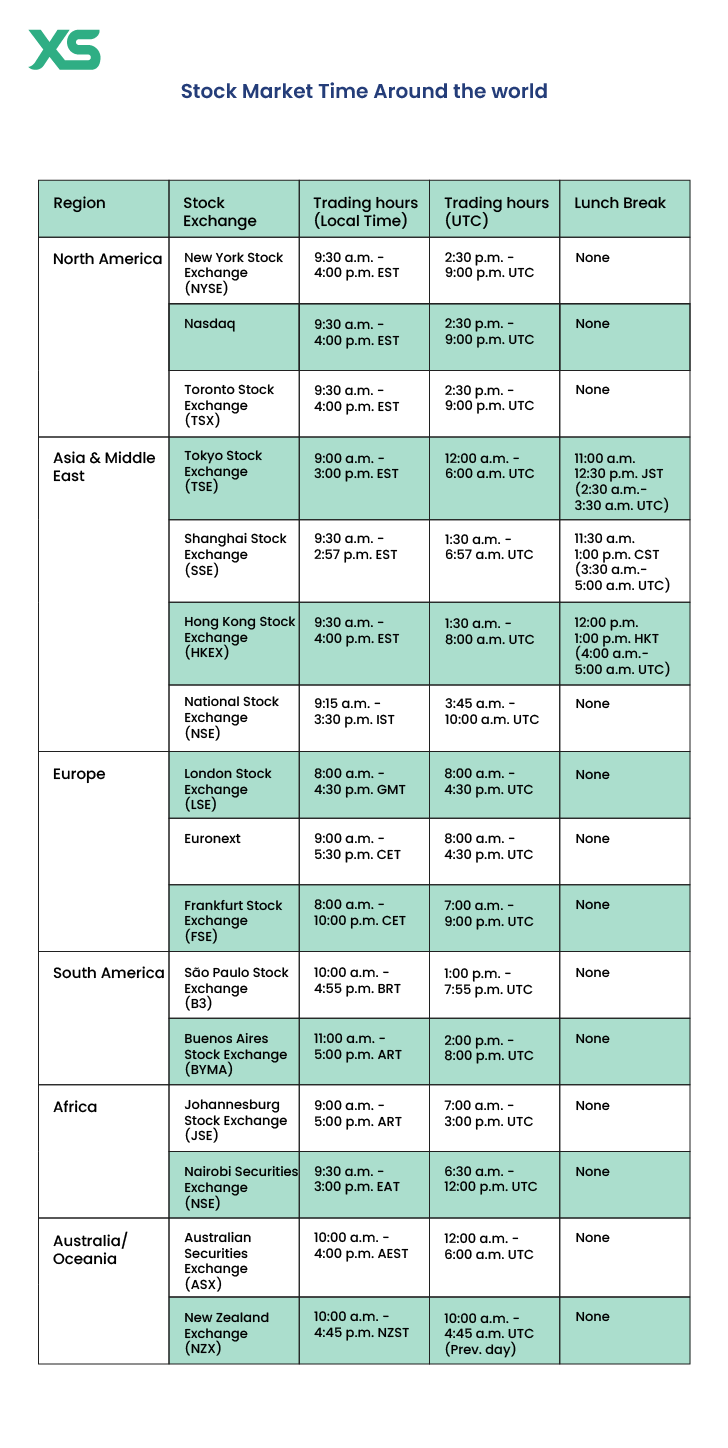
The standard trading session for the U.S. stock market begins at 9:30 AM Eastern Time (ET) and concludes at 4:00 PM ET, Monday through Friday. This 6.5-hour window is when the vast majority of trading volume occurs. During these hours, liquidity is at its peak, meaning the “bid-ask spread”—the difference between the price a buyer is willing to pay and the price a seller is willing to accept—is usually at its narrowest. This is the optimal time for most retail investors to execute trades, as it ensures they are getting a fair market price with minimal slippage.
The Extended Hours Landscape: Pre-Market and After-Hours
While the “floor” may close at 4:00 PM, the digital market continues to hum through electronic communication networks (ECNs).
- Pre-Market Trading: Most brokers allow investors to trade as early as 4:00 AM ET, though the most active pre-market window usually begins around 8:00 AM ET. This period is often characterized by lower volume and higher volatility, frequently driven by overnight news or early-morning economic reports.
- After-Hours Trading: Running from 4:00 PM to 8:00 PM ET, the after-hours session is where “earnings season” comes to life. Companies typically report their quarterly results after the closing bell to ensure all investors have equal access to information. While this session offers the opportunity to react immediately to news, the lack of participants can lead to wild price swings that may not reflect the stock’s value when the regular market opens the next morning.
The Global Relay: Trading the World’s Financial Centers
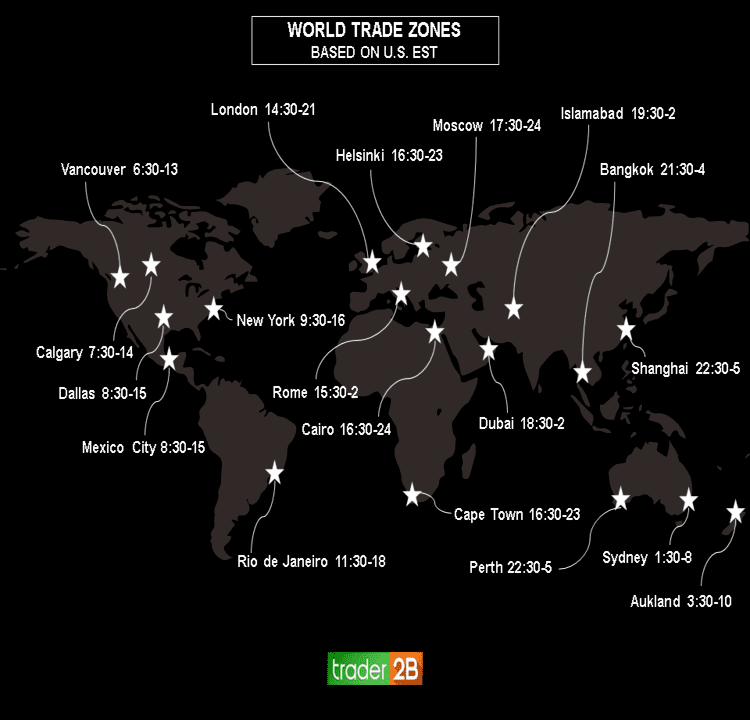
Money never truly sleeps; it simply moves from one time zone to the next. For those looking to diversify their portfolios internationally or trade global macro trends, understanding the “Global Relay” is essential. The market operates like a baton being passed across the planet.
The European Powerhouse: London and Frankfurt
As the U.S. market is winding down or in its deep slumber, the European markets are in full swing. The London Stock Exchange (LSE), one of the oldest and most influential in the world, typically operates from 8:00 AM to 4:30 PM Greenwich Mean Time (GMT).
A critical period for global investors is the “overlap” window—the hours between 9:30 AM and 11:30 AM ET—when both the New York and London markets are open simultaneously. This is often the most liquid period of the day for currency pairs (Forex) and large-cap multinational stocks, as institutional capital from both sides of the Atlantic is active.
The Asian Session: Tokyo, Hong Kong, and Sydney
When it is evening in New York, the sun is rising on the Asian markets. The Tokyo Stock Exchange (TSE) generally operates from 9:00 AM to 3:00 PM JST, with a scheduled lunch break (a rarity in Western markets). Following closely are the Hong Kong Stock Exchange and the Shanghai Stock Exchange.
Investors focused on the tech hardware sector or global manufacturing often watch the Asian open to gauge sentiment, as many of the world’s largest semiconductor and consumer electronics companies are listed on these exchanges. The “opening” of the Asian session can often set the tone for how U.S. futures will trade overnight.
Navigating the Calendar: Market Holidays and Special Closures
Knowing the hours of the day is only half the battle; an investor must also know the days of the year. The stock market does not follow the same schedule as the post office or every local bank, though they often overlap with federal holidays.
Fixed and Floating Federal Holidays
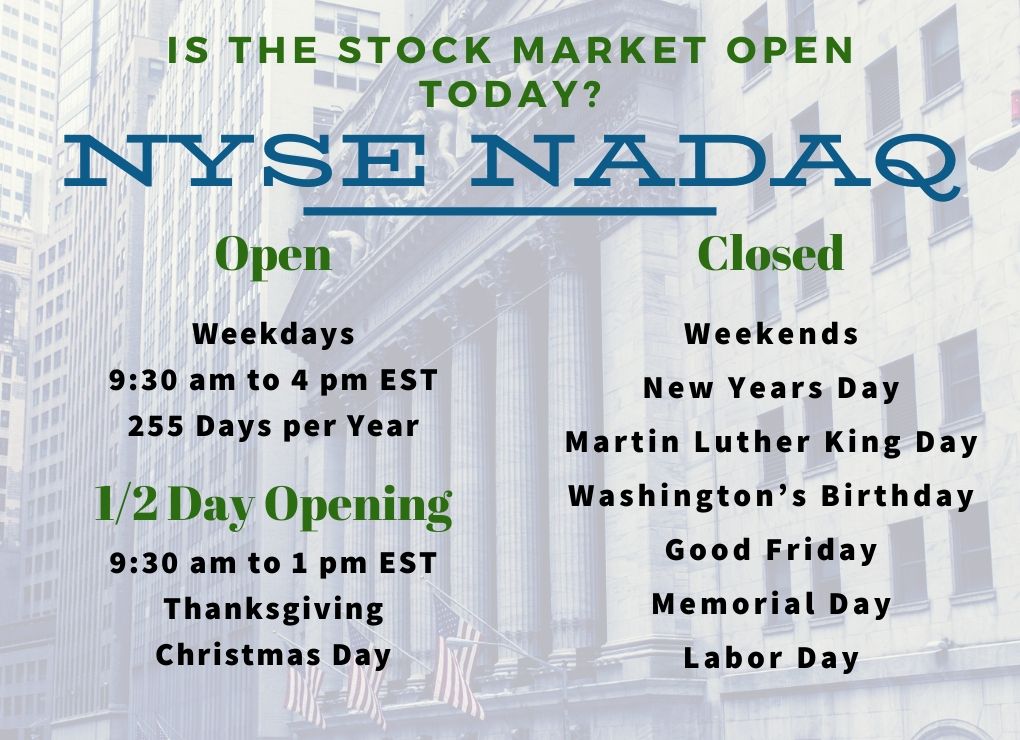
In the United States, the NYSE and NASDAQ are closed on major holidays, including New Year’s Day, Martin Luther King Jr. Day, Washington’s Birthday (Presidents’ Day), Good Friday, Memorial Day, Juneteenth, Independence Day, Labor Day, Thanksgiving, and Christmas.
If a holiday falls on a Saturday, the market usually closes on the preceding Friday. If it falls on a Sunday, the market closes on the following Monday. Being unaware of these closures can lead to “trapped” capital—where an investor wants to exit a position due to breaking news but finds the exchange doors locked until the following Tuesday morning.
Early Closures and Trading Half-Days
There are specific days, most notably the day after Thanksgiving (Black Friday) and sometimes Christmas Eve, when the market closes early at 1:00 PM ET. These “half-days” are notoriously low-volume. Many institutional traders take the day off, leaving the market susceptible to erratic movements caused by smaller trades. For the prudent investor, these are often days to observe rather than engage, as the lack of liquidity can make entering or exiting large positions unnecessarily expensive.
Strategic Timing: Why “When” You Trade Matters
If you look at a chart of market activity, you will notice that volume is not distributed evenly throughout the day. It usually follows a “U-shaped” curve: high at the open, low during the middle of the day, and high again at the close. This distribution has significant implications for your investment strategy.
The Volatility of the Opening Bell
The first 30 to 60 minutes of the trading day (9:30 AM – 10:30 AM ET) are often the most volatile. This is known as the “price discovery” phase, where the market absorbs all the news, earnings, and global events that happened overnight. Professional traders often refer to this as “amateur hour,” as retail emotions can drive prices to extremes before institutional “smart money” enters to stabilize the trend. Unless you are an experienced day trader, waiting until 10:30 AM to place a trade can often lead to more stable entries.
The “Lunchtime Lull” and the Closing Cross
From 12:00 PM to 2:00 PM ET, the market often enters a “lull.” Volume drops as floor traders and institutional desks take breaks. During this time, the market may drift aimlessly, and spreads may widen slightly.
Conversely, the “Power Hour” (3:00 PM – 4:00 PM ET) sees a surge in activity. Large mutual funds and ETFs often perform their “rebalancing” near the close to ensure their holdings match their benchmarks. The “Closing Cross”—the final auction that determines the official closing price of a stock—is a massive liquidity event. For long-term investors, the closing price is the most important data point of the day, as it represents the final consensus on a company’s value.
Digital Tools and Platforms for Real-Time Market Monitoring
In an era of instant information, no investor should have to guess whether the market is open or what the current session sentiment is. Utilizing the right financial technology can help you stay synchronized with global markets.
Brokerage Apps and Time Zone Converters
Most modern brokerage platforms (such as Fidelity, Schwab, or Robinhood) provide clear indicators of whether the market is in “Regular Session” or “Extended Hours.” However, if you are trading international stocks, a dedicated world clock or a time zone converter specifically designed for traders is invaluable. These tools help you visualize the overlaps between London, New York, and Tokyo, allowing you to identify the windows of maximum liquidity.
Economic Calendars and News Aggregators
The market doesn’t just “open” and “close” in a vacuum; it responds to scheduled economic data. Tools like Bloomberg, Reuters, or even free economic calendars (like those found on Yahoo Finance or Investing.com) track when the Federal Reserve will announce interest rate decisions or when Labor Department jobs reports will be released. Often, the market may be “open,” but trading will effectively freeze for a few minutes in anticipation of these high-impact announcements. Being aware of the “economic clock” is just as vital as knowing the exchange clock.
Conclusion: Mastering the Market Clock
“When is the market open?” is a question that serves as the gateway to professional-grade investing. It is about more than just knowing that the doors open at 9:30 AM; it is about recognizing the rhythmic breathing of global capital. By understanding the nuances of pre-market volatility, the importance of the New York-London overlap, and the liquidity patterns of the trading day, you can move from being a reactive participant to a proactive strategist.
The most successful investors respect the clock. They know when to seek liquidity, when to avoid the “noise” of the opening bell, and when to step back during holiday thins. In the pursuit of financial independence, time is your greatest asset—not just the years you stay invested, but the hours and minutes you choose to execute your plan.
aViewFromTheCave is a participant in the Amazon Services LLC Associates Program, an affiliate advertising program designed to provide a means for sites to earn advertising fees by advertising and linking to Amazon.com. Amazon, the Amazon logo, AmazonSupply, and the AmazonSupply logo are trademarks of Amazon.com, Inc. or its affiliates. As an Amazon Associate we earn affiliate commissions from qualifying purchases.