
The Dow Jones Industrial Average (DJIA) is perhaps the most recognized financial metric in the world. Often referred to simply as “the Dow,” it serves as a primary barometer for the health of the United States stock market and, by extension, the broader global economy. For investors, traders, and everyday savers, the question of “what is the highest the Dow Jones has ever been” is more than just a trivia point; it is a vital indicator of market sentiment, economic growth, and the purchasing power of capital.

As of mid-2024, the Dow Jones Industrial Average reached a historic milestone, surpassing the 41,000 mark for the first time in its 128-year history. While the specific “highest” number fluctuates daily with market volatility, the trajectory of the Dow remains a fascinating study in the resilience of American industry and the compounding power of the equity markets.
Understanding the All-Time Highs of the Dow Jones Industrial Average
To understand the record-breaking peaks of the Dow, one must first understand what the index represents. Unlike the S&P 500, which is market-cap weighted, the Dow is a price-weighted index consisting of 30 prominent “blue-chip” companies listed on stock exchanges in the United States. Because it focuses on these titans of industry—ranging from technology giants like Apple and Microsoft to financial mainstays like Goldman Sachs—a new all-time high in the Dow often signals a period of robust corporate profitability.
The Current Record and Recent Milestones
In May 2024, the Dow Jones Industrial Average made headlines globally by crossing the psychological threshold of 40,000. This followed a period of intense market scrutiny regarding inflation and interest rates. Shortly thereafter, in July 2024, the index continued its upward climb, setting new intraday records above 41,200.
These milestones are significant because they represent a full recovery and expansion from the bear market of 2022. For investors, these highs are a testament to the fact that the market eventually rewards patience. Reaching 40,000 took the Dow roughly three and a half years after it first crossed the 30,000 mark in late 2020. This pace of growth, despite global supply chain issues and geopolitical tensions, highlights the underlying strength of the corporate balance sheets within the index.
Intraday vs. Closing Highs: Why the Difference Matters
When discussing the “highest” the Dow has ever been, financial analysts distinguish between two types of records: the intraday high and the closing high.
- The Intraday High: This is the absolute highest price the index touched during the 6.5 hours of the trading day.
- The Closing High: This is the level at which the index finished the day at 4:00 PM EST.
For historical record-keeping, the closing high is often considered the more “official” benchmark, as it reflects the final consensus of value for that day. However, for investors watching the market in real-time, the intraday high serves as a psychological ceiling that, once broken, can trigger further buying momentum. Understanding this distinction helps investors avoid “emotional trading” based on temporary spikes that may not hold by the end of the session.
A Historical Perspective: The Journey to 40,000 and Beyond
The Dow’s journey to its current highs is a narrative of American economic evolution. Since its inception in 1896, the index has survived depressions, world wars, and technological revolutions. Looking at how we arrived at today’s record levels provides a necessary perspective for long-term wealth management.
From the Great Depression to the Post-War Boom
For decades, the Dow struggled to reach what we would now consider modest numbers. Before the 1929 crash, the Dow hit a high of 381 points. Following the crash, it took until 1954—twenty-five years later—for the index to return to that level. This era taught the financial world a somber lesson about risk and the dangers of excessive leverage. However, the post-WWII era ushered in a period of unprecedented expansion, leading the Dow to finally cross the 1,000-point threshold in 1972.
The Tech Bubble and the Great Recession Recovery
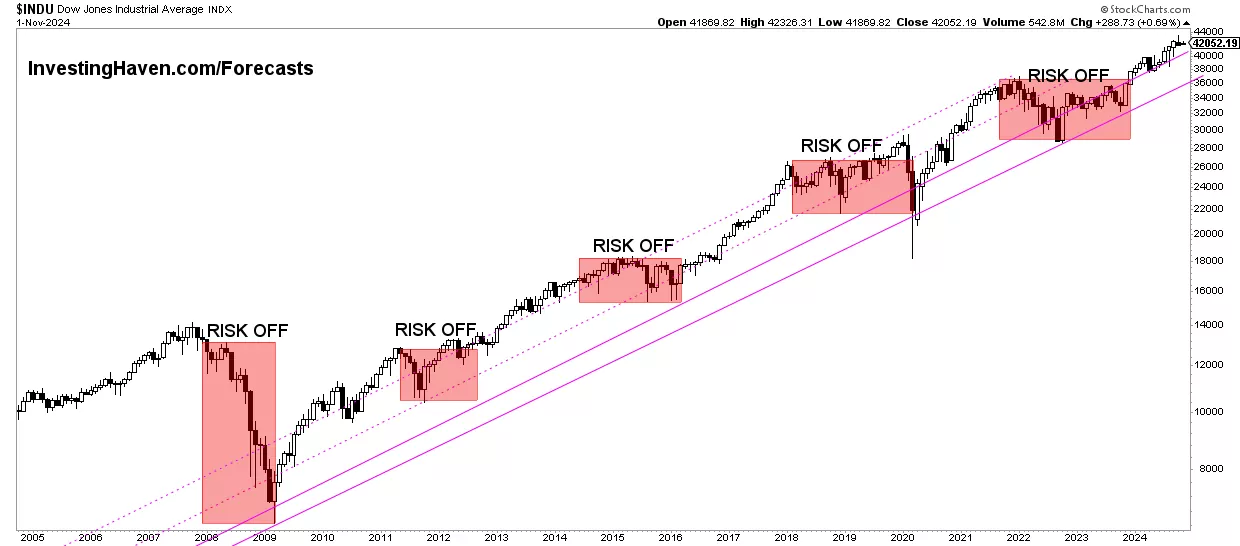
The late 20th century saw a rapid acceleration in the Dow’s growth. Fueled by the rise of computing and a globalizing economy, the index hit 10,000 in 1999. The subsequent “Dot-com” crash and the 2008 Financial Crisis were significant setbacks, with the Dow falling below 7,000 during the depths of the Great Recession. Yet, the recovery that followed was one of the longest bull markets in history. By 2017, the index had doubled to 20,000, and by early 2021, it had surged past 30,000.
The Post-Pandemic Rally: How the Dow Hit New Heights
The most recent push to all-time highs above 41,000 was largely driven by the “post-pandemic” economic environment. Despite fears of a recession in 2023, the U.S. consumer remained resilient. High interest rates, intended to curb inflation, initially put pressure on stocks, but as the Federal Reserve signaled a potential “soft landing,” the Dow rallied. The integration of Artificial Intelligence (AI) into the business models of Dow components like Microsoft and Salesforce also provided a significant boost to investor optimism, propelling the index to its current record-breaking levels.

Key Factors Driving the Dow to Record Levels
Record highs do not happen in a vacuum. Several macroeconomic and corporate factors must align to push the 30 stocks of the Dow to their peak valuations.
Monetary Policy and the Role of the Federal Reserve
The Federal Reserve is perhaps the most influential force behind the Dow’s performance. When the Fed lowers interest rates, it becomes cheaper for companies to borrow money to expand, and more attractive for investors to move capital out of bonds and into stocks. Conversely, even in high-interest-rate environments, the Dow can reach new highs if the Fed successfully manages inflation without stifling growth. The record highs of 2024 were largely fueled by investor anticipation that inflation was cooling and that a more favorable monetary environment was on the horizon.
Corporate Earnings and the Dominance of Blue-Chip Leaders
Ultimately, the Dow is a reflection of the earnings power of its 30 components. Record highs are usually supported by record profits. In recent years, companies like UnitedHealth Group, Goldman Sachs, and Home Depot have reported strong margins despite inflationary pressures. Because the Dow is price-weighted, the performance of its highest-priced stocks has a disproportionate impact on the index. When these corporate titans report strong quarterly earnings and optimistic guidance, it provides the fundamental “fuel” necessary to push the index to new peaks.
Technological Innovation and Productivity Gains
While the Dow is often seen as the “old guard” of the stock market, its composition has evolved to include massive technology players. The inclusion of companies like Amazon and Apple means that the index now benefits directly from the digital economy. Productivity gains from AI, cloud computing, and automated logistics allow these companies to scale more efficiently, driving up their stock prices and, consequently, the Dow Jones average.
What Record Highs Mean for Your Personal Finance Strategy
For the individual investor, seeing the Dow Jones at its “highest ever” can be a double-edged sword. On one hand, it indicates that your portfolio is likely performing well. On the other hand, it often triggers a fear of a market correction.
The Psychology of “Buying at the Top”
A common mistake in personal finance is waiting for a “dip” that never comes. While it may feel counterintuitive to invest when the market is at an all-time high, historical data shows that the market spends a significant amount of time at or near record levels. Investors who sat on the sidelines when the Dow hit 20,000 missed the subsequent 100% gain to 40,000. Successful investing often requires ignoring the “all-time high” headlines and focusing on consistent participation.
Diversification and Long-Term Wealth Building
While the Dow’s record highs are a cause for celebration, they also serve as a reminder to rebalance. If the Dow’s surge has made your stock holdings a much larger percentage of your net worth than originally planned, it might be time to move some gains into other asset classes like bonds, real estate, or international equities. This “Money” niche strategy ensures that you lock in some of the gains achieved during these record-breaking runs while protecting yourself against potential downturns.
Using Financial Tools to Navigate Volatility
Modern investors have more tools than ever to manage their wealth during market peaks. Utilizing dollar-cost averaging (DCA) allows you to invest a set amount of money at regular intervals, regardless of whether the Dow is at a record high or a temporary low. Additionally, using financial tracking apps and portfolio stabilizers can help you monitor the “Relative Strength Index” (RSI) of the Dow to see if it is “overbought” or “oversold,” providing a more data-driven approach to your investment decisions.
Looking Ahead: The Future of the Dow Jones
The question “what is the highest the Dow Jones has ever been” is a moving target. As the American economy continues to innovate and expand, today’s record highs will likely become tomorrow’s support levels.
Potential Headwinds: Inflation and Geopolitical Risks
No climb is without its challenges. Investors must remain mindful of potential headwinds that could pull the Dow away from its highs. Persistent inflation could force the Federal Reserve to keep interest rates higher for longer, which traditionally puts a cap on stock market valuations. Furthermore, geopolitical instability can cause sudden “shocks” to the market, leading to rapid, though often temporary, retreats from all-time highs.
The Resilience of the American Economy
Despite the risks, the historical trend of the Dow Jones is undeniably upward. The index is designed to evolve; as companies decline, they are replaced by the next generation of industrial and technological leaders. This inherent “survivorship bias” ensures that the Dow remains a collection of the most successful businesses in the world. For those focused on long-term wealth creation, the highest the Dow has ever been is merely a milestone on a much longer journey toward economic prosperity. By staying informed and maintaining a disciplined financial strategy, investors can navigate these peaks with confidence, knowing that the “highest high” is usually just a prelude to the next great expansion.
aViewFromTheCave is a participant in the Amazon Services LLC Associates Program, an affiliate advertising program designed to provide a means for sites to earn advertising fees by advertising and linking to Amazon.com. Amazon, the Amazon logo, AmazonSupply, and the AmazonSupply logo are trademarks of Amazon.com, Inc. or its affiliates. As an Amazon Associate we earn affiliate commissions from qualifying purchases.