
In the world of traditional equity trading, the ringing of the opening bell at 9:30 AM EST signals the start of the financial day, and the closing bell at 4:00 PM EST brings it to a halt. However, for those navigating the high-stakes world of futures contracts, the clock never truly seems to stop. For the modern investor, understanding when futures open is not merely a matter of administrative curiosity; it is a fundamental pillar of risk management and strategic execution.
Futures markets are designed to provide liquidity and price discovery around the clock, reflecting the global nature of the underlying assets they represent—whether those are barrels of crude oil, bushels of corn, or the value of the S&P 500. This article explores the intricate schedule of the futures market, the regional nuances of global sessions, and how investors can leverage these hours to optimize their portfolios.

Understanding the 23/5 Nature of Futures Markets
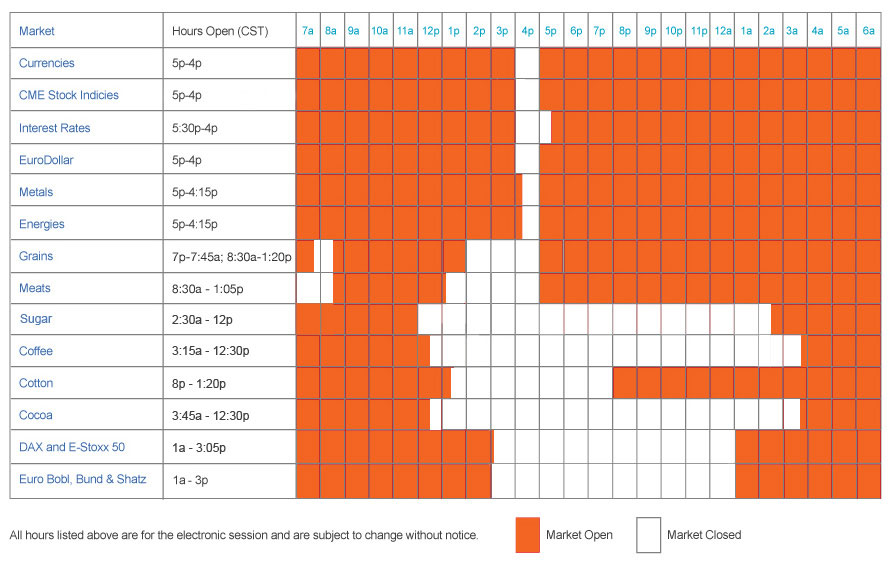
Unlike the spot stock market, which operates on a rigid “9-to-5” schedule relative to its local time zone, the futures market operates on what is commonly referred to as a 23/5 cycle. This means that for five days a week, the markets are open nearly 24 hours a day, providing a continuous stream of price data that reacts to global geopolitical and economic events in real-time.
The CME Group and the Standardized Trading Week
The majority of global futures trading occurs through the CME Group (Chicago Mercantile Exchange), which includes the CBOT, NYMEX, and COMEX. For most asset classes, the trading week begins on Sunday at 6:00 PM Eastern Time (ET) and concludes on Friday at 5:00 PM ET.
During the week, there is a brief daily pause—usually between 5:00 PM and 6:00 PM ET—to allow for daily settlement procedures and maintenance of the electronic systems. This 60-minute window is the only time during the business week when traders cannot execute orders. Understanding this rhythm is vital for investors who use futures to hedge against “gap risk”—the danger of a price jumping significantly while the market is closed.
Why Futures Don’t Close Like Stocks
The primary reason futures remain open while stocks are closed is the necessity of global risk management. If a major economic shift occurs in Tokyo or London while the New York Stock Exchange is shuttered, multinational corporations and institutional investors need a venue to adjust their exposure immediately. Futures serve as the “early warning system” of the financial world. By staying open through the night, these markets ensure that information is absorbed incrementally rather than causing a chaotic explosion of volatility at the traditional 9:30 AM stock market open.
Key Trading Sessions and Regional Opening Times
While the electronic platforms are active nearly 24/7, the character of the market changes based on which global financial hub is currently at its desk. Liquidity—the ease with which one can buy or sell without moving the price—ebbs and flows throughout these sessions.
The US Session (Equity and Index Futures)
The most liquid period for index futures, such as the E-mini S&P 500 (ES) and the E-mini Nasdaq-100 (NQ), occurs during the US cash market hours. While these contracts open on Sunday evening, the “RTH” (Regular Trading Hours) session from 9:30 AM to 4:00 PM ET sees the highest volume. During this time, the underlying stocks are trading, providing a tight arbitrage link between the futures price and the actual index value. For short-term traders, this is the optimal window for execution due to the tightest bid-ask spreads.
The European Session (Eurex and International Exposure)
As the US sleeps, the European session takes the lead, typically starting around 2:00 AM or 3:00 AM ET. Markets like the Eurex (home to the DAX and Euro Stoxx 50) provide significant movement. For US-based futures traders, this session is critical because European economic data releases often impact the US Dollar and, by extension, commodity futures like Gold and Crude Oil. The “overlap” period—when London is finishing its day and New York is starting (roughly 8:00 AM to 11:30 AM ET)—is often the most volatile and high-volume period of the entire 24-hour cycle.
The Asian-Pacific Session (The Early Movers)
The futures “day” technically begins during the Asian session. When the markets open at 6:00 PM ET on Sunday, it is Monday morning in Sydney, Tokyo, and Hong Kong. This session is often characterized by lower volume but can be prone to “flash” movements if news breaks. Investors monitoring the Sunday open are looking for “gaps”—differences between Friday’s close and Sunday’s open—which signal how the market has digested weekend news, such as election results or unexpected central bank announcements.

The Importance of Pre-Market and After-Hours Activity
In the digital age, the distinction between “regular hours” and “after hours” has blurred, yet the technical mechanics of the opening remain distinct.
Globex Trading and Electronic Access
CME Globex is the premier electronic trading platform that pioneered 24-hour futures trading. Because Globex is decentralized, an investor in Singapore can trade US Treasury futures at the same time as an investor in Zurich. The “open” on Globex is a seamless electronic process. However, investors must be aware that “electronic” does not always mean “liquid.” Executing a large order at 2:00 AM ET may result in “slippage” (the difference between the expected price and the executed price) because there are fewer participants active on the platform compared to the mid-day rush.
Dealing with Gaps and Weekend Risk
The most significant “open” of all is the Sunday evening open. Since futures are leveraged instruments, a significant gap against a trader’s position can lead to a margin call before they even have a chance to react. Professional money managers often reduce their position sizes before the Friday close to account for this weekend risk. If a major geopolitical event occurs on a Saturday, the Sunday 6:00 PM ET open is the first opportunity for the world to “price in” that event.
Asset-Specific Timing: When Gold, Oil, and Bitcoin Futures Open
Not every futures contract follows the exact same heartbeat. While most follow the general CME schedule, certain commodities and newer asset classes have specific nuances.
Energy and Metals (NYMEX/COMEX)
Crude Oil (CL) and Gold (GC) are perhaps the most sensitive to global timing. While they follow the Sunday-Friday 23/5 schedule, their primary liquidity is tied to specific “pit” equivalents. For instance, Gold often sees a massive surge in activity at 8:20 AM ET, coinciding with the traditional start of floor trading. Similarly, Crude Oil often reacts sharply to the 9:00 AM ET window and the weekly inventory reports released by the EIA on Wednesdays at 10:30 AM ET.
Cryptocurrencies (CME Bitcoin Futures)
The arrival of Bitcoin futures brought the “always-on” world of crypto into the regulated futures environment. Unlike the underlying Bitcoin spot market, which trades 24/7/365, CME Bitcoin futures (BTC) still follow the standard futures week. They open Sunday at 6:00 PM ET and close Friday at 5:00 PM ET. This creates an interesting dynamic where the “gap” on Sunday evening can be massive if Bitcoin had a volatile weekend in the unregulated spot markets.
Strategic Implications for the Modern Investor
Knowing when the markets open is the first step; knowing how to trade those openings is where the value lies.
Volatility Patterns at the Open
Statistically, the first 15 to 30 minutes after a market open (whether the Sunday evening open or the 9:30 AM ET equity open) are the most volatile. This is known as “price discovery.” Orders that were queued up while the market was paused or thin are hitting the book all at once. For conservative investors, it is often wise to wait for the “opening range” to be established before committing capital.
Leveraging Liquidity for Better Execution
For those looking to enter long-term positions, timing the entry during “Power Hour” (the final hour of the US session) or during the mid-morning liquidity peak is generally more cost-effective than trading in the middle of the night. High liquidity ensures that the spread between the “bid” (what buyers want to pay) and the “ask” (what sellers want to receive) is as narrow as possible, reducing the hidden costs of trading.
In conclusion, the question of “when do futures open” reveals the interconnected machinery of global finance. From the Sunday evening open at 6:00 PM ET to the final Friday settlement at 5:00 PM ET, the futures market provides a continuous window into the world’s economic health. By understanding these sessions, respecting the daily pauses, and accounting for regional liquidity shifts, investors can move beyond mere participation and begin to master the strategic timing required for long-term financial success.
aViewFromTheCave is a participant in the Amazon Services LLC Associates Program, an affiliate advertising program designed to provide a means for sites to earn advertising fees by advertising and linking to Amazon.com. Amazon, the Amazon logo, AmazonSupply, and the AmazonSupply logo are trademarks of Amazon.com, Inc. or its affiliates. As an Amazon Associate we earn affiliate commissions from qualifying purchases.