
In the world of personal finance and global investing, few terms are uttered with as much frequency or reverence as the “S&P 500.” Whether you are listening to nightly business news, reading a quarterly 401(k) statement, or following the latest trends in the financial markets, the S&P 500 is the primary yardstick by which economic health and investment performance are measured. But what exactly is it?
The S&P 500, or the Standard & Poor’s 500 Index, is a stock market index that tracks the performance of 500 of the largest publicly traded companies in the United States. It is widely regarded as the best single gauge of large-cap U.S. equities. Because it includes approximately 80% of the available market capitalization of the U.S. stock market, it serves as a powerful proxy for the American economy. For the individual investor, understanding the S&P 500 is not just a matter of financial literacy; it is the foundation of a modern wealth-building strategy.

Understanding the Fundamentals: Mechanics of the Index
To truly grasp what the S&P 500 represents, one must look beyond the three-letter tickers and the daily price fluctuations. It is a carefully curated list managed by S&P Dow Jones Indices, a joint venture that oversees thousands of financial benchmarks.
The History and Evolution of the S&P 500
The index as we know it today was launched on March 4, 1957. However, its roots go back to 1923, when the Standard Statistics Company began tracking 233 companies. Following a merger with Poor’s Publishing in 1941, the index expanded. The move to 500 companies in 1957 was revolutionary, as it leveraged the growing computational power of the era to provide a more real-time, comprehensive view of the market than had ever been possible. Over the decades, it has evolved from a list dominated by industrial and railroad companies to one that reflects the digital and service-oriented economy of the 21st century.
Float-Adjusted Market Capitalization Weighting
Unlike some other indices that use a simple price-weighted average, the S&P 500 uses a float-adjusted market capitalization weighting method. “Market capitalization” is the total value of a company’s outstanding shares (share price multiplied by the number of shares). “Float-adjusted” means the index only counts the shares available to the public, excluding those held by insiders or governments.
In this system, larger companies have a greater impact on the index’s movement. For example, if a tech giant with a $3 trillion market cap sees its stock price rise by 2%, it will pull the S&P 500 higher far more significantly than a $20 billion company seeing a 10% gain. While this reflects the actual economic weight of these corporations, it also means the index can become “top-heavy” during periods when a few massive companies dominate the market.
How Companies Earn Their Spot: The Selection Process
It is a common misconception that the S&P 500 is simply a list of the 500 largest companies in America. In reality, being included in the index is a mark of prestige that requires meeting rigorous eligibility criteria. The selection is not done by a computer program alone; it is overseen by the U.S. Index Committee at S&P Dow Jones Indices.
Eligibility Criteria and Financial Health
To be considered for the S&P 500, a company must be a U.S. corporation and meet specific size and liquidity requirements. As of 2024, the market cap threshold is generally above $15.8 billion, though this number is adjusted periodically to reflect market conditions.
Beyond size, the committee looks at:
- Liquidity: The stock must be easy to buy and sell, with a high trading volume.
- Public Float: At least 50% of the company’s shares must be available for public trading.
- Profitability: Perhaps the most important “gatekeeper” rule is that the sum of the company’s earnings over the previous four consecutive quarters must be positive, as must the most recent quarter. This ensures that the index reflects established, viable businesses rather than speculative startups.
The Role of the Index Committee
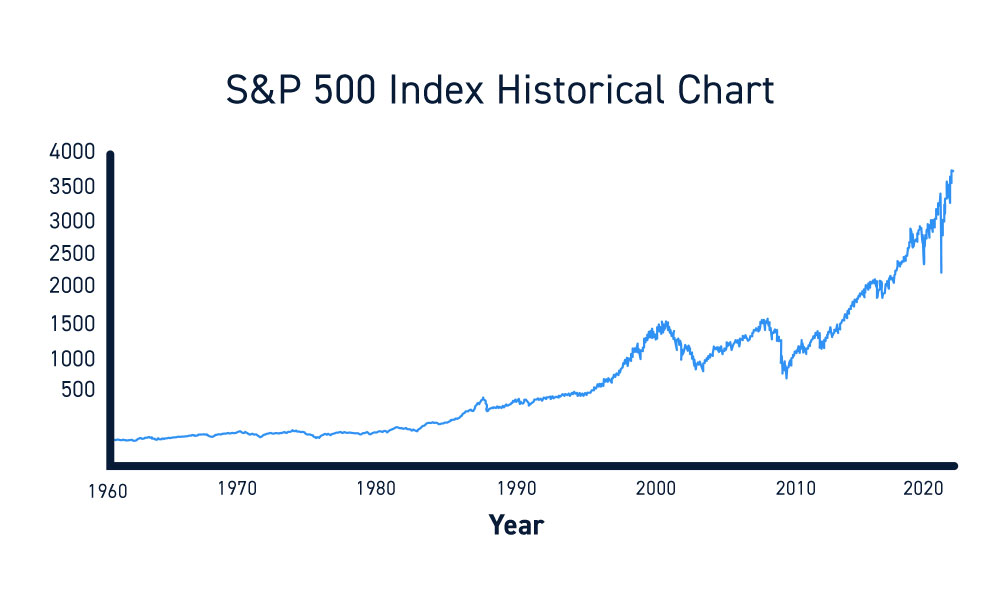
The Index Committee meets monthly to review the composition of the S&P 500. They strive to ensure that the index remains a representative “slice” of the U.S. economy. When a company no longer meets the criteria—perhaps due to a decline in market value or a merger—it is removed, and a new candidate is added. This “survivorship” mechanism is part of why the S&P 500 has historically trended upward over long periods; it systematically replaces failing businesses with rising stars.
Why the S&P 500 Matters to Every Investor

For most people, the S&P 500 isn’t just a number on the news; it is the engine behind their retirement savings. Its importance stems from its role as both a benchmark and a barometer.
A Barometer for the U.S. Economy
Because the S&P 500 spans 11 different sectors—including Technology, Healthcare, Financials, Consumer Discretionary, and Energy—it provides a diversified view of how corporate America is performing. When the S&P 500 is in a “bull market” (rising), it generally indicates that corporations are profitable, consumer spending is healthy, and investor confidence is high. Conversely, a “bear market” (a drop of 20% or more) often precedes or accompanies economic recessions.
The Ultimate Performance Benchmark
For professional fund managers and individual investors alike, the S&P 500 is the standard of excellence. If a “growth fund” or a “value fund” claims to be successful, investors check if it “beat the S&P.” Interestingly, data from S&P Global (the SPIVA reports) consistently shows that over long periods (10 to 15 years), the vast majority of active fund managers fail to outperform the S&P 500. This realization led to the “passive investing” revolution, where investors stop trying to pick individual winning stocks and instead choose to “buy the whole haystack.”
How to Invest: Turning the Index into a Portfolio
You cannot “buy” the S&P 500 index itself because it is merely a mathematical calculation. However, you can invest in financial products designed to track its performance with near-perfect accuracy.
Index Funds and ETFs
The most common way to invest in the S&P 500 is through Index Mutual Funds or Exchange-Traded Funds (ETFs).
- ETFs (Exchange-Traded Funds): Popular options like the SPDR S&P 500 ETF Trust (SPY), the iShares Core S&P 500 ETF (IVV), and the Vanguard S&P 500 ETF (VOO) allow you to buy a “piece” of all 500 companies in a single transaction. These trade on the stock exchange like a regular stock.
- Index Mutual Funds: These are similar but are usually purchased directly through a brokerage like Fidelity or Schwab. They are ideal for automated, recurring investments (like a 401(k) contribution).
The primary advantage of these vehicles is their low cost. Because no expensive team of analysts is needed to “pick” stocks—the computer just follows the index—the expense ratios are often as low as 0.03%. This means for every $10,000 invested, you might only pay $3 a year in fees.
Risks and Diversification Factors
While the S&P 500 is diversified across 500 companies, it is not without risk. It is a 100% equity (stock) investment, meaning it can be volatile. During the 2008 financial crisis or the 2020 COVID-19 crash, the index saw significant double-digit declines. Furthermore, because it is limited to large-cap U.S. companies, an investor relying solely on the S&P 500 misses out on small-cap companies and international markets. Therefore, while it is an excellent core holding, many financial advisors recommend pairing it with other asset classes for a truly balanced portfolio.
The S&P 500 vs. Other Major Indices
To understand the S&P 500’s unique position, it helps to compare it to the other “Big Two” indices that dominate the headlines.
The Dow Jones Industrial Average (DJIA)
The Dow is the oldest index, but it is much narrower, consisting of only 30 “blue-chip” companies. Unlike the S&P 500, the Dow is price-weighted. This means a company with a higher stock price has more influence, regardless of its actual size. Most professional investors view the S&P 500 as a much more accurate representation of the total market than the Dow.
The Nasdaq Composite
The Nasdaq tracks over 2,500 companies listed on the Nasdaq exchange. It is heavily weighted toward the Technology and Biotechnology sectors. While the S&P 500 includes many of the same tech giants (like Apple and Microsoft), it also includes “old economy” sectors like Utilities, Industrials, and Real Estate, which the Nasdaq often lacks. The S&P 500 is generally seen as the “middle ground”—more diversified than the Nasdaq but more comprehensive than the Dow.
Conclusion: The Power of the 500
The S&P 500 is more than just a list of stocks; it is a reflection of human ingenuity, corporate competition, and the collective growth of the global economy. For the disciplined investor, it offers a path to participate in the profits of the world’s most successful corporations without the need for complex trading strategies or deep financial expertise.
By providing a transparent, rules-based, and diversified approach to the equity markets, the S&P 500 has democratized wealth building. Whether you are a first-time investor opening a Roth IRA or a seasoned professional managing millions, the S&P 500 remains the definitive map of the financial landscape. Understanding its mechanics, its selection process, and its historical significance is the first step toward long-term financial success in the modern world.
aViewFromTheCave is a participant in the Amazon Services LLC Associates Program, an affiliate advertising program designed to provide a means for sites to earn advertising fees by advertising and linking to Amazon.com. Amazon, the Amazon logo, AmazonSupply, and the AmazonSupply logo are trademarks of Amazon.com, Inc. or its affiliates. As an Amazon Associate we earn affiliate commissions from qualifying purchases.