
For many individuals embarking on their journey toward financial independence, the term “S&P 500” is often the first piece of professional jargon they encounter. It is cited daily on news broadcasts, discussed in hushed tones by wealth managers, and celebrated by retail investors as the ultimate barometer of American economic health. But what exactly is it?
At its core, the Standard & Poor’s 500 Index, commonly known as the S&P 500, is a stock market index that tracks the performance of approximately 500 of the largest companies listed on stock exchanges in the United States. It is widely regarded as the best single gauge of large-cap U.S. equities. Because it includes a diverse array of companies across all sectors of the economy, it provides a much more comprehensive picture of the market than the Dow Jones Industrial Average, which only tracks 30 companies.

Understanding the S&P 500 is not merely an academic exercise; it is a fundamental step in mastering personal finance and long-term wealth building. By understanding how this index functions, how it is composed, and how to invest in it, you can move from being a spectator of the economy to an active participant in global growth.
1. The Mechanics of the Index: How the S&P 500 Works
The S&P 500 is not a random collection of companies; it is a meticulously curated list managed by a committee at S&P Dow Jones Indices. To understand its power, one must first understand how it is calculated and maintained.
Market Capitalization Weighting
Unlike some indices that are price-weighted (where the stock price alone determines the influence of a company), the S&P 500 is a float-adjusted market-capitalization-weighted index. This means that the impact of a company’s price change on the index is proportional to its total market value.
In simple terms, a 1% move in a trillion-dollar company like Apple or Microsoft has a significantly larger impact on the S&P 500 than a 1% move in a company with a $20 billion market cap. This structure ensures that the index reflects the actual economic weight of the companies within it. The “float-adjusted” part means the index only counts shares available to the public, excluding closely held shares or those owned by governments.
The Selection Process and Eligibility Criteria
A common misconception is that the S&P 500 simply consists of the 500 largest American companies. In reality, the S&P Index Committee follows strict eligibility criteria to ensure the index remains a high-quality representation of the investable universe.
To be considered for inclusion, a company must meet several requirements:
- Market Cap: It must have an unadjusted market capitalization of at least $15.8 billion (this threshold is periodically updated).
- Liquidity: The stock must be highly liquid, ensuring it is easy for institutional investors to buy and sell.
- Profitability: The company must report positive earnings over the most recent quarter, as well as the sum of its last four consecutive quarters.
- Public Float: At least 50% of its shares must be available for public trading.
Rebalancing and Evolution
The S&P 500 is not static. The committee meets quarterly to rebalance the index, adding rising stars and removing companies that no longer meet the criteria (often due to declining market value or mergers). This “survival of the fittest” mechanism is one of the index’s greatest strengths; it automatically prunes underperformers and incorporates the innovative companies driving the future of the economy.
2. Why the S&P 500 is the Gold Standard for Investors
In the world of money and investing, the S&P 500 serves two primary roles: it is a “yardstick” for performance and a “vehicle” for wealth accumulation.
The Ultimate Benchmark
Professional fund managers and individual investors alike use the S&P 500 as the benchmark to beat. If a high-fee mutual fund returns 8% in a year while the S&P 500 returns 12%, the fund manager has failed to provide value. For the average person, the S&P 500 provides a sobering reality check: it is incredibly difficult to consistently outperform this index over the long term. This realization led to the rise of “passive investing,” where individuals choose to match the market rather than try to beat it.
Historical Performance and Wealth Generation
Historically, the S&P 500 has delivered an average annual return of approximately 10% before inflation. While the market does not go up every year—witnessing significant downturns in 2008 and 2022—the long-term trajectory has been consistently upward.
For a personal finance strategist, the S&P 500 represents the power of compounding. An investment of $10,000 into an S&P 500 index fund, with no further contributions, would grow to over $174,000 in 30 years, assuming a 10% average return. This reliable growth profile makes it the cornerstone of retirement accounts, 401(k)s, and brokerage portfolios worldwide.
Sector Diversification
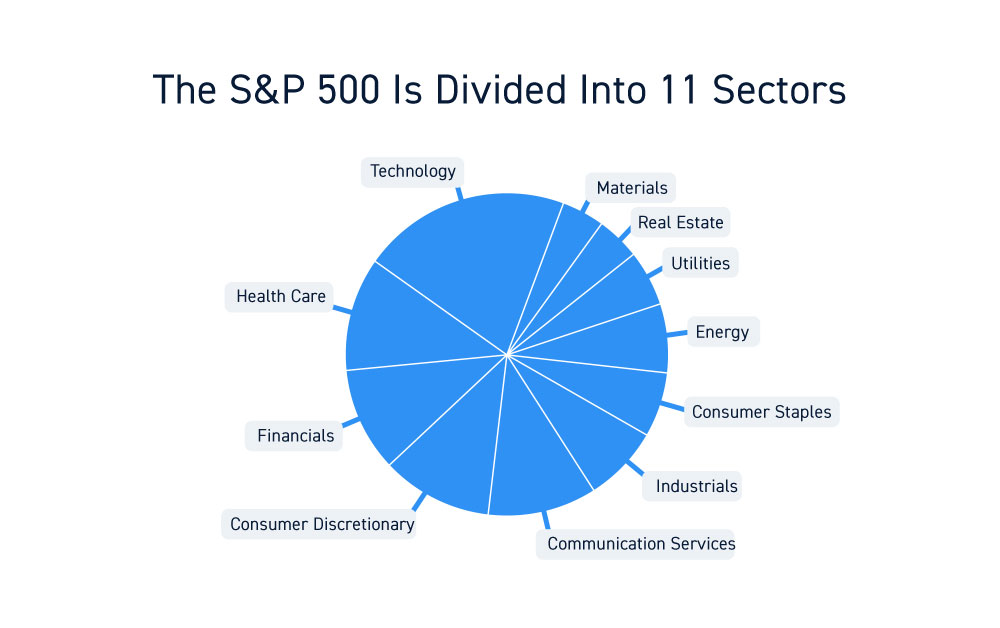
One of the most significant benefits of the S&P 500 is its inherent diversification. When you own the index, you own a piece of eleven different sectors:
- Information Technology
- Health Care
- Financials
- Consumer Discretionary
- Communication Services
- Industrials
- Consumer Staples
- Energy
- Utilities
- Real Estate
- Materials

This means that if the tech sector is struggling, your portfolio may be cushioned by gains in energy or healthcare. It is a built-in risk management tool for the modern investor.
3. How to Invest: Turning Knowledge into Income
You cannot “buy” the S&P 500 index itself because it is just a mathematical calculation. However, you can invest in financial products designed to mirror its performance.
Index Funds vs. Exchange-Traded Funds (ETFs)
The two most popular ways to gain exposure to the S&P 500 are through Index Mutual Funds and ETFs.
- Index Mutual Funds: These are ideal for long-term savers who want to set up automatic monthly contributions. They trade once a day after the market closes.
- ETFs: These trade like stocks throughout the day. Popular tickers include SPY (the first-ever US-listed ETF), VOO (Vanguard’s low-cost option), and IVV (iShares).
For the cost-conscious investor, ETFs like VOO and IVV are often preferred because of their extremely low “expense ratios”—often as low as 0.03%. This means for every $10,000 invested, you only pay $3 a year in management fees.
The Strategy of Dollar-Cost Averaging
The most effective way to invest in the S&P 500 is through a strategy called Dollar-Cost Averaging (DCA). Instead of trying to “time the market” by waiting for a dip, you invest a fixed amount of money at regular intervals (e.g., $500 every month).
When prices are high, your $500 buys fewer shares. When prices are low, your $500 buys more. Over time, this lowers your average cost per share and removes the emotional stress of market volatility. In the realm of personal finance, consistency almost always outperforms timing.
Dividends and Reinvestment
Many companies within the S&P 500 pay dividends—a portion of their profits distributed to shareholders. While the dividend yield of the index is typically modest (around 1.3% to 2%), these payments are crucial. By utilizing a Dividend Reinvestment Plan (DRIP), you automatically use those dividends to buy more shares of the index. Over decades, reinvested dividends can account for nearly half of the total total return of an S&P 500 investment.
4. Risks and Considerations: Navigating the Downsides
While the S&P 500 is a powerful tool for building wealth, no investment is without risk. A sophisticated understanding of money requires an acknowledgment of the index’s limitations.
Market Volatility and Bear Markets
The S&P 500 is subject to market cycles. “Bear markets” (defined as a drop of 20% or more from recent highs) occur roughly every 3.5 to 5 years. For an investor near retirement, a sharp decline can be devastating if they do not have a diversified asset allocation that includes bonds or cash reserves. The index is a vehicle for the long-term; it is poorly suited for money needed within the next three to five years.
Concentration Risk
In recent years, the S&P 500 has become increasingly “top-heavy.” A handful of massive technology companies—often referred to as the “Magnificent Seven”—now make up a significant percentage of the index’s total value. This means that if the tech sector experiences a bubble or a regulatory crackdown, the entire index will suffer, regardless of how well the other 490+ companies are performing. This concentration can lead to higher volatility than the index has historically experienced.
The Lack of Small-Cap and International Exposure
The S&P 500 only tracks large American companies. By investing exclusively in this index, you miss out on the explosive growth potential of small-cap stocks (smaller, younger companies) and the diversification of international markets in Europe, Asia, and emerging economies. Most financial advisors recommend the S&P 500 as a “core” holding, but suggest supplementing it with international and small-cap funds to create a truly global portfolio.
5. The Future of Index Investing
As we move further into the 21st century, the S&P 500 remains a dynamic entity. It is increasingly reflecting the shift toward a digital, service-oriented economy. The inclusion of companies involved in AI, renewable energy, and biotechnology ensures that the index remains relevant.
For the modern investor, the S&P 500 is more than an index; it is a testament to the resilience and innovation of the corporate world. It democratizes wealth by allowing anyone with $50 to own a slice of the greatest companies in the world. Whether you are a seasoned business professional or a student just starting your first side hustle, the S&P 500 is the most reliable engine ever created for turning consistent savings into lasting financial legacy.
In conclusion, the S&P 500 is the cornerstone of a “Money” focused lifestyle. It rewards patience, punishes panic, and provides a clear path toward financial freedom. By focusing on low costs, long horizons, and consistent contributions, you can leverage the power of the 500 most successful businesses in America to secure your own financial future.
aViewFromTheCave is a participant in the Amazon Services LLC Associates Program, an affiliate advertising program designed to provide a means for sites to earn advertising fees by advertising and linking to Amazon.com. Amazon, the Amazon logo, AmazonSupply, and the AmazonSupply logo are trademarks of Amazon.com, Inc. or its affiliates. As an Amazon Associate we earn affiliate commissions from qualifying purchases.