
In the realm of personal and business finance, numbers are the fundamental language of progress. However, raw data—such as a bank balance or a gross revenue figure—rarely tells the full story on its own. To truly understand the health of an investment, the efficiency of a budget, or the profitability of a business venture, one must master the concept of the percentage.
A percentage is more than just a mathematical expression; it is a tool for comparison and a metric for growth. Whether you are calculating the interest on a high-yield savings account, determining your debt-to-income ratio for a mortgage application, or evaluating the dividend yield of a stock, knowing how to figure out percentages is an essential skill in the “Money” niche. This guide provides a comprehensive breakdown of percentage calculations through the lens of financial management, ensuring you can navigate your fiscal life with precision and confidence.
1. The Fundamental Mechanics of Financial Percentages
Before diving into complex financial models, it is vital to establish a rock-solid understanding of the basic percentage formula. In finance, a percentage represents a portion of a whole, expressed as a fraction of 100. This standardization allows investors and consumers to compare disparate figures on an equal playing field.
The Core Formula: Part Over Whole
The most basic way to figure out a percentage is the “Part over Whole” method. The formula is:
(Part / Whole) x 100 = Percentage
For example, if you set a goal to save $500 this month and you have currently saved $125, you divide 125 by 500 to get 0.25. Multiplying by 100 gives you 25%. In financial terms, you have achieved 25% of your monthly savings goal.
Converting Decimals and Fractions in Finance
Financial tools and spreadsheets often use decimals rather than whole percentages. Understanding that 5% is equivalent to 0.05 is crucial when calculating interest or taxes. To convert a percentage to a decimal, simply move the decimal point two places to the left. This skill is particularly useful when using a calculator to determine sales tax or a tip at a business lunch. If a consulting fee is 15% on a $2,000 project, multiplying 2,000 by 0.15 is more efficient than performing a multi-step division.
Calculating Percentage Change: Growth and Loss
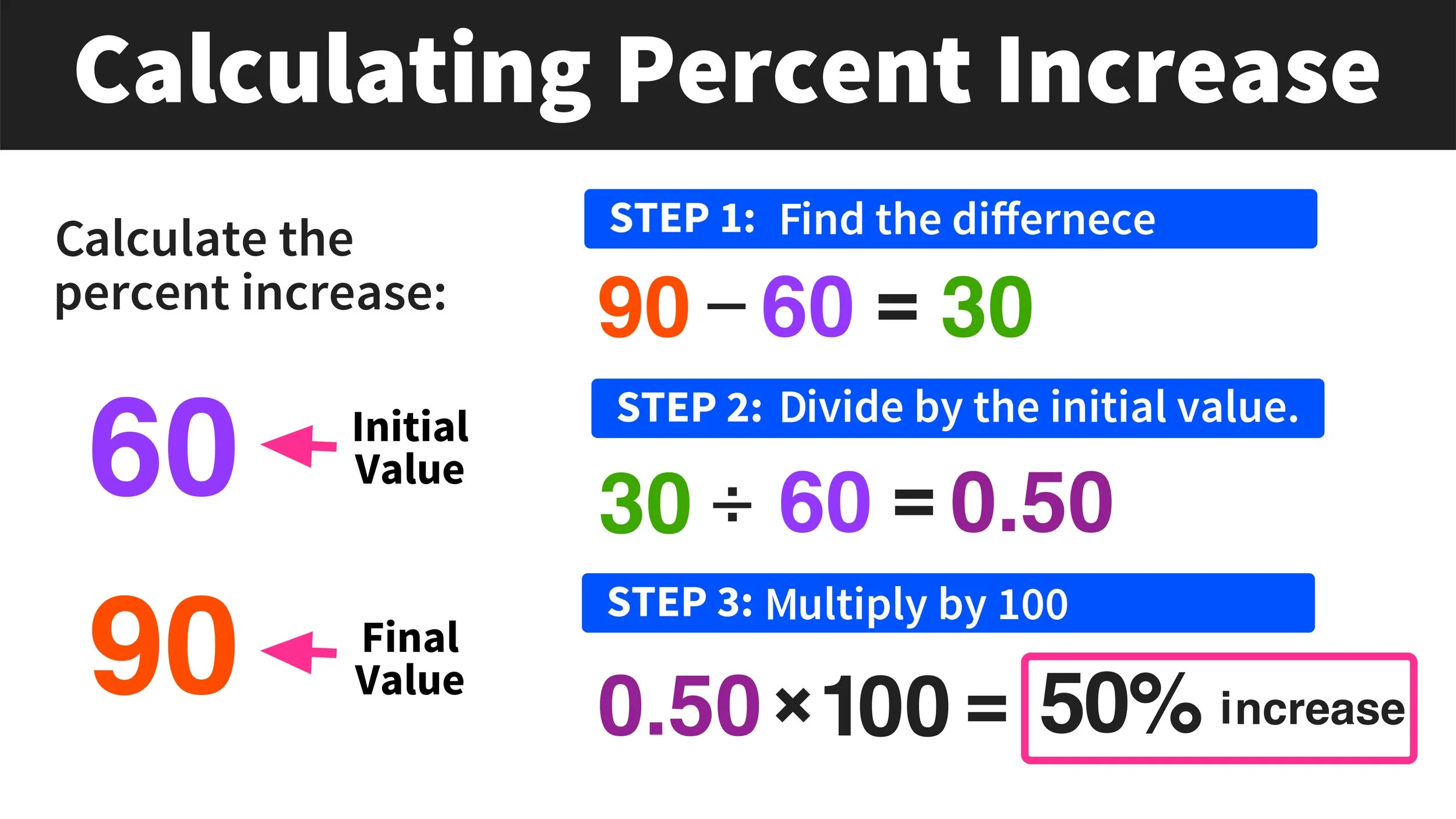
In the world of investing, we rarely care about a static number; we care about how that number has changed over time. The formula for percentage change is:
[(New Value – Old Value) / Old Value] x 100
If your stock portfolio was worth $10,000 last year and is worth $11,500 today, the change is $1,500. Dividing $1,500 by the original $10,000 gives you 0.15, or a 15% return. Mastering this formula allows you to objectively measure the performance of any asset.
2. Percentages in Personal Finance: Mastering Your Budget
Personal finance is effectively the management of percentages. While the dollar amounts may change as your career progresses, the ratios that define a healthy financial life remain remarkably consistent. By viewing your budget through the lens of percentages, you create a scalable system for wealth.
The 50/30/20 Rule
One of the most popular budgeting frameworks is the 50/30/20 rule. This strategy dictates that 50% of your after-tax income should go toward “Needs” (housing, utilities, groceries), 30% toward “Wants” (entertainment, dining out), and 20% toward “Financial Goals” (debt repayment, savings, investments). To figure out if you are meeting these benchmarks, you must take your total monthly take-home pay as the “Whole” and each spending category as the “Part.” If your rent is $2,000 and your income is $5,000, your housing is exactly 40% of your budget—leaving only 10% for other needs if you wish to stick to the formula.
Determining Your Debt-to-Income Ratio (DTI)
When applying for credit, lenders focus heavily on your Debt-to-Income ratio. This percentage represents how much of your gross monthly income goes toward paying debts. To calculate this, sum all your monthly debt obligations (student loans, car payments, credit card minimums) and divide by your gross monthly income. A DTI of 36% or lower is generally considered healthy. Understanding how to calculate this percentage yourself allows you to see your financial health through the eyes of a bank before you ever submit a loan application.

The Savings Rate: The Most Important Number
While many people focus on their net worth, your “Savings Rate” is often a better predictor of financial independence. This is the percentage of your disposable income that you redirect into savings or investments. By calculating this percentage monthly, you can track your efficiency. A person earning $100,000 who saves 20% ($20,000) is often in a better long-term position than someone earning $200,000 who only saves 5% ($10,000).
3. Investing and Market Growth: Understanding Returns and Ratios
In the “Money” niche, percentages are the primary metric for success. Whether you are looking at a brokerage statement or a real estate pro forma, the ability to interpret these figures is what separates an amateur from a sophisticated investor.
Calculating Return on Investment (ROI)
ROI is the universal language of the investment world. It measures the efficiency of an investment relative to its cost. The formula—Net Profit / Cost of Investment x 100—is used to compare the performance of different asset classes. For instance, if you flip a house and make a $50,000 profit on a $250,000 investment, your ROI is 20%. Comparing this to a 7% average annual return in the stock market helps you decide where your capital is best deployed.
Percentage Change vs. Percentage Points
A common point of confusion in financial news is the difference between a percentage change and a change in percentage points. If the Federal Reserve raises interest rates from 3% to 4%, that is a 1 percentage point increase. However, in terms of the interest itself, it is a 33.3% increase (1 divided by 3). Understanding this distinction is vital when analyzing mortgage rates or bond yields, as small shifts in percentage points can lead to massive percentage changes in your monthly payments.
The Power of Compound Interest
Compound interest is often described as the eighth wonder of the world, and it is entirely driven by percentages. When you earn a 7% return on an investment, that 7% is added to your principal. The following year, you earn 7% on the new, larger total. This “percentage on a percentage” effect is what allows small, consistent investments to grow into substantial wealth over decades. To figure out how long it takes for an investment to double at a certain percentage rate, investors use the “Rule of 72”: divide 72 by your annual interest rate. At a 10% return, your money doubles roughly every 7.2 years.
4. Business Finance and Profitability Metrics
For entrepreneurs and business owners, percentages are the vital signs of the company. They tell you if your pricing is correct, if your overhead is too high, and if the business is actually sustainable in the long run.
Gross and Net Profit Margins
A business can have millions of dollars in revenue and still be failing if its margins are too slim.
- Gross Profit Margin: (Revenue – Cost of Goods Sold) / Revenue. This tells you how much profit you make on each product before accounting for overhead.
- Net Profit Margin: Net Income / Revenue. This is the “bottom line” percentage—how much of every dollar earned actually stays in the company’s pocket after every single expense is paid.
High-growth tech companies might prioritize revenue, but a mature, healthy business always focuses on maintaining a strong net profit margin percentage.
Effective Tax Rates and Deductions
Businesses and high-net-worth individuals rarely pay the “statutory” tax rate (the one written in the law). Instead, they focus on the “Effective Tax Rate.” This is figured out by dividing the total tax paid by the total taxable income. If a business earns $1,000,000 but utilizes credits and deductions to pay only $150,000 in taxes, their effective tax rate is 15%, even if the corporate tax bracket is 21%. Mastering this calculation is a cornerstone of strategic tax planning.
Markup vs. Margin: Avoiding the Common Pitfall
One of the most frequent mistakes in business finance is confusing markup with margin.
- Markup is the percentage added to the cost to reach a selling price. (If a product costs $80 and you sell it for $100, the markup is 25%).
- Margin is the percentage of the selling price that is profit. (Using the same $100 sale, the $20 profit represents a 20% margin).
If a business owner wants a 25% margin but applies a 25% markup, they will consistently underperform their financial projections. Knowing how to figure out these specific percentages ensures that pricing strategies align with profit goals.
Conclusion: The Path to Financial Mastery
Figuring out percentages is not merely a schoolhouse exercise; it is the bedrock of financial intelligence. From the simplicity of a “Part over Whole” calculation to the complexity of net profit margins and compound interest trajectories, percentages provide the clarity needed to make informed decisions with your money.
By applying these formulas to your personal budget, your investment portfolio, and your business ventures, you move away from guesswork and toward a data-driven financial life. In the world of money, those who understand percentages are the ones who control the narrative of their wealth. Whether you are aiming for debt freedom, early retirement, or business expansion, let the power of the percentage be your guide to fiscal success.
aViewFromTheCave is a participant in the Amazon Services LLC Associates Program, an affiliate advertising program designed to provide a means for sites to earn advertising fees by advertising and linking to Amazon.com. Amazon, the Amazon logo, AmazonSupply, and the AmazonSupply logo are trademarks of Amazon.com, Inc. or its affiliates. As an Amazon Associate we earn affiliate commissions from qualifying purchases.