
MicroStrategy (MSTR) has long been a fascinating, albeit often volatile, stock on the public markets. Once primarily known as a business intelligence software company, its strategic pivot towards becoming a significant holder of Bitcoin has fundamentally reshaped its investment profile. When MSTR’s stock experiences a downturn on a given day, it’s rarely due to a single isolated factor, but rather a complex interplay of macroeconomic forces, company-specific news, and, most critically, the mercurial movements of the cryptocurrency market. Understanding these dynamics is crucial for any investor attempting to navigate the unique investment thesis that MicroStrategy presents.

At its core, MicroStrategy’s share price is largely a proxy for Bitcoin. While the company still operates its enterprise software business, the vast majority of its market valuation and investor interest now hinges on its colossal Bitcoin holdings. This makes MSTR an unconventional investment, blending traditional equity market risks with the nascent, often unpredictable, volatility of digital assets. Therefore, a daily decline in MSTR stock is almost invariably a signal that one or more of these interconnected factors are exerting downward pressure on its value, directly impacting its Bitcoin-centric valuation and broader investor sentiment.
Understanding MicroStrategy’s Unique Investment Thesis
MicroStrategy’s journey from a traditional software firm to a publicly traded Bitcoin proxy is one of the most audacious corporate strategies in recent memory. Under the leadership of Michael Saylor, the company began accumulating Bitcoin in August 2020, positioning itself as the largest corporate holder of the cryptocurrency. This decision has created a unique investment vehicle, but also exposes shareholders to a distinct set of risks and rewards.
The Bitcoin Bet: A Corporate Strategy Unprecedented
MicroStrategy’s thesis is straightforward: Bitcoin is a superior store of value and a hedge against inflation, and by converting its treasury assets and raising capital to acquire BTC, the company offers shareholders indirect exposure to the digital asset. This strategy has been lauded by crypto proponents and scrutinized by traditional finance analysts. The sheer scale of its holdings means that MicroStrategy’s balance sheet is heavily weighted towards Bitcoin, making its financial health and stock performance inextricably linked to the cryptocurrency’s price movements. This “Bitcoin bet” is the primary lens through which MSTR is now viewed by the market, overshadowing its legacy software operations in terms of market impact.
Software Business vs. Bitcoin Holdings: Dissecting MSTR’s Dual Identity
While Bitcoin dominates the narrative, MicroStrategy still generates revenue and cash flow from its enterprise analytics and business intelligence software. This segment provides a baseline of operational stability, but its contribution to the overall valuation has been significantly diminished by the sheer magnitude of the Bitcoin treasury. Investors typically look at MSTR as having a “sum-of-parts” valuation: the value of its software business plus the market value of its Bitcoin holdings, minus any associated debt. However, the software business often trades at a significant discount in the eyes of the market, primarily because the Bitcoin holdings introduce such a high degree of volatility and risk. A common analytical approach is to view the stock as a leveraged play on Bitcoin, given that the company has used convertible notes and other debt instruments to finance some of its purchases.
The Volatility Factor: Bitcoin’s Influence on Share Price
The most direct and immediate driver of MSTR’s daily stock movements is the price of Bitcoin itself. Given MicroStrategy’s substantial holdings, even minor fluctuations in BTC can translate into significant changes in the company’s net asset value (NAV) per share. When Bitcoin experiences a notable downturn, MSTR’s stock almost always follows suit, often with amplified volatility due to its leveraged nature and the market’s perception of it as a pure-play Bitcoin investment. This inherent correlation means that the factors influencing Bitcoin – such as regulatory news, macroeconomic data, or institutional flows – are paramount in determining MSTR’s short-term trajectory.
Macroeconomic Headwinds and Broader Market Sentiment
Beyond the immediate price action of Bitcoin, MicroStrategy’s stock performance is also heavily influenced by the prevailing macroeconomic environment and the broader market’s appetite for risk. As a growth-oriented company with a highly speculative asset on its balance sheet, MSTR is particularly sensitive to shifts in monetary policy and investor confidence.
Interest Rate Hikes and Inflationary Pressures
Central bank policies, particularly interest rate decisions, play a significant role. When central banks raise interest rates to combat inflation, it typically increases the cost of capital and makes future earnings less attractive when discounted back to the present. This tends to exert downward pressure on growth stocks and speculative assets, as investors rotate out of higher-risk holdings into more conservative, yield-bearing investments. Bitcoin, often touted as an “inflation hedge,” paradoxically can suffer in environments where higher rates increase the opportunity cost of holding non-yielding assets, and MSTR, by extension, feels this pressure. Concerns about sustained inflation, coupled with aggressive monetary tightening, can therefore create a challenging backdrop for MSTR.
Risk-Off Environment: Impact on Growth Stocks and Speculative Assets
In periods of economic uncertainty or market stress, investors often adopt a “risk-off” posture. This involves selling off assets perceived as higher-risk or speculative – a category into which both MicroStrategy and Bitcoin squarely fall. When there is fear of recession, geopolitical instability, or a broad market correction, capital tends to flow out of equities, particularly those with less predictable earnings or high beta, and into perceived safe havens like government bonds or cash. MSTR’s significant exposure to a volatile asset like Bitcoin makes it particularly vulnerable during such risk-off phases, as investors prioritize capital preservation over high-growth potential.
Geopolitical Instability and Investor Confidence
Global geopolitical events can also ripple through financial markets, impacting investor confidence and capital allocation. Conflicts, trade wars, or political instability in major economies can create uncertainty, leading to increased market volatility and a flight to safety. Such events can depress overall market sentiment, causing broad sell-offs across equity markets, including growth stocks and technology companies like MicroStrategy. Furthermore, geopolitical tensions can sometimes directly impact cryptocurrency markets, either through concerns about regulatory crackdowns or their potential use as a sanctions circumvention tool, further affecting MSTR’s underlying asset.
The Bitcoin Price Rollercoaster: MSTR’s Primary Driver
It cannot be overstated: the single most dominant factor influencing MicroStrategy’s stock performance on any given day is the price movement of Bitcoin. The company’s strategy has effectively turned its stock into a publicly traded, leveraged Bitcoin exchange-traded fund (ETF) in all but name, making its fate largely intertwined with that of the cryptocurrency market.

Direct Correlation: How BTC Movements Sway MSTR
The correlation between MSTR and BTC is profound. When Bitcoin rises, MSTR typically outperforms, often exhibiting a higher beta due to the company’s leveraged exposure (using debt to buy more Bitcoin). Conversely, when Bitcoin falls, MSTR often experiences sharper declines. This is because every dollar change in Bitcoin’s price directly impacts the value of MicroStrategy’s considerable holdings, which in turn affects its net asset value and, ultimately, its share price. Investors who buy MSTR are effectively taking a long position on Bitcoin, accepting the heightened volatility that comes with it. Therefore, any news or event that influences Bitcoin’s price, from regulatory announcements to major liquidations in the crypto derivatives market, will have a direct and significant impact on MSTR’s stock.
Liquidation Fears and Margin Call Speculation
A critical aspect of MicroStrategy’s Bitcoin strategy involves its use of debt. The company has purchased a substantial amount of Bitcoin using the proceeds from convertible notes and secured loans, some of which are collateralized by its existing Bitcoin holdings. This introduces a “liquidation risk.” If the price of Bitcoin were to fall below a certain threshold, MicroStrategy could theoretically face margin calls on its collateralized loans, potentially forcing it to sell some of its Bitcoin to meet its obligations. While the company has repeatedly stated it has sufficient uncollateralized Bitcoin and other mechanisms to avoid such a forced sale, the speculation around this risk can create significant downward pressure on the stock during periods of extreme Bitcoin price weakness. Investor anxiety about potential forced liquidations can amplify MSTR’s decline, as the market prices in a worst-case scenario.
Institutional Investor Sentiment Towards Crypto
The broader sentiment of institutional investors towards cryptocurrencies also plays a vital role. When major institutional players express skepticism or reduce their exposure to digital assets, it can trigger a broader sell-off in the crypto market, dragging Bitcoin and, subsequently, MSTR down. Conversely, increased institutional adoption or positive commentary can fuel rallies. MicroStrategy’s stock acts as a bellwether for institutional appetite for crypto exposure within the traditional stock market framework. Any news related to institutional funds, ETFs, or major financial entities entering or exiting the crypto space will likely impact MSTR’s daily performance.
Company-Specific News and Analyst Outlooks
While macroeconomic trends and Bitcoin’s price are dominant forces, MicroStrategy’s own operational performance, strategic announcements, and the opinions of market analysts also contribute to its daily stock movements. These factors provide a layer of company-specific influence that can sometimes diverge from the broader trends.
Earnings Reports and Balance Sheet Analysis
Despite the focus on Bitcoin, MicroStrategy still reports quarterly earnings for its software business. While the revenue and profitability of this segment are often overshadowed by the Bitcoin treasury, they still matter. Strong performance in its core software business can provide a floor for the stock, demonstrating a viable underlying enterprise. Conversely, weak earnings or a deteriorating outlook for the software division can add another layer of selling pressure, especially if the Bitcoin price is also declining. Investors also meticulously scrutinize the balance sheet, particularly the carrying value of its Bitcoin holdings, its debt levels, and its liquidity position. Any changes in these key financial metrics, or management’s commentary surrounding them, can impact investor confidence and drive stock movements.
Management Commentary and Strategic Shifts
Statements from MicroStrategy’s management, particularly its Executive Chairman Michael Saylor, are closely watched by the market. Saylor is a vocal proponent of Bitcoin and his public comments often reiterate the company’s long-term conviction in the digital asset. Any perceived shift in strategy, such as plans for further Bitcoin acquisitions, changes in debt financing, or even minor comments on the state of the crypto market, can influence investor perception and MSTR’s stock price. For instance, an announcement about raising additional capital to buy more Bitcoin might be met with enthusiasm during a bull market but apprehension during a bear market, highlighting the dual nature of investor response to its strategy.
Analyst Ratings, Price Targets, and Market Perceptions
Stock analysts from investment banks and research firms regularly issue reports on MicroStrategy, providing ratings (buy, hold, sell) and price targets. These reports analyze the company’s financial performance, its Bitcoin strategy, and its market positioning. A downgrade from a prominent analyst or a significant revision to a price target can directly impact investor sentiment and trigger a sell-off. Conversely, an upgrade or a positive research note can provide upward momentum. These analyst opinions, while not always perfect predictors, contribute to the collective market perception of MSTR’s value and future prospects.
Navigating Volatility: Investor Considerations for MSTR
Investing in MicroStrategy is not for the faint of heart. Its unique business model creates a profile of exceptionally high volatility and risk, but also significant potential reward. Understanding these characteristics is paramount for any investor considering MSTR.
Risk Assessment: Understanding the High-Risk, High-Reward Profile
MicroStrategy represents a highly concentrated bet on Bitcoin. Its stock offers a leveraged way to gain exposure to the cryptocurrency, but this leverage cuts both ways. While it amplifies gains during Bitcoin bull runs, it also magnifies losses during downturns. Investors must conduct a thorough risk assessment, acknowledging that the vast majority of their investment’s performance will hinge on the highly unpredictable movements of Bitcoin. This means accepting the potential for significant drawdowns and understanding that MSTR’s price is subject to both the inherent volatility of crypto and the broader market’s perception of risk.
Diversification and Portfolio Management
Given MicroStrategy’s concentrated risk profile, it is rarely recommended as a core holding for a diversified portfolio. For investors seeking exposure to Bitcoin, MSTR might be considered a satellite position – a smaller allocation that complements broader diversification across traditional asset classes and other investment vehicles. Effective portfolio management dictates that such high-beta, speculative assets should be balanced with lower-risk holdings to mitigate overall portfolio volatility. An investor’s overall asset allocation should reflect their risk tolerance, financial goals, and time horizon, ensuring that a position in MSTR does not disproportionately expose them to undue risk.
Long-Term Vision vs. Short-Term Fluctuations
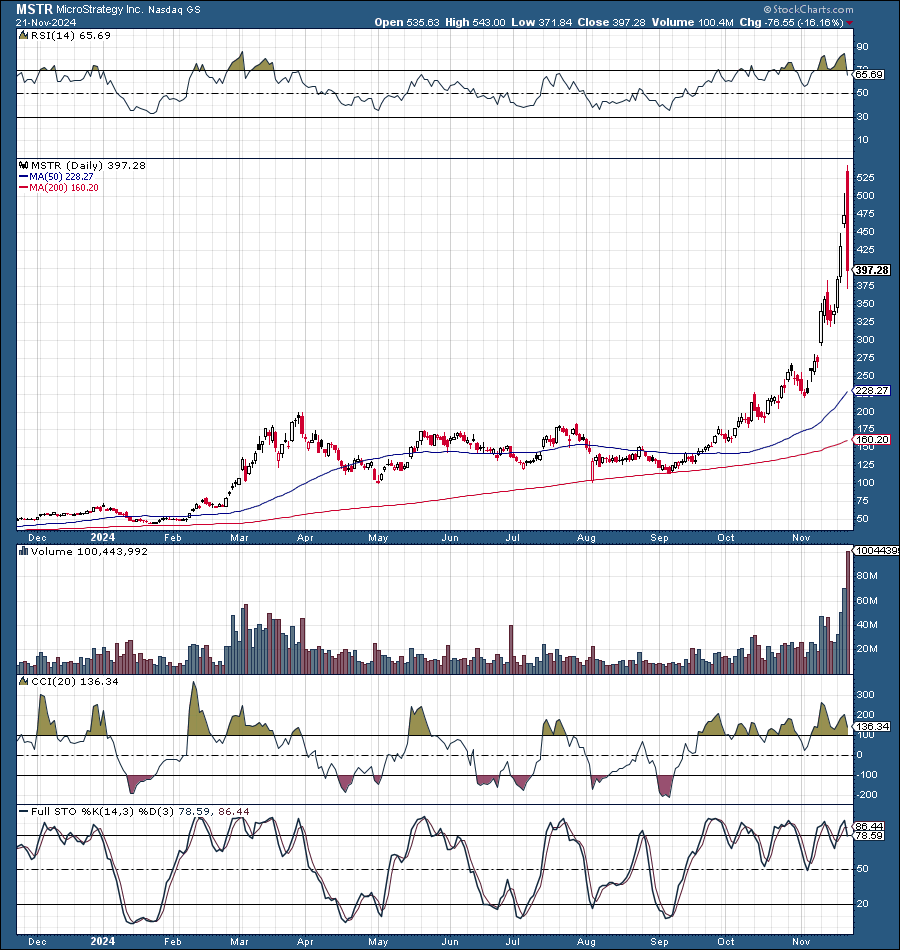
For those invested in MSTR, it’s crucial to distinguish between short-term daily fluctuations and the company’s long-term strategic vision. Michael Saylor and MicroStrategy’s management have consistently articulated a multi-decade conviction in Bitcoin as a foundational digital asset. Investors who align with this long-term thesis may view daily price drops as mere noise or even buying opportunities, rather than fundamental shifts. However, short-term traders might capitalize on MSTR’s volatility, attempting to profit from its rapid swings. Understanding one’s own investment horizon and philosophy is key to reacting appropriately to the daily movements of a stock like MicroStrategy. A drop in MSTR stock today, while potentially unsettling, might simply be a reflection of transient market sentiment or Bitcoin’s inherent choppiness, rather than an indictment of its long-term strategy.
aViewFromTheCave is a participant in the Amazon Services LLC Associates Program, an affiliate advertising program designed to provide a means for sites to earn advertising fees by advertising and linking to Amazon.com. Amazon, the Amazon logo, AmazonSupply, and the AmazonSupply logo are trademarks of Amazon.com, Inc. or its affiliates. As an Amazon Associate we earn affiliate commissions from qualifying purchases.