
Purchasing a vehicle is often the second-largest financial commitment most individuals make, trailing only the purchase of a home. Yet, many consumers walk into a dealership with only a vague idea of what they can afford, often falling into the trap of focusing solely on the “monthly number” rather than the total cost of the debt. To navigate this process successfully, you must approach it through the lens of personal finance and strategic planning. Understanding how to figure out a car payment involves more than just plugging numbers into a calculator; it requires a deep dive into interest rates, loan terms, principal amounts, and the long-term impact on your net worth.

The Three Pillars of a Car Loan: Principal, Interest, and Term
Before you can calculate a payment, you must understand the three primary variables that dictate the outcome. These components work in tandem; changing one will invariably affect the others and the overall health of your monthly budget.
Understanding the Principal Amount
The principal is the actual amount of money you are borrowing from a lender to cover the purchase price of the vehicle. It is important to distinguish the principal from the “sticker price” or MSRP of the car. The principal is calculated by taking the agreed-upon purchase price, adding sales tax, registration fees, and dealer documentation fees, and then subtracting your down payment and any trade-in equity.
Lowering your principal is the most direct way to lower your car payment. For every $1,000 you put down upfront, you typically shave about $20 off your monthly payment (assuming a standard interest rate and a 60-month term).
The Role of the Annual Percentage Rate (APR)
The interest rate, or APR, is the cost of borrowing the money. This is where your credit score plays a pivotal role. In the world of personal finance, your creditworthiness determines whether you are offered a 3% “prime” rate or an 18% “subprime” rate. On a $30,000 loan, the difference between these two rates can result in thousands of dollars in extra interest over the life of the loan. Understanding your APR is essential because it dictates how much of your monthly payment goes toward the actual car versus the bank’s profit.
Loan Term Length and Its Psychological Trap
The term is the duration of the loan, usually expressed in months (e.g., 36, 48, 60, 72, or 84 months). While a longer term—such as 72 or 84 months—will significantly lower your monthly payment, it is often a financial pitfall. Longer terms mean you will be paying interest for a longer period, and you risk falling into “negative equity,” where you owe more on the car than it is worth. From a wealth-building perspective, the shortest term you can afford is almost always the best financial move.
The Mathematics of the Monthly Payment
While most people use online financial tools to get an instant number, understanding the underlying formula provides clarity on how your money is moving. Car loans are typically “amortized,” meaning the payment is fixed, but the ratio of interest to principal changes over time.
The Amortization Formula
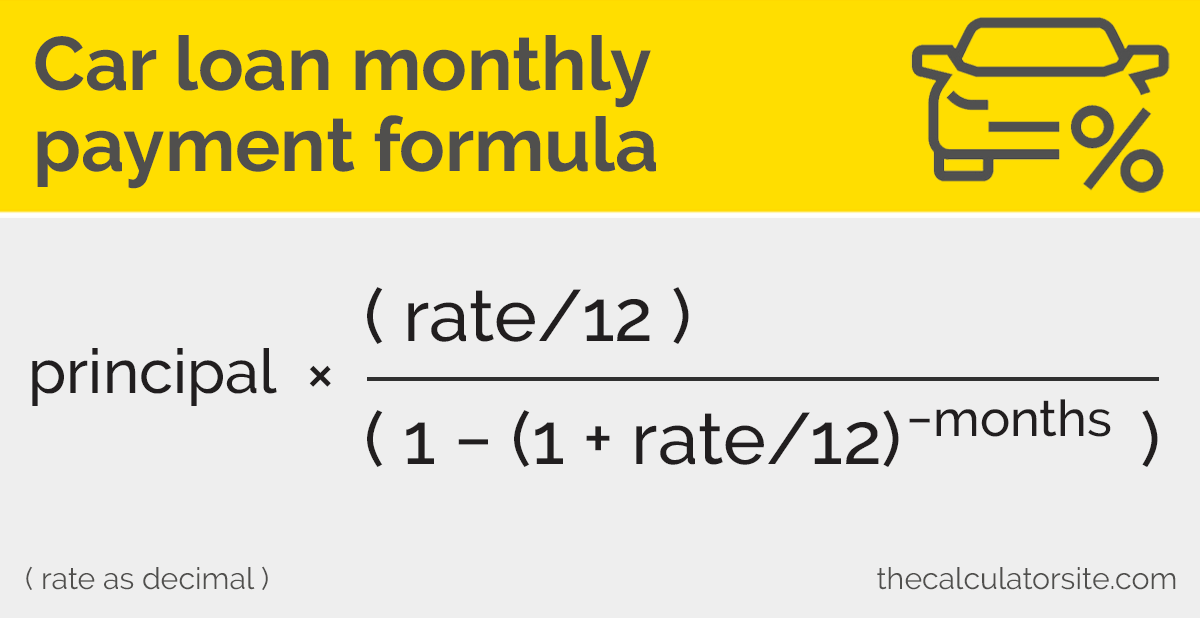
The standard formula for calculating a monthly payment ($P$) is:
P = L [ i(1 + i)^n ] / [ (1 + i)^n – 1 ]
- L = Loan amount (Principal)
- i = Monthly interest rate (APR divided by 12)
- n = Number of months (Term)
By looking at this formula, it becomes clear that interest is compounded. In the early stages of your loan, a larger portion of your payment goes toward interest. As the principal balance drops, less interest is charged, and more of your payment goes toward the actual value of the vehicle.
Using Financial Tools and Calculators
In the modern digital landscape, you don’t need to do long-form math. However, you should use calculators that allow for “what-if” scenarios. A professional-grade car payment calculator should include fields for sales tax (which varies by state), trade-in value, and any “out-the-door” fees. When figuring out your payment, always use the “out-the-door” price rather than the MSRP to ensure your budget remains accurate.
Factoring in Sales Tax and Fees
A common mistake in car payment calculation is forgetting that the price tag on the window is not the final amount financed. Depending on your location, sales tax can add 5% to 10% to the total cost. Furthermore, dealerships often charge documentation fees, and states require title and registration fees. If you do not pay these out of pocket, they are rolled into the loan, increasing your principal and, consequently, your monthly interest.
Strategic Financial Rules for Affordability
To maintain a healthy financial life, you should not simply ask, “Can I make this payment?” but rather, “Does this payment fit within a balanced financial plan?” Personal finance experts often suggest specific frameworks to prevent “car poor” scenarios.
The 20/4/10 Rule
This is a gold standard in personal finance for vehicle purchasing:
- 20% Down Payment: Put at least 20% down to avoid immediate negative equity as the car depreciates the moment you drive it off the lot.
- 4-Year Term: Finance the car for no more than 48 months (4 years). This ensures you aren’t paying for a vehicle long after its reliability begins to fade.
- 10% of Income: Your total transportation costs (including payment, insurance, and fuel) should not exceed 10% of your gross monthly income.
Debt-to-Income (DTI) Ratio Considerations
Lenders look at your Debt-to-Income ratio when deciding whether to approve your loan and at what rate. If your car payment pushes your total monthly debt payments (including rent/mortgage and student loans) above 36% to 43% of your gross income, you may be viewed as a high-risk borrower. Figuring out your car payment involves ensuring that this new debt doesn’t jeopardize your ability to qualify for other lines of credit, such as a mortgage, in the future.
The Opportunity Cost of a High Payment
Every dollar sent to a car lender is a dollar that cannot be invested in the stock market or a retirement account. When figuring out your payment, consider the “opportunity cost.” For example, a $600 monthly car payment over five years equals $36,000. If that same $600 were invested in a diversified index fund with a 7% average annual return, it would grow to over $43,000 in those same five years. Understanding this trade-off is a hallmark of sophisticated financial planning.
Beyond the Payment: Calculating Total Cost of Ownership (TCO)
A car payment is only one part of the monthly expense. To truly figure out the cost of a car, you must look at the Total Cost of Ownership.
Insurance Premiums
Newer cars, especially those financed through a lender, require “full coverage” insurance. This includes liability, collision, and comprehensive coverage. Depending on your age, driving record, and the vehicle type, insurance can add $100 to $300 to your monthly transportation budget. Always get an insurance quote for the specific vehicle you are considering before signing the loan documents.
Fuel and Maintenance Reserves
While fuel costs fluctuate, they are a recurring line item. Additionally, even new cars require maintenance—oil changes, tire rotations, and eventual brake replacements. A wise financial move is to set aside a “sinking fund” or a monthly maintenance reserve. If you estimate $50 a month for maintenance and $150 for fuel, your $400 car payment is actually a $600 monthly commitment.
Depreciation: The Silent Cost
Depreciation isn’t a bill you pay every month, but it is a real financial cost. A car is a depreciating asset, meaning it loses value over time. When figuring out your payment, consider the resale value of the car four or five years down the line. Vehicles that hold their value well (low depreciation) essentially “cost” you less in the long run because you recoup more of your money when it’s time to sell or trade.
Tactics to Lower Your Calculated Payment
If your initial calculations show a payment that is too high for your budget, there are several levers you can pull to bring that number down without extending the loan term to a dangerous length.
Improving Your Credit Score Before Applying
Because interest is a major component of the payment, a higher credit score is your best tool. If your score is in the “fair” range, taking six months to pay down credit card balances and ensure on-time payments can move you into the “good” or “excellent” range, potentially saving you 5% or more on your APR.
Maximizing Trade-in Value and Down Payments
The most effective way to lower a payment is to reduce the principal. Instead of accepting the first trade-in offer from a dealer, get quotes from third-party buyers or consider a private sale to maximize the equity you can put toward the new car. Similarly, if you can delay your purchase by three months to save an additional $2,000 for a down payment, your monthly payment will drop significantly.

Considering Certified Pre-Owned (CPO) Options
If the payment for a brand-new car is out of reach, a Certified Pre-Owned vehicle offers a middle ground. CPO cars have already taken the largest “depreciation hit” (which occurs in the first two years), but they often come with manufacturer warranties and lower price tags, resulting in a much more manageable monthly payment.
In conclusion, figuring out a car payment is an exercise in comprehensive financial awareness. By balancing the principal, interest, and term, and by looking beyond the monthly bill to the total cost of ownership, you can make a purchase that fits your lifestyle without compromising your long-term financial security. Real affordability is found where your vehicle needs and your wealth-building goals intersect.
aViewFromTheCave is a participant in the Amazon Services LLC Associates Program, an affiliate advertising program designed to provide a means for sites to earn advertising fees by advertising and linking to Amazon.com. Amazon, the Amazon logo, AmazonSupply, and the AmazonSupply logo are trademarks of Amazon.com, Inc. or its affiliates. As an Amazon Associate we earn affiliate commissions from qualifying purchases.