
The term “cistern” often conjures images of ancient Mediterranean ruins or rustic stone-lined pits. However, in the context of modern infrastructure and the burgeoning field of GreenTech, the water cistern has undergone a radical technological transformation. Far from being a simple storage tank, the contemporary cistern is a sophisticated piece of hydraulic engineering integrated with smart sensors, advanced filtration systems, and sustainable materials. As global water scarcity becomes an increasingly pressing issue, understanding the technology behind water cisterns—and how they are being digitized—is essential for the next generation of smart city planning and residential architectural design.
Understanding the Core Technology: Evolution from Stone to Synthetic
At its most fundamental level, a water cistern is a waterproof receptacle designed to catch and store rainwater or groundwater for future use. While the concept remains unchanged for millennia, the materials science governing their construction has seen exponential leaps in the last two decades.
High-Performance Materials: Polyethylene, Steel, and Reinforced Concrete
Modern cisterns are categorized largely by their material composition, which determines their durability, chemical resistance, and installation complexity.
- High-Density Polyethylene (HDPE): Most residential and light-commercial cisterns now utilize UV-stabilized, food-grade HDPE. These tanks are rotationally molded to ensure a seamless construction, preventing the structural weaknesses often found in welded or jointed units.
- Galvanized and Corrugated Steel: For large-scale industrial applications, engineers employ heavy-gauge steel coated with specialized epoxy or polymer liners (such as G-115 galvanized coating). These structures are engineered to withstand massive hydrostatic pressure and environmental stressors.
- Pre-cast and Cast-in-Place Concrete: Used primarily for underground installations, modern concrete cisterns utilize crystalline waterproofing admixtures. This technology allows the concrete to “self-heal” micro-cracks by reacting with moisture to form insoluble crystals, ensuring the vessel remains airtight for decades.
The Mechanics of Collection and Filtration Systems
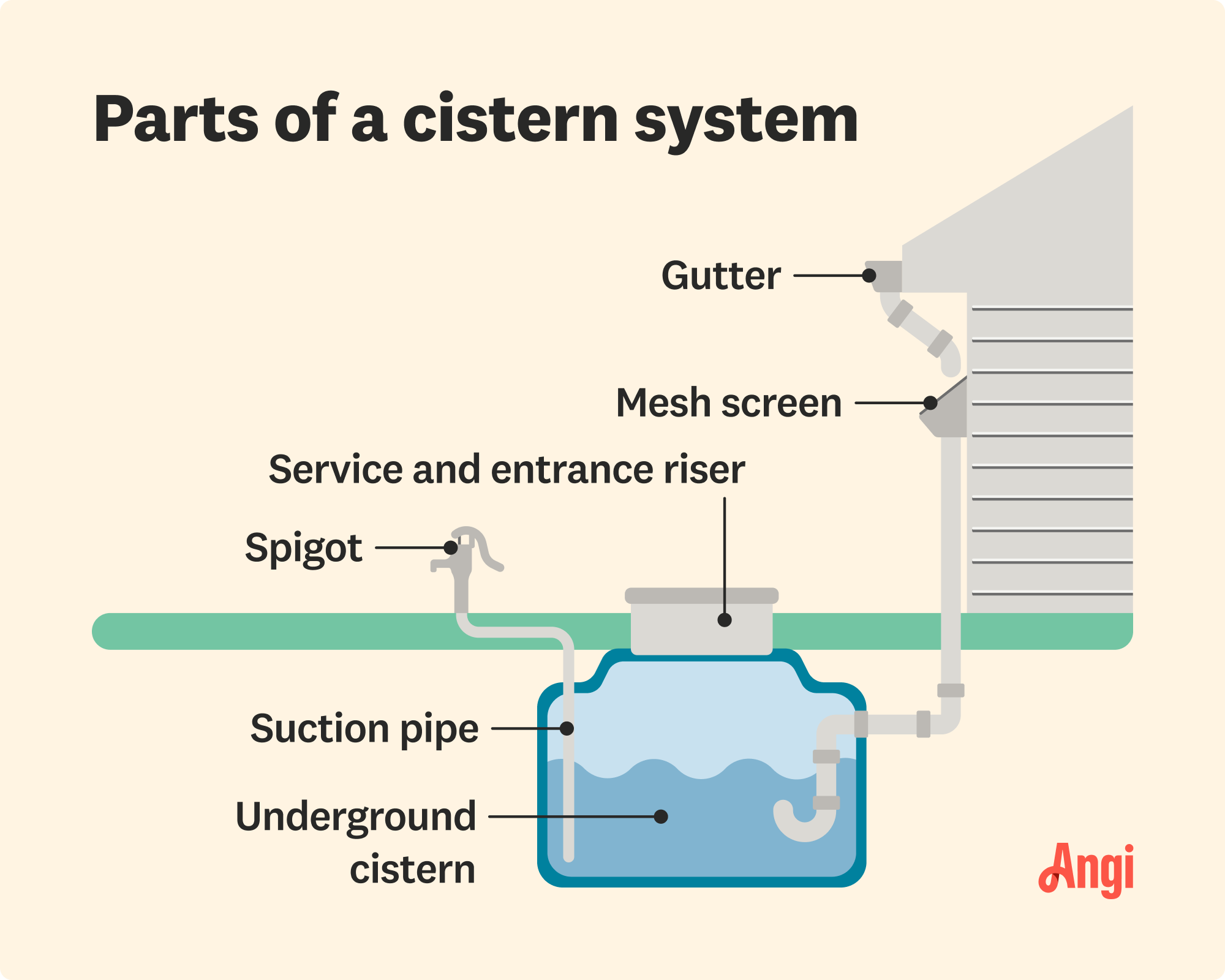
The efficiency of a cistern is not just in its storage capacity but in its “treatment train”—the technical sequence that moves water from the catchment surface (usually a roof) to the tank. This involves “first-flush diverters,” which are mechanical valves that automatically discard the first several gallons of runoff. This initial water usually contains the highest concentration of atmospheric pollutants and debris. Only after this mechanical purge does the “clean” water enter the storage chamber, utilizing vortex filters that use centrifugal force to separate fine particles without the need for high-maintenance mesh screens.
The Integration of Smart Water Management (The “Internet of Cisterns”)
As the “Internet of Things” (IoT) expands into every facet of home and industrial management, water cisterns have become nodes in the digital ecosystem. A “smart cistern” is no longer a passive container but an active participant in a building’s resource management system.
IoT Sensors and Real-Time Level Monitoring
Modern cisterns are now equipped with ultrasonic or hydrostatic pressure sensors that provide millimeter-accurate data on water levels. These sensors transmit data via protocols such as LoRaWAN, Wi-Fi, or NB-IoT to a centralized dashboard.
- Ultrasonic Sensors: These use sound waves to measure the distance between the sensor and the water surface, providing non-contact monitoring that prevents sensor degradation.
- Hydrostatic Transducers: Submerged at the bottom of the tank, these measure the weight of the water column above them to determine volume.
This data allows property managers and homeowners to view consumption patterns on their smartphones, identifying leaks or unusual usage spikes in real-time.
Automated Filtration and Purification Tech
For water intended for potable use (drinking water), the technology suite within the cistern is significantly more complex. Modern systems integrate multi-stage purification arrays:
- UV Sterilization: As water is pumped out of the cistern, it passes through a stainless steel chamber housing a high-intensity Ultraviolet lamp. This disrupts the DNA of bacteria and viruses, rendering them harmless without the use of chemicals.
- Electro-Adsorptive Media: Advanced filters use a positive charge to attract and trap sub-micron particles, including heavy metals and pharmaceutical residues that traditional carbon filters might miss.
- Automated Backwashing: Smart controllers can trigger a reverse flow through the filtration media based on pressure differentials, ensuring the system maintains high throughput without human intervention.
Architectural Engineering and Strategic Installation
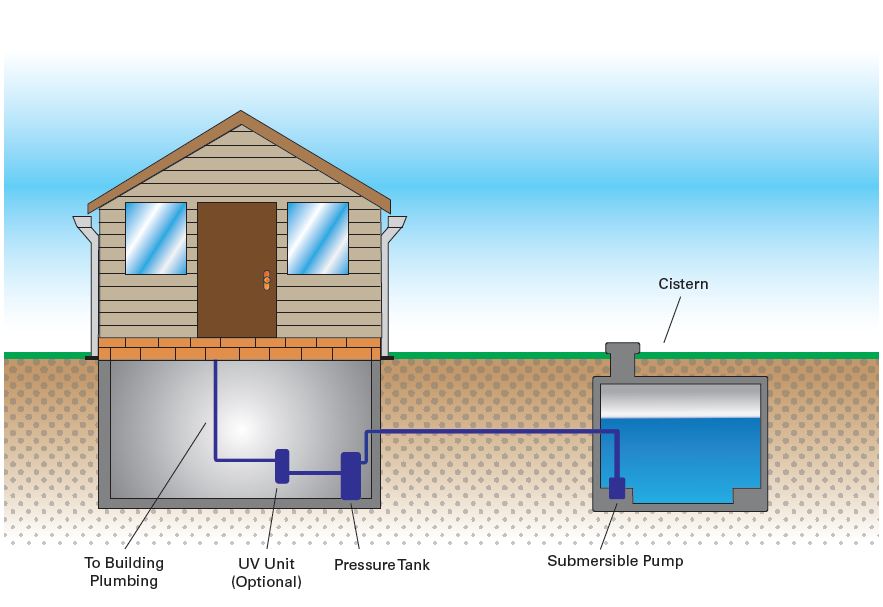
The placement and integration of a cistern require precise structural engineering. Whether the system is localized for a single-family home or scaled for a data center, the technical constraints of fluid dynamics and soil mechanics are paramount.
Above-Ground vs. Underground Systems: Technical Constraints
The choice between above-ground and underground storage is driven by engineering trade-offs.
- Underground Cisterns: These require sophisticated excavation and structural reinforcement to resist the “buoyancy effect”—the tendency of an empty tank to be pushed out of the ground by the surrounding water table. They offer the advantage of thermal stability, keeping stored water cool and preventing algae growth by eliminating sunlight.
- Above-Ground Cisterns: These are easier to maintain and can utilize gravity-fed systems, reducing the energy load required for pumping. However, they must be engineered with opaque materials to block UV radiation, which otherwise fosters biological activity.
Pump Technology and Pressure Regulation
A cistern is only as effective as its delivery system. Modern installations utilize Variable Speed Drive (VSD) pumps. Unlike traditional pumps that are either “on” or “off,” VSD pumps adjust their motor speed to match the specific demand for water. If a user opens a single tap, the pump runs at a low frequency; if a commercial irrigation system activates, the pump ramps up. This tech not only extends the lifespan of the hardware but significantly reduces the electrical footprint of the water system.
Digital Tools for Water Conservation and Efficiency
Beyond the hardware, the software layer of cistern management is where the most significant innovations are occurring. We are seeing the rise of dedicated applications and AI-driven platforms that treat water as a data point to be optimized.
Mobile Apps for Residential Water Autonomy
Consumer-facing apps now allow users to manage their cisterns with the same granularity as their bank accounts. These platforms offer:
- Forecasting: By integrating with local meteorological data, the software can predict when the cistern will be replenished by rainfall and advise the user on whether to conserve water or if they have a surplus for landscaping.
- Auto-Switching: In systems connected to a municipal backup, the software can automatically switch from cistern water to city water if the tank levels drop below a critical threshold, ensuring a seamless supply while prioritizing the “free” harvested water.
AI-Driven Predictive Consumption Modeling
In industrial settings, machine learning algorithms analyze historical usage data alongside production schedules. For example, a tech campus using a cistern for cooling tower makeup-water can use AI to predict demand based on ambient temperature and server load. This allows the system to pre-treat or move water between storage units in anticipation of high-demand periods, optimizing the efficiency of the entire facility.
The Future of Distributed Water Infrastructure
As we look toward the future, the technology of the cistern is moving from isolated units to “Distributed Water Infrastructure.” This vision involves interconnected networks of storage units across a city that can share data and potentially resources.

Scalable Solutions for Urban and Industrial Environments
Urban planners are increasingly looking at “Blue-Green” infrastructure, where cisterns are integrated into the very fabric of the city.
- Modular Storage: Engineers are designing modular cistern units that double as structural elements, such as retaining walls or foundation blocks. This “functional integration” minimizes the footprint of water storage in dense urban environments.
- Graywater Tech Integration: The next technological frontier is the hybrid cistern—a system that manages both harvested rainwater and treated graywater (from sinks and showers). This requires advanced biological reactors and membrane bioreactors (MBRs) to be housed within or adjacent to the cistern, creating a closed-loop system that reduces a building’s external water dependency by up to 80%.
In conclusion, the modern water cistern is a triumph of multi-disciplinary engineering. It bridges the gap between ancient necessity and futuristic tech, combining materials science, IoT connectivity, and advanced fluid dynamics. As we transition into an era where water is increasingly viewed as a precious digital and physical asset, the technology housed within these vessels will be the silent backbone of sustainable living and industrial resilience. By moving away from centralized, aging grids and toward these intelligent, localized storage systems, we are leveraging technology to secure one of our most vital resources.
aViewFromTheCave is a participant in the Amazon Services LLC Associates Program, an affiliate advertising program designed to provide a means for sites to earn advertising fees by advertising and linking to Amazon.com. Amazon, the Amazon logo, AmazonSupply, and the AmazonSupply logo are trademarks of Amazon.com, Inc. or its affiliates. As an Amazon Associate we earn affiliate commissions from qualifying purchases.