
In the landscape of American finance, few names carry as much weight as Chase. Whether you are opening a basic savings account, applying for a premium credit card, or seeking a mortgage for a first home, Chase is often the first port of call. However, for many consumers and retail investors, a fundamental question remains: Who actually owns Chase?
Unlike a private family business or a government-held entity, the ownership of Chase—officially known as JPMorgan Chase & Co.—is a complex web of institutional power, individual stakeholders, and public market dynamics. Understanding who controls this financial titan is not just an exercise in corporate trivia; it is a vital lesson in how the global financial system operates and how personal wealth is managed at the highest levels.
The Corporate Structure: JPMorgan Chase & Co.
To understand who owns Chase, one must first understand what Chase is. Chase is the consumer and commercial banking brand of JPMorgan Chase & Co., a multinational financial services holding company. While the “Chase” brand handles the retail side—branches, ATMs, and credit cards—the “J.P. Morgan” brand typically handles investment banking, asset management, and private banking for the ultra-wealthy.
The Evolution of a Financial Powerhouse
The ownership of Chase today is the result of decades of mergers and acquisitions. The most significant of these occurred in 2000, when J.P. Morgan & Co. merged with Chase Manhattan Corporation. This merger created a diversified financial services firm that could compete on every level of the global economy. Because JPMorgan Chase & Co. is a publicly traded company, it does not have a single “owner.” Instead, it is owned by thousands of individual and institutional shareholders who trade its stock on the New York Stock Exchange under the ticker symbol JPM.
The Role of the Board of Directors
While the shareholders are the technical owners, they do not manage the day-to-day operations of the bank. That responsibility falls to the Board of Directors and the executive leadership team. Led by Chairman and CEO Jamie Dimon, the board acts as a fiduciary for the shareholders. They ensure that the company’s strategies align with the interests of those who own the stock, focusing on profitability, risk management, and long-term growth.
The Primary Shareholders: Institutional Dominance
When we look at the official filings with the Securities and Exchange Commission (SEC), a clear picture emerges: Chase is primarily owned by large institutional investors. These are massive organizations that manage money on behalf of millions of individual savers, pension holders, and retail investors.
The “Big Three” Asset Managers
The largest owners of JPMorgan Chase are the same firms that dominate much of the S&P 500: The Vanguard Group, BlackRock, and State Street Corporation.
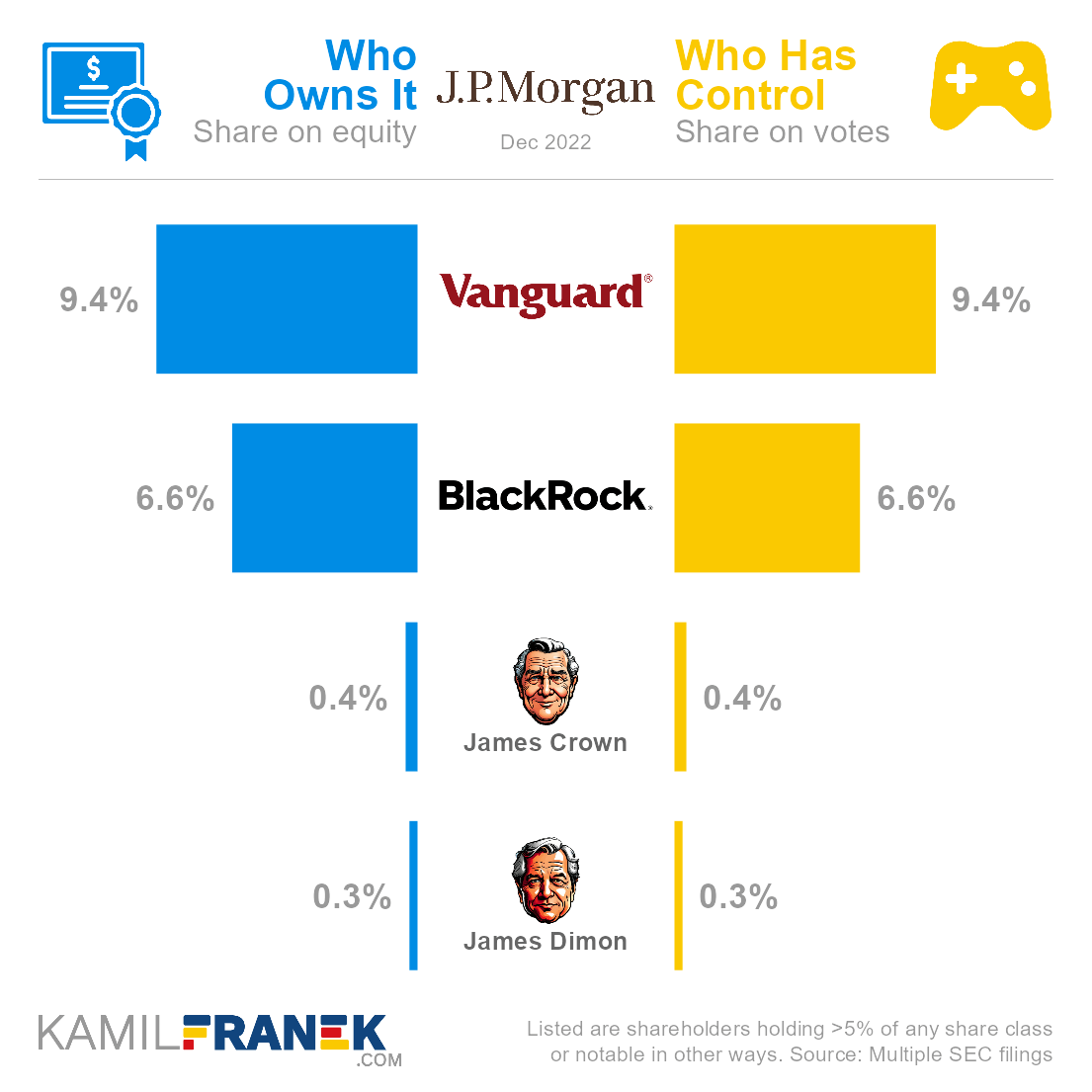
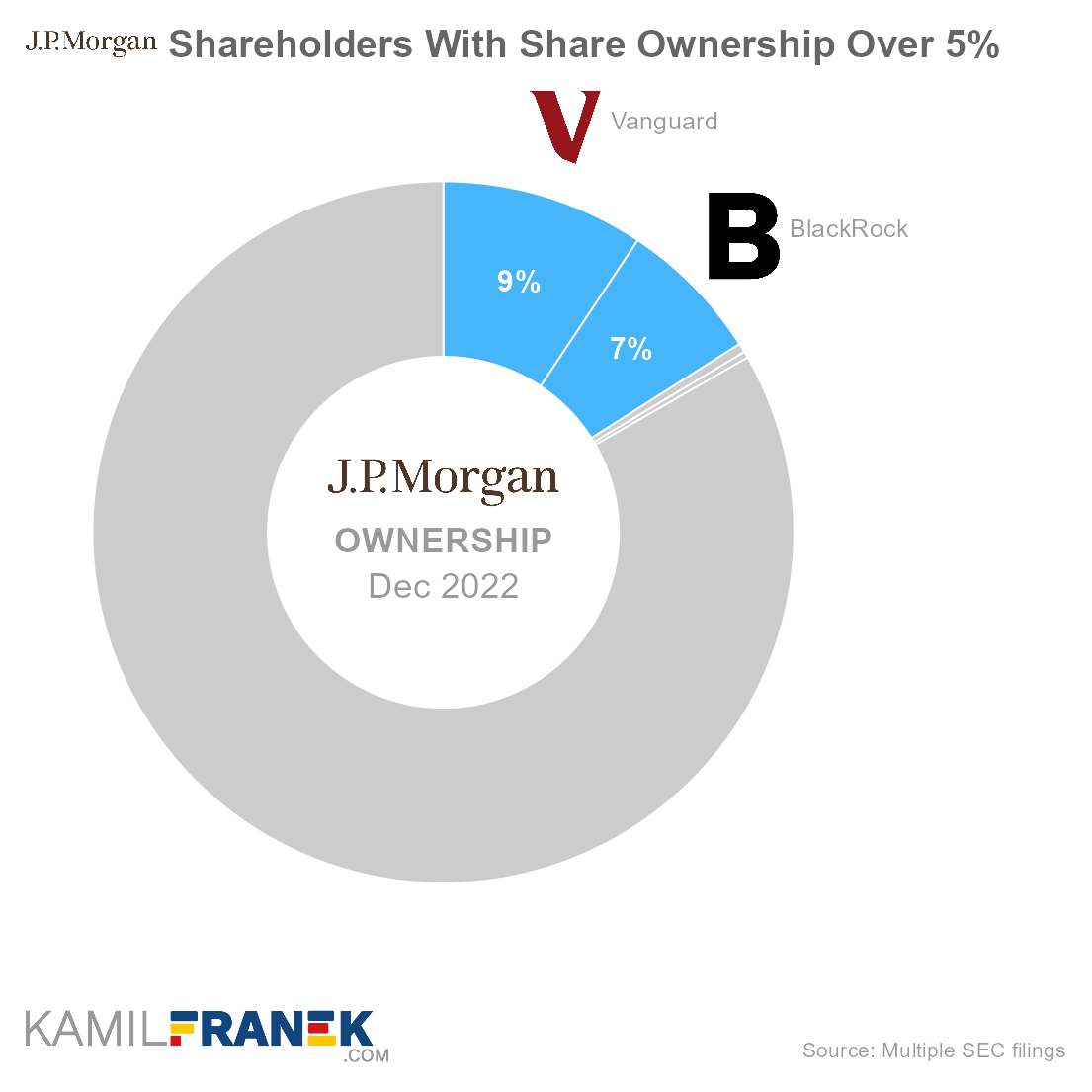
- The Vanguard Group: Often holding the largest stake (typically between 8% and 9%), Vanguard owns JPM shares across its various mutual funds and ETFs. If you own a Vanguard Total Stock Market Index Fund, you are, in a small way, a part-owner of Chase.
- BlackRock: As the world’s largest asset manager, BlackRock holds a significant percentage of the bank, often through its iShares line of ETFs.
- State Street: Through its SPDR funds, State Street holds a substantial portion of the company’s equity, rounding out the trio of institutional giants that exert significant influence over corporate governance.
Institutional vs. Individual Ownership
Institutional investors own roughly 70% to 80% of JPMorgan Chase & Co. This high level of institutional ownership provides a degree of stability to the stock price, as these entities tend to hold shares for the long term. The remaining percentage is held by “retail investors”—regular people buying shares through brokerage accounts—and “insiders,” who are the executives and board members of the bank itself.

Inside the C-Suite: Insider Ownership
While Jamie Dimon is the face of the bank, his personal ownership stake, while worth hundreds of millions of dollars, represents only a fraction of the total company (usually less than 0.5%). However, because he holds a significant number of shares, his personal wealth is directly tied to the bank’s performance, aligning his interests with those of the larger institutional shareholders.
The Financial Powerhouse: What Ownership Represents in the Economy
Ownership of Chase isn’t just about holding a piece of a bank; it’s about holding a stake in the backbone of the American economy. As a “Global Systemically Important Bank” (G-SIB), the health of Chase is often seen as a proxy for the health of the U.S. financial system.
Market Capitalization and Valuation
JPMorgan Chase & Co. consistently ranks as the largest bank in the United States by assets and one of the largest in the world by market capitalization. With a valuation that frequently exceeds $500 billion, the “owners” of Chase are invested in an entity that moves trillions of dollars daily. This scale allows the bank to generate massive profits through interest income, trading fees, and advisory services, which are then redistributed to owners in the form of dividends and stock buybacks.
The Dividend Strategy for Shareholders
One of the primary reasons investors choose to own Chase is its commitment to returning capital. For those in the “Money” niche, JPM is often viewed as a “dividend aristocrat” in the making. The bank has a history of consistently paying out dividends, providing a steady income stream for the pension funds and retirees who comprise its ownership base. When the bank performs well, the owners benefit not just through share price appreciation, but through direct cash payments.
What Ownership Means for the Average Consumer
If you are a Chase customer, you might wonder how this ownership structure affects your bank account or your credit card interest rate. The reality of a publicly-owned bank is that it must balance two often-competing interests: the needs of the customers and the demands of the shareholders.
Stability and Risk Management
Because Chase is owned by major institutions like Vanguard and BlackRock, there is immense pressure on the bank to maintain a “fortress balance sheet.” This term, famously used by Jamie Dimon, refers to the bank’s practice of keeping high levels of capital reserves to weather economic storms. For a customer, this means your deposits are held by one of the most stable financial institutions in the world. The owners demand safety because a collapse would be catastrophic for their portfolios.
The Drive for Profitability
On the flip side, because the owners expect a return on their investment, Chase is driven to maximize efficiency and profitability. This can manifest in various ways, such as the fees associated with premium accounts or the interest rates offered on savings. The bank must remain competitive to attract customers, but it must also remain profitable to satisfy its owners. This tension drives the innovation we see in Chase’s digital tools and loyalty programs, such as the Chase Sapphire ecosystem, which is designed to capture high-value customers who generate consistent revenue for the firm.
Conclusion: The Shared Legacy of Chase
In the end, the question “Who owns Chase?” has a two-fold answer. On paper, it is owned by the institutional giants of Wall Street—Vanguard, BlackRock, and State Street—who manage the wealth of the masses. On a functional level, it is a publicly-owned engine of capitalism that serves as a cornerstone of the global financial infrastructure.
For the individual interested in personal finance and investing, Chase represents the pinnacle of the corporate banking model. It is a reminder that in the modern economy, the largest “owners” are often the funds that represent our own 401(k)s and IRAs. By understanding the ownership of Chase, we gain insight into the circular nature of money: the bank serves the public, the public invests in the bank through funds, and the bank returns profits to those funds to grow the public’s wealth. It is a complex, massive, and highly regulated cycle that ensures Chase remains a dominant force in the financial world for the foreseeable future.
aViewFromTheCave is a participant in the Amazon Services LLC Associates Program, an affiliate advertising program designed to provide a means for sites to earn advertising fees by advertising and linking to Amazon.com. Amazon, the Amazon logo, AmazonSupply, and the AmazonSupply logo are trademarks of Amazon.com, Inc. or its affiliates. As an Amazon Associate we earn affiliate commissions from qualifying purchases.