
The fundamental building blocks of the universe, matter, can be broadly categorized into two main groups: pure substances and mixtures. While the concept of mixtures—combinations of different substances that retain their individual properties—is readily apparent in our daily lives (think of a salad or saltwater), understanding pure substances requires a more precise definition. Pure substances, by contrast, are characterized by a fixed composition and distinct, unchanging properties. They cannot be separated into simpler substances by physical means. This singular nature makes them critical components in scientific research, industrial processes, and even the development of advanced technologies.

Within the realm of pure substances, a crucial distinction exists, one that underpins much of our understanding of chemistry and material science. Identifying and differentiating these types of pure substances is not merely an academic exercise; it is foundational to grasping how matter behaves, interacts, and can be manipulated for specific applications. From the development of advanced materials in the tech industry to the precise formulations required in manufacturing, a deep comprehension of these pure substance types is essential. This article will delve into the two primary classifications of pure substances, exploring their definitions, characteristics, and significance, particularly as they relate to the technological landscape.
Elements: The Indivisible Foundations of Matter
At the most elemental level, we find elements. An element is a pure substance consisting of only one type of atom, defined by the number of protons in its nucleus, known as its atomic number. This atomic number is unique to each element and cannot be altered by chemical means. Once an element is identified, its properties are inherent and constant. The periodic table, a cornerstone of chemistry, organizes all known elements based on their atomic structure and recurring chemical properties, providing a systematic framework for understanding their behavior.
The discovery and understanding of elements have evolved dramatically throughout history. Ancient civilizations recognized a handful of elements like gold, silver, and iron, often mistaking compounds for elements. The scientific revolution, however, brought about rigorous experimentation and observation, leading to the systematic identification of a growing number of elements. The modern definition of an element, based on atomic structure, solidified in the early 20th century with the advent of nuclear physics.
The Building Blocks of Technology: Properties and Applications
The technological sector is profoundly dependent on the unique properties of various elements. Consider the semiconductor industry, a lynchpin of modern computing and electronics. Silicon (Si), a metalloid, is the quintessential example. Its ability to conduct electricity under specific conditions, controllable through doping with other elements, makes it the foundation of transistors, integrated circuits, and microprocessors. The purity of silicon used in these applications is paramount; even minute traces of impurities can drastically alter its electrical conductivity, rendering it unusable for its intended purpose. This necessitates highly sophisticated purification techniques, a testament to the importance of elemental purity in high-tech manufacturing.
Beyond silicon, other elements play indispensable roles. Rare earth elements, a group of 17 chemically similar metallic elements, are crucial for the production of magnets in hard drives and electric vehicles, phosphors in display screens, and catalysts in petroleum refining. Their unique magnetic and optical properties are irreplaceable in many advanced technologies. Lithium (Li), another element, is the backbone of rechargeable batteries powering everything from smartphones to electric cars. Its high electrochemical potential and low atomic mass make it an ideal candidate for energy storage.
Furthermore, metals like copper (Cu) are vital for their electrical conductivity in wiring, while noble metals such as gold (Au) and platinum (Pt) are prized for their corrosion resistance and catalytic properties, finding applications in specialized electronic components and sensors. Even gases, which are also elements, are critical. Nitrogen (N₂) is used as an inert atmosphere to prevent oxidation in manufacturing processes and in the cryogenic cooling of sensitive electronic equipment. The careful selection and procurement of elements with specific, unadulterated properties are therefore non-negotiable for innovation and reliability in the tech industry. The pursuit of ever-higher purity levels for these elements directly fuels advancements in miniaturization, performance, and efficiency across a vast spectrum of technological applications.
Compounds: Synthesized from Elements with Fixed Ratios
In contrast to elements, compounds are pure substances formed when two or more different elements chemically combine in a fixed ratio. Unlike mixtures, where the constituent substances retain their individual identities, the elements in a compound undergo a chemical reaction to form a new substance with entirely new properties that are distinct from those of the original elements. For example, water (H₂O) is a compound formed from hydrogen (H) and oxygen (O). Hydrogen is a highly flammable gas, and oxygen is essential for combustion. Yet, when combined in a 2:1 atomic ratio, they form water, a liquid that extinguishes fire. This illustrates the profound transformation that occurs at the chemical level.
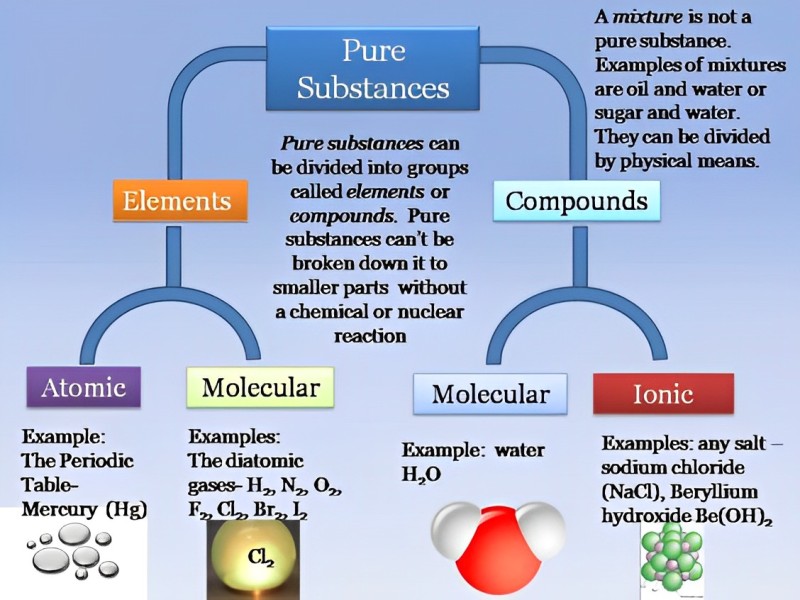
The composition of a compound is always consistent, regardless of its origin or how it was formed. This fixed ratio is governed by the law of definite proportions, a fundamental principle in chemistry. The chemical bonds holding the atoms together in a compound are strong and require chemical reactions to break. Separation of a compound into its constituent elements can only be achieved through chemical processes, such as electrolysis or chemical decomposition.
Synthesized for Innovation: The Role of Compounds in Technology
The technological world is replete with examples of compounds, often engineered for specific functionalities. From the materials that form the physical structure of devices to the intricate chemical compounds enabling their operation, their importance cannot be overstated.
Semiconductor doping is a prime example of how manipulating compounds, or more accurately, creating specific compositions involving elemental doping, leads to advanced functionality. While silicon is an element, its electrical properties are drastically altered by introducing controlled amounts of other elements, forming specific compound-like structures at the atomic level. For instance, doping silicon with phosphorus (a Group 15 element) creates an n-type semiconductor, while doping with boron (a Group 13 element) creates a p-type semiconductor. These doped silicon wafers are the fundamental components of transistors and integrated circuits.
Beyond semiconductors, the materials science behind modern technology relies heavily on a vast array of compounds. Ceramics, often metal oxides, are used for their high-temperature resistance, electrical insulation, and hardness in applications like spark plugs, the casings of some electronic devices, and high-performance components. Polymers, large molecules made up of repeating subunits of smaller organic molecules, are ubiquitous. Plastics, synthetic fibers, and rubber are all polymers, engineered with diverse properties such as flexibility, strength, and transparency for use in device casings, insulation, and flexible displays. The precise chemical structure and composition of these polymers dictate their performance characteristics.
Specialty chemicals are another crucial category of compounds. These are often complex organic or inorganic compounds developed for specific high-value applications. In the realm of electronics manufacturing, for instance, photoresists are light-sensitive compounds used in photolithography to etch patterns onto semiconductor wafers. Etchants are chemical compounds designed to selectively remove material during the manufacturing process. Dyes and pigments used in displays and printing technologies are also compounds, meticulously formulated to produce specific colors and light absorption/reflection properties.
The development of new materials with enhanced properties—lighter, stronger, more conductive, or more resistant to environmental factors—often involves the synthesis and precise control of novel compounds. For instance, research into perovskites has shown significant promise for next-generation solar cells due to their efficient light-harvesting capabilities. Similarly, the quest for advanced battery technologies involves the exploration of new electrolyte compounds and electrode materials, such as lithium-ion compounds, which are essential for efficient energy storage and rapid charging. The ability to synthesize and characterize these compounds with exceptional purity and accuracy is a direct enabler of technological progress, allowing for the creation of smaller, faster, more efficient, and more durable electronic devices and systems.

The Interplay and Significance in Technological Advancement
The distinction between elements and compounds is not merely a theoretical construct; it is a practical imperative that drives innovation and product development within the technology sector. The very foundation of our digital world is built upon the precise manipulation and application of both elemental purity and the controlled synthesis of compounds.
The pursuit of higher purity levels for elements is a continuous endeavor. For semiconductors, even parts per billion (ppb) or parts per trillion (ppt) of impurities in silicon can lead to performance degradation or outright failure. This has spurred the development of sophisticated purification techniques like zone refining and chemical vapor deposition, pushing the boundaries of material science and engineering. The consistent quality and predictable behavior of highly purified elements are non-negotiable for the reliability and scalability of electronic components.
Conversely, the creation and characterization of novel compounds with specific desired properties are at the heart of material discovery and innovation. Researchers and engineers constantly explore new combinations of elements and design intricate molecular structures to achieve breakthroughs. This includes developing advanced alloys for structural components in aerospace and high-performance computing, discovering new polymers with enhanced thermal or electrical properties for flexible electronics, and synthesizing specialized chemicals for cutting-edge manufacturing processes. The ability to predict, design, and synthesize compounds with tailored characteristics is a key determinant of technological advancement.
The interdependence is clear: the properties of elements dictate the potential building blocks, while the ability to combine them into compounds unlocks a universe of possibilities. For example, the inherent conductivity of copper (an element) is essential for electrical wiring. However, the development of sophisticated semiconductor compounds, such as gallium arsenide (GaAs) or indium phosphide (InP), has enabled much faster electronic devices due to their superior electron mobility compared to silicon. These compounds, while containing elements, exhibit entirely new sets of electrical and optical properties.
In conclusion, a firm grasp of the two types of pure substances—elements and compounds—is fundamental to understanding the physical basis of technology. Elements represent the fundamental, indivisible atomic building blocks, each with inherent, unchanging properties. Compounds, on the other hand, are formed by the chemical union of elements in fixed ratios, resulting in new substances with distinct characteristics. The relentless pursuit of ultrapure elements and the ingenious synthesis of new compounds are the twin engines that power progress in the ever-evolving landscape of technology, from the microchips in our smartphones to the advanced materials shaping our future.
aViewFromTheCave is a participant in the Amazon Services LLC Associates Program, an affiliate advertising program designed to provide a means for sites to earn advertising fees by advertising and linking to Amazon.com. Amazon, the Amazon logo, AmazonSupply, and the AmazonSupply logo are trademarks of Amazon.com, Inc. or its affiliates. As an Amazon Associate we earn affiliate commissions from qualifying purchases.