
The term “hex” can evoke a variety of images and associations, from arcane spells and mysterious enchantments to the fundamental building blocks of digital information. Within the realm of technology, understanding “hex” is not about conjuring spirits, but about deciphering the language of computers and the digital world. It’s a fundamental concept that underpins how data is represented, processed, and displayed, impacting everything from the code that runs your favorite applications to the images you see on your screen. This article will demystify the concept of hexadecimal notation, explore its critical role in computing, and illuminate why it’s an essential piece of knowledge for anyone seeking a deeper understanding of technology.
Understanding Hexadecimal Notation: Beyond the Binary
Computers, at their core, operate on a binary system – a language of ones and zeros. While this is the most fundamental way a computer understands information, it’s incredibly cumbersome for humans to read and work with. Imagine trying to represent a simple color code or a memory address using only long strings of binary digits. This is where hexadecimal notation steps in, offering a more compact and human-readable representation of binary data.
The Power of Base-16
Hexadecimal, often abbreviated as “hex,” is a positional numeral system with a base of 16. This means it uses 16 distinct symbols to represent numbers. In contrast, the decimal system we use daily has a base of 10, employing the digits 0 through 9. The hexadecimal system expands upon this by using the digits 0 through 9 and then introducing the first six letters of the alphabet: A, B, C, D, E, and F. These letters represent the decimal values 10 through 15, respectively:
- A = 10
- B = 11
- C = 12
- D = 13
- E = 14
- F = 15
This system is particularly well-suited for representing binary data because each hexadecimal digit can represent exactly four binary digits (bits). This is because 2 to the power of 4 equals 16, the base of the hexadecimal system. This direct correspondence makes conversion between binary and hexadecimal remarkably efficient.
The Conversion Advantage
Let’s illustrate the conversion advantage with an example. Consider the binary number 11110000. In decimal, this would be a straightforward calculation. However, to represent this in hexadecimal, we can group the binary digits into sets of four, starting from the right: 1111 and 0000.
- The first group,
1111, directly translates to the hexadecimal digit ‘F’ (which represents 15 in decimal). - The second group,
0000, directly translates to the hexadecimal digit ‘0’.
Therefore, the binary number 11110000 is equivalent to F0 in hexadecimal. This is significantly more concise and easier to grasp than the original 8-bit binary string. Conversely, taking a hexadecimal digit like ‘A’ (which represents 10 in decimal) and converting it back to binary is also a simple four-bit representation: 1010. This clean mapping is a primary reason for hexadecimal’s prevalence in computing.
Notation and Recognition
To distinguish hexadecimal numbers from decimal numbers, they are often prefixed with 0x (e.g., 0xF0) or suffixed with ‘h’ (e.g., F0h). This notation is crucial for programming languages and technical documentation to avoid ambiguity and ensure correct interpretation of the data. Recognizing these prefixes or suffixes is the first step in identifying a hexadecimal value.
The Pervasive Influence of Hex in Technology
Hexadecimal notation is not an esoteric concept confined to the deepest recesses of computer science; its influence is felt across a wide spectrum of technological applications and disciplines. From the fundamental representation of data to the user-facing interfaces of software, hex plays a vital, albeit often invisible, role.
Data Representation and Memory Addressing
At the most granular level, hexadecimal is indispensable for representing raw data and memory addresses. When developers work with memory dumps, debugging programs, or analyzing network packets, they are often presented with streams of hexadecimal values. This is because memory is organized in bytes, and each byte can be efficiently represented by two hexadecimal digits.
For instance, a typical computer memory address might look like 0x7FFF.... This hexadecimal representation is far more manageable than its equivalent in binary, which would be a very long string of ones and zeros. Similarly, raw data formats, file headers, and configuration files frequently utilize hexadecimal to display bytes of information. This allows developers and system administrators to quickly identify patterns, spot anomalies, and understand the underlying structure of data.
Color Representation in Digital Graphics

One of the most visible applications of hexadecimal notation is in defining colors for web pages, graphics software, and digital displays. The RGB (Red, Green, Blue) color model is commonly used, where each primary color component is assigned a value to determine the final hue. In hexadecimal, each of these components is represented by two hex digits, ranging from 00 (no intensity) to FF (full intensity).
For example, pure red is represented as #FF0000. Here, FF for red means maximum intensity, 00 for green means no intensity, and 00 for blue means no intensity. Pure white is #FFFFFF (maximum intensity for all three), and black is #000000 (no intensity for any). Intermediate colors are combinations of these values, such as a shade of purple like #800080 (medium red, no green, medium blue). This hexadecimal representation is concise, widely adopted, and easily understood by web developers and graphic designers.
Network Protocols and Data Transmission
When data is transmitted across networks, it is broken down into packets. The headers of these packets contain critical information such as source and destination IP addresses, port numbers, and control flags. These addresses and identifiers are often represented and analyzed using hexadecimal notation. For example, IPv6 addresses, which are much longer than IPv4 addresses, are universally represented in hexadecimal form to make them more manageable. Debugging network traffic often involves examining packet data in hexadecimal dumps to identify issues with data integrity or protocol implementation.
Hexadecimal in Programming and Software Development
The practical implications of hexadecimal reach deeply into the day-to-day activities of software developers and engineers. Its utility extends from the foundational aspects of coding to the debugging and optimization of complex systems.
Debugging and Error Analysis
When a program encounters an error, the debugging process often involves inspecting the program’s state, including memory contents and register values. These values are frequently displayed in hexadecimal format by debugging tools. This is because hexadecimal provides a compact and decipherable representation of the underlying binary data that the CPU is working with. Developers can quickly identify specific bytes, compare values, and trace the flow of data by looking at hexadecimal dumps. For instance, a programmer might encounter a memory address represented as 0xDEADBEEF, which is a memorable hexadecimal value often used as a placeholder or for debugging purposes to indicate an uninitialized or corrupted memory region.
File Formats and Data Interpretation
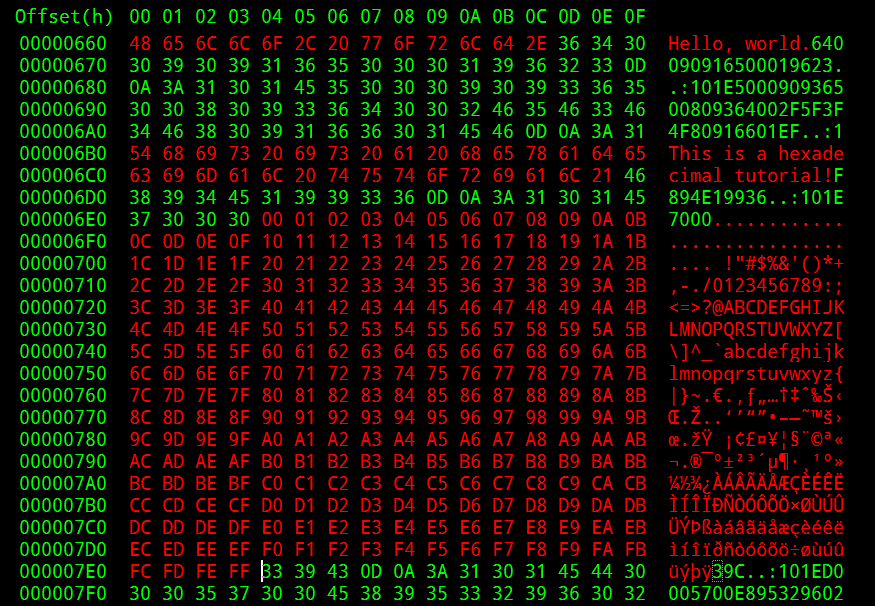
Many file formats, from image files and executable programs to configuration files, store data in binary. When examining these files at a low level, hexadecimal editors (often called hex editors or hex viewers) are used. These tools display the raw byte content of a file in hexadecimal, allowing users to inspect, edit, and understand the internal structure of various file types. This is invaluable for reverse engineering, data recovery, and understanding how different applications store and interpret information. For example, the header of a JPEG image file will contain specific hexadecimal byte sequences that identify it as a JPEG, and understanding these patterns can be crucial for diagnosing image corruption issues.
Working with Low-Level Hardware and Embedded Systems
In the realm of embedded systems, operating systems, and hardware interaction, hexadecimal is a fundamental language. When dealing with device drivers, microcontroller registers, or direct memory access, developers often work with hexadecimal representations of memory-mapped I/O ports and hardware registers. This is because these operations often involve manipulating individual bits or bytes, and hexadecimal provides a convenient way to represent and manipulate these values. For example, configuring a specific hardware peripheral might involve writing specific hexadecimal values to designated memory addresses that control the peripheral’s behavior.
The Broader Implications: Why Hex Matters
Understanding hexadecimal notation is more than just learning a new numbering system; it’s about gaining a deeper appreciation for the underlying mechanisms that power our digital world. It provides a crucial bridge between the abstract world of human-readable code and the concrete reality of how computers process and store information.
Bridging the Human-Machine Gap
As mentioned, binary is the native language of computers. However, it is inherently difficult for humans to read, write, and comprehend. Hexadecimal, with its base-16 structure, offers a compromise. It’s compact enough to be manageable for humans while still maintaining a direct and simple relationship with binary. This makes it an ideal intermediary for representing complex binary data in a more accessible format. Without this bridge, interacting with low-level systems, analyzing data, and debugging would be exponentially more challenging.
Essential for Technical Literacy
In an increasingly digital society, a certain level of technical literacy is becoming essential. For anyone aspiring to work in technology, understand computer systems, or even troubleshoot common digital issues, a grasp of hexadecimal is a valuable asset. It unlocks a deeper understanding of how data is represented, how programs function at a fundamental level, and how various digital components communicate. Whether you are a software developer, a system administrator, a cybersecurity analyst, or even a curious hobbyist, knowing what a hex value signifies can significantly enhance your capabilities and comprehension.

Future-Proofing Your Understanding
As technology continues to evolve, the fundamental principles of data representation remain constant. While new programming languages, tools, and frameworks emerge, the underlying need to understand binary and its hexadecimal representation will persist. By investing the time to learn hexadecimal, you are equipping yourself with a foundational skill that will remain relevant across various technological advancements. It’s a cornerstone of computer science that provides a durable and transferable understanding of how digital information is managed and manipulated.
In conclusion, “hex” is far more than a curious term; it’s a vital linguistic tool in the world of technology. It’s the efficient translator that allows us to interact with the binary language of computers, making complex data structures, memory addresses, and color codes understandable and manageable. From the intricate workings of software to the vibrant hues on our screens, hexadecimal plays a silent yet indispensable role, empowering us to navigate and understand the digital landscape with greater clarity and precision.
aViewFromTheCave is a participant in the Amazon Services LLC Associates Program, an affiliate advertising program designed to provide a means for sites to earn advertising fees by advertising and linking to Amazon.com. Amazon, the Amazon logo, AmazonSupply, and the AmazonSupply logo are trademarks of Amazon.com, Inc. or its affiliates. As an Amazon Associate we earn affiliate commissions from qualifying purchases.