
The Treaty of Versailles, signed in 1919 to formally end World War I, stands as a monumental document in 20th-century history. Within its extensive clauses, one article, often referred to as the “War Guilt Clause,” etched itself into the collective memory of nations and had profound, long-lasting financial repercussions. This was Article 231, a seemingly straightforward statement that would unleash a torrent of economic and political instability, fundamentally altering the financial landscape of Europe and the world for decades to come. Understanding Article 231 is not merely an academic exercise in historical jurisprudence; it is crucial for grasping the intricate ways in which political pronouncements can translate into crippling financial burdens, shaping economies and influencing international relations.
The article’s impact transcended its legal wording, becoming a potent symbol of humiliation and financial subjugation for Germany. Its consequences rippled through global finance, contributing to hyperinflation, economic depression, and ultimately, providing fertile ground for extremist ideologies. Examining Article 231 through a financial lens reveals the devastating power of imposed reparations and the complex interplay between war, peace treaties, and economic prosperity.
The Genesis of a Financial Reckoning: The War Guilt Clause and Its Financial Implications
Article 231 of the Treaty of Versailles was drafted with the intention of establishing legal responsibility for the war. However, its practical application initiated a cycle of financial demands that would cripple the defeated nations.
The Text and Its Immediate Financial Interpretation
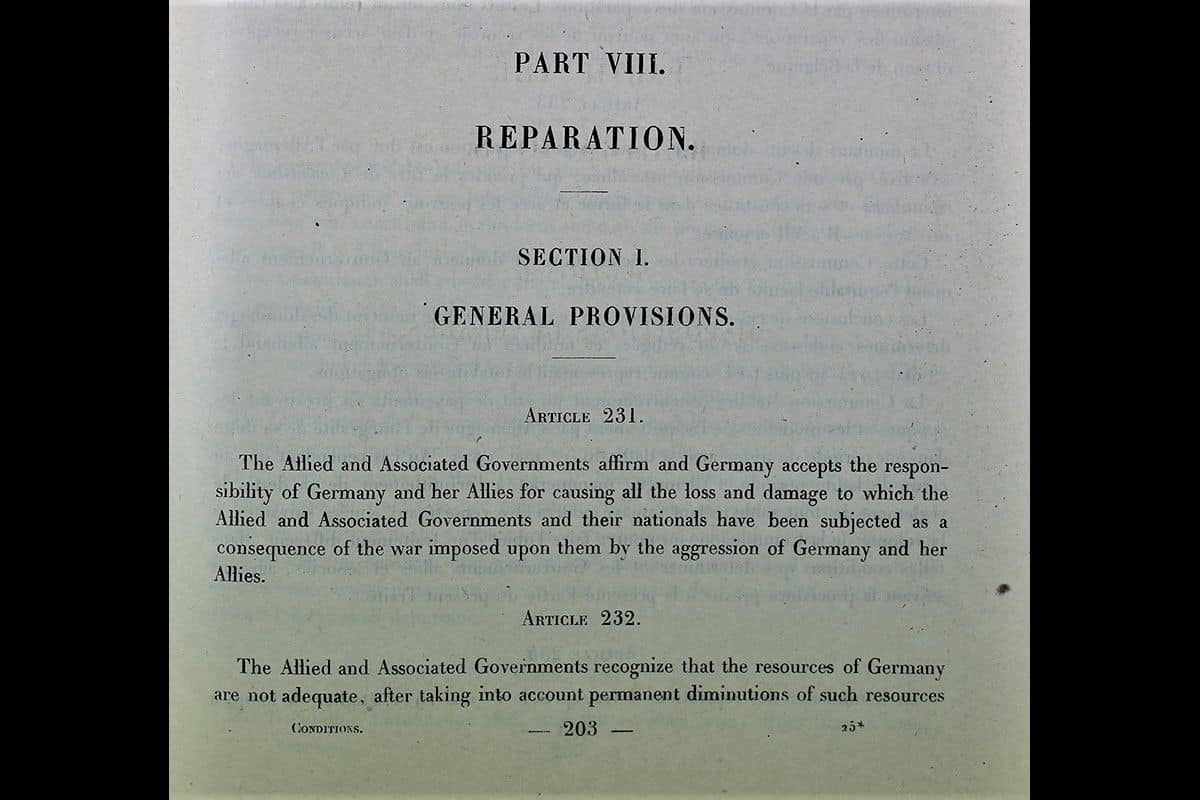
The wording of Article 231 is deceptively simple: “The Allied and Associated Governments affirm and Germany accepts the responsibility of Germany and her allies for causing all the loss and damage to which the Allied and Associated Governments and their nationals have been subjected as a consequence of the war imposed upon them by the aggression of Germany and her allies.”
While the clause itself did not explicitly detail the amount of reparations, it laid the foundational legal argument for demanding them. The “loss and damage” it referred to was interpreted by the Allied powers as encompassing not only direct military expenditures but also civilian casualties, economic disruption, and the costs of demobilization. This broad interpretation opened the door for immense financial claims against Germany. The immediate financial implication was clear: Germany was legally obligated to pay for the entirety of the war’s devastation, a sum that would be determined later but was widely understood to be astronomical. This imposed financial burden was not a simple debt; it was framed as a moral and legal imperative, designed to punish and to prevent future aggression through economic incapacitation.
The Economic Rationale (from the Allied Perspective)
From the perspective of the victorious Allied powers, demanding reparations was seen as a necessary economic measure for several interconnected reasons. Firstly, it was a form of compensation for the immense human and material losses they had suffered. Countries like France, which had been a primary battleground, faced widespread destruction and required substantial funds for reconstruction. Secondly, reparations were intended to weaken Germany economically, thereby preventing it from posing a military threat in the future. A crippled economy would limit Germany’s capacity to rearm and rebuild its military might. Thirdly, for some Allied nations, particularly France, reparations also served as a form of punitive justice, a way to ensure that the perceived aggressor bore the financial brunt of its actions. The economic rationale, therefore, was a blend of recoupment, deterrence, and retribution, all channeled through the mechanism of financial compensation.
The Legal Foundation for Financial Reparations
Article 231 provided the crucial legal bedrock upon which the subsequent reparations demands were built. Without this “War Guilt Clause,” the Allied powers would have lacked the definitive legal justification for imposing such stringent financial obligations on Germany. The clause established Germany’s sole responsibility, thereby absolving the Allied powers of shared culpability and creating a unilateral claim for damages. This legal framing was essential for the political will of the Allied nations to impose and enforce what would become the largest financial transfer in history at that time. It transformed a political desire for retribution and compensation into a legally binding international obligation, with profound and often devastating financial consequences for the party deemed responsible.
The Unfolding Financial Catastrophe: From Reparations to Ruin
The theoretical financial obligations stipulated by Article 231 quickly materialized into a tangible and devastating economic reality for Germany, with global ramifications.
The Reparations Commission and the Dawes Plan
Following the ratification of the Treaty of Versailles, the Inter-Allied Reparations Commission was established to determine the total sum Germany would have to pay. In 1921, this commission set the figure at a staggering 132 billion gold marks, an amount that was widely considered unpayable by many economic observers. This astronomical figure far exceeded Germany’s capacity to generate revenue, especially given the economic disruption of the war and the territorial losses imposed by the treaty.
The immediate effect of this demand was severe economic distress within Germany. The government attempted to meet its obligations through printing money, leading to rampant inflation. By 1923, Germany experienced hyperinflation, rendering its currency virtually worthless. Savings were wiped out, businesses collapsed, and widespread poverty ensued. This economic devastation not only impacted Germany but also had a chilling effect on international trade and investment, as the uncertainty surrounding German reparations created instability.
Recognizing the unsustainability of the original reparations schedule, international efforts were made to restructure the payments. The Dawes Plan, introduced in 1924, was a significant attempt to alleviate Germany’s financial burden and stabilize its economy. The plan restructured the payment schedule, provided Germany with a substantial international loan, and introduced a foreign currency reserve mechanism. The Dawes Plan succeeded in temporarily stabilizing the German economy and allowing for a period of relative prosperity in the mid-1920s. However, it did not erase the fundamental issue of Germany’s perceived inability to meet the reparations demands indefinitely, and it still tied Germany’s financial stability to external factors and the goodwill of its former enemies.
The Impact on Global Financial Markets
The unresolved issue of German reparations had a profound and destabilizing effect on global financial markets throughout the 1920s. The sheer magnitude of the potential claims created a pervasive sense of uncertainty. Investors were hesitant to commit capital to Germany, fearing that its economy would be perpetually drained by reparations payments. This reluctance stifled foreign investment and hindered economic recovery not only in Germany but also in other European nations that relied on German economic stability for trade and loan repayments.
Furthermore, the reparations system was intricately linked to the war debts owed by Allied nations to the United States. The “all or nothing” nature of the reparations, where Germany was expected to pay vast sums to the Allies, who in turn were expected to repay their debts to the U.S., created a fragile circular flow of money. This reliance on German payments made the entire international financial system vulnerable to any disruption in Germany’s ability to pay. When Germany faltered, the entire edifice of international finance began to shake, contributing to the global economic instability that would culminate in the Great Depression. The interconnectedness meant that a crisis in one part of the system could rapidly cascade, demonstrating the far-reaching financial consequences of the decisions made in Versailles.
The Road to the Great Depression and Beyond
The economic turmoil directly and indirectly fueled by Article 231 and the subsequent reparations demands played a significant role in the lead-up to the Great Depression. The crippling reparations weakened the German economy, making it a fragile node in the global financial network. The hyperinflation of the early 1920s was a stark warning of the economic fragility. When the Wall Street Crash of 1929 occurred, the already precarious global financial system, heavily reliant on a stable Germany, buckled under the strain.
Germany’s inability to service its debts and meet reparations obligations exacerbated the international financial crisis. The widespread economic suffering in Germany, a direct consequence of the financial policies dictated by the treaty, fostered deep resentment and political extremism. This created fertile ground for the rise of Adolf Hitler and the Nazi Party, whose promises of economic revival and national resurgence resonated with a population disillusioned by years of financial hardship and national humiliation. The financial burden imposed by Article 231, therefore, did not merely lead to economic hardship; it contributed to a political climate that would ultimately plunge the world into an even more devastating global conflict. The financial scars left by Article 231 were not confined to balance sheets; they were etched into the very fabric of societies, shaping destinies and leading to unforeseen historical consequences.
The Lingering Financial Legacy: Lessons from Article 231
The economic and political ramifications of Article 231 offer enduring lessons about the complexities of international finance, the impact of punitive measures, and the interconnectedness of global economies. Its legacy continues to inform our understanding of post-conflict reconstruction and the principles of equitable financial settlements.
The Perils of Imposed Financial Penalties
Article 231 stands as a stark historical case study on the perils of imposing excessively punitive financial penalties on a defeated nation. The unrealistic reparations demands, legally enshrined by the “War Guilt Clause,” did not achieve their intended goals of lasting peace or economic stability. Instead, they fostered resentment, crippled the German economy, and contributed to a climate of political extremism. The experience underscores a crucial financial lesson: economic sanctions and reparations, when perceived as overly harsh and unachievable, can breed instability rather than resolution. They can transform a defeated populace into a breeding ground for radicalism, with far-reaching consequences that extend beyond the initial financial imposition. The goal of post-conflict finance should ideally be to foster recovery and reintegration, not to create perpetual financial subjugation.
The Interconnectedness of Global Finance
The intricate web connecting German reparations to Allied war debts and the broader international financial system highlights the undeniable interconnectedness of global finance. The failure of Germany to meet its obligations sent shockwaves throughout the international economy, demonstrating how the financial health of one nation can significantly impact others. This concept remains profoundly relevant today. Globalized markets mean that financial crises can spread rapidly across borders, as seen in the 2008 financial crisis. Article 231 serves as a historical reminder that financial stability is a collective endeavor, and disruptions in one major economy can have cascading effects on others, necessitating international cooperation and carefully considered financial frameworks.
Towards a More Equitable Financial Framework for Peace
The devastating consequences of Article 231 have undeniably informed contemporary approaches to international financial settlements in the aftermath of conflict. While the specific context of post-WWI reparations is unique, the underlying principles of fairness, feasibility, and economic recovery remain paramount. Modern approaches to post-conflict finance often prioritize reconstruction, economic development, and debt relief over purely punitive measures. The aim is to foster a stable environment that allows for a nation’s reintegration into the global economy, thereby promoting long-term peace and prosperity. The lessons learned from the financial disaster wrought by Article 231 continue to shape how the international community grapples with the delicate balance between justice, accountability, and the pragmatic financial realities of building a lasting peace.
aViewFromTheCave is a participant in the Amazon Services LLC Associates Program, an affiliate advertising program designed to provide a means for sites to earn advertising fees by advertising and linking to Amazon.com. Amazon, the Amazon logo, AmazonSupply, and the AmazonSupply logo are trademarks of Amazon.com, Inc. or its affiliates. As an Amazon Associate we earn affiliate commissions from qualifying purchases.