
Charles’s Law, a fundamental principle in thermodynamics, describes the relationship between the volume and temperature of a gas at constant pressure. While seemingly straightforward, understanding what remains constant is crucial for its accurate application and for appreciating its broader implications, especially within the realm of technology where gases are manipulated and controlled in countless ways. This article will delve into the constants of Charles’s Law, exploring their significance in technological applications, from everyday devices to advanced scientific instrumentation.
The Unwavering Principle: Constant Pressure
The cornerstone of Charles’s Law is the condition of constant pressure. This means that the external forces acting upon the gas within a system do not change. Imagine a balloon filled with air. As you heat the air inside, it expands. If the balloon were rigid, the pressure would increase. However, a balloon is flexible, and its elastic skin allows the volume to increase to accommodate the heated gas, thereby maintaining a relatively constant internal pressure that balances the external atmospheric pressure. This ability to maintain constant pressure is what allows the volume-temperature relationship of Charles’s Law to hold true.

Pressure in Real-World Technological Systems
In technological applications, maintaining constant pressure is not always an inherent property of the system. Often, it requires deliberate design and engineering. Consider a gas cylinder used for industrial processes or medical applications. The pressure inside is carefully regulated to ensure a consistent flow rate of the gas. If the temperature of the cylinder changes, say due to ambient temperature fluctuations or heat generated by an associated process, Charles’s Law dictates that the volume of the gas (within the cylinder) would change if the pressure were not actively managed. In such scenarios, pressure regulators are employed. These devices automatically adjust to maintain a steady pressure output, preventing the volume changes predicted by Charles’s Law from causing operational inconsistencies or safety hazards.
The Role of Pressure in Gas Handling and Storage
The safe and efficient handling and storage of gases are heavily influenced by the principles of Charles’s Law, and by extension, the importance of constant pressure. For instance, when transporting compressed gases, understanding how temperature variations might affect the gas volume is critical. If pressure were allowed to fluctuate, significant volume changes could lead to over-pressurization or under-pressurization of storage containers, posing risks. Therefore, systems designed for gas storage and transport often incorporate pressure monitoring and control mechanisms. These systems are engineered to ensure that while the temperature might fluctuate, the pressure remains within safe and operational limits, allowing for predictable gas behavior governed by Charles’s Law. This is particularly relevant in the development of portable power sources that rely on compressed gases, where maintaining consistent pressure for regulated energy release is paramount.
The Variable Dance: Volume and Temperature
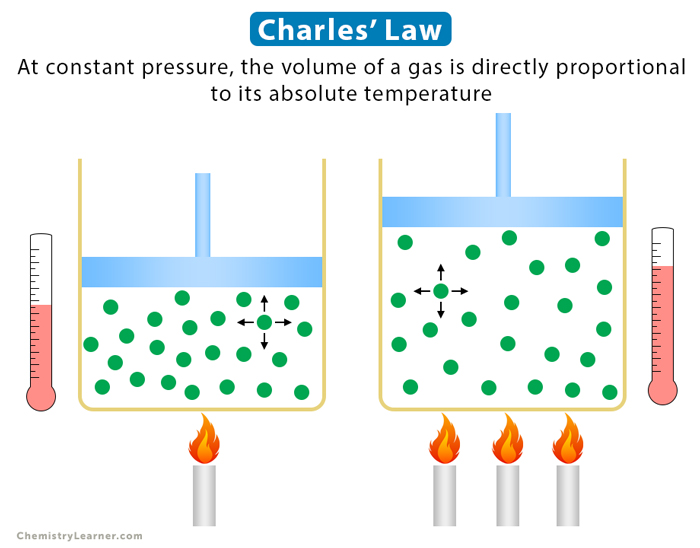
While pressure is held constant, it is the interplay between volume and temperature that Charles’s Law so elegantly describes. Specifically, the law states that for a fixed amount of gas, the volume is directly proportional to its absolute temperature. This means that as the temperature increases, the volume also increases, and conversely, as the temperature decreases, the volume decreases, provided the pressure remains unchanged.
Direct Proportionality in Action
The direct proportionality implies that if you double the absolute temperature of a gas while keeping the pressure constant, its volume will also double. This is because increasing the temperature of a gas increases the kinetic energy of its molecules. These molecules move faster and collide with the container walls more frequently and with greater force. To maintain a constant pressure, the volume must expand, providing more space for the molecules to move and thus reducing the frequency of collisions with the walls. This expansion is the observable manifestation of Charles’s Law.
Applications in Thermal Management and Control
In the realm of technology, understanding and manipulating this volume-temperature relationship is vital for thermal management and control. Consider the cooling systems in electronic devices. Heat generated by components can cause gases within the cooling system to expand. If this expansion is not managed, it can lead to increased pressure, potentially damaging the device. Charles’s Law informs the design of these systems, ensuring that the volume can accommodate temperature changes without compromising pressure integrity. This can involve using flexible components or ensuring sufficient headspace within sealed units. Similarly, in the manufacturing of components that involve gases, precise temperature control is used to achieve desired volume changes, which in turn can influence material properties or assembly tolerances.
Gas Thermometers and Temperature Sensing
The direct proportionality described by Charles’s Law forms the basis of gas thermometers. These devices measure temperature by observing the change in volume of a gas when its temperature changes, while maintaining constant pressure. A common type of gas thermometer consists of a bulb filled with a gas, connected to a measuring device that can record volume changes. As the temperature of the surroundings changes, the gas inside the bulb expands or contracts. By calibrating the thermometer, these volume changes can be directly correlated to temperature readings. This principle is foundational for highly accurate temperature measurements in scientific research and industrial processes where precise temperature monitoring is critical, such as in semiconductor fabrication or climate control systems within sensitive technological environments.

The Unchanged Quantity: The Amount of Gas
Another crucial aspect that remains constant in Charles’s Law is the amount of gas itself. This refers to the number of moles, or the mass, of the gas being studied. Charles’s Law is derived under the assumption that no gas is added to or removed from the system. If the amount of gas were to change, the relationship between volume and temperature would be altered.
Fixed Gas Quantity in Sealed Systems
In many technological applications, systems are designed to be sealed, thereby ensuring that the amount of gas within them remains constant. For example, in a refrigeration cycle, the refrigerant gas circulates within a closed loop. While its temperature and volume change at different stages of the cycle, the total amount of refrigerant remains the same. Charles’s Law, in conjunction with other thermodynamic laws, helps engineers predict and manage these changes to optimize the cooling efficiency. The predictability offered by a constant amount of gas simplifies complex thermodynamic calculations, leading to more reliable and efficient system designs.
Implications for Gas Purity and Contamination
The constancy of the gas amount also highlights the importance of gas purity and the prevention of contamination in sensitive technological processes. If impurities were to enter a system governed by Charles’s Law, they would effectively alter the “amount” of the primary gas. This could lead to deviations from the predicted behavior, impacting performance and potentially causing errors. For instance, in the creation of vacuum systems for scientific instruments or electronics manufacturing, maintaining a high vacuum requires the removal of all gas molecules. Any residual gas, even in small quantities, will behave according to gas laws, and its presence can be detected and accounted for. The principle of a constant gas amount underscores the need for rigorous purity standards and contamination control measures in these environments.
Modeling Gas Behavior in Complex Devices
In advanced technological devices, understanding the behavior of gases is often essential for modeling and simulation. Whether it’s the gas dynamics within a jet engine, the behavior of plasma in semiconductor etching, or the fuel-air mixture in internal combustion engines, accurate predictions require a solid grasp of fundamental gas laws. Charles’s Law, by stipulating a constant amount of gas, provides a simplified framework that can be built upon. By assuming a fixed quantity, engineers can isolate the effects of temperature and pressure on volume, allowing for the development of more sophisticated models that account for other variables. This allows for the optimization of designs, the prediction of performance under various conditions, and the troubleshooting of issues in complex technological systems.
The Broader Significance in Technological Design
The constants in Charles’s Law – pressure and the amount of gas – are not merely theoretical constructs; they are fundamental design considerations in a vast array of technological applications. By understanding and controlling these constants, engineers can harness the predictable behavior of gases to create innovative and efficient solutions.
Designing for Thermal Expansion and Contraction
The direct proportionality between volume and temperature, with constant pressure and gas amount, is a key factor in designing systems that account for thermal expansion and contraction. Many materials expand when heated and contract when cooled. Gases exhibit this phenomenon even more dramatically. In technologies like bridges, pipelines, and even the structural components of satellites, engineers must incorporate mechanisms to accommodate these volume changes. For instance, expansion joints in bridges allow for the predictable expansion and contraction of the structural elements due to temperature fluctuations, preventing stress buildup. Similarly, in the construction of large cryogenic storage tanks for industrial gases, the expansive properties of gases at different temperatures are carefully calculated to ensure the structural integrity of the containers under varying environmental conditions.
Optimizing Gas-Based Energy Systems
From compressed air tools to pneumatic systems, and even in the broader context of energy generation, understanding Charles’s Law is crucial for optimizing gas-based energy systems. The ability to store and release energy through the controlled expansion and contraction of gases relies on predictable thermodynamic behavior. For example, in pneumatic actuators used in automation, the controlled introduction and release of compressed air at a constant pressure allows for precise mechanical movements. The efficiency of these systems is directly tied to how well their volume and temperature changes are managed, adhering to the principles of Charles’s Law. This optimization leads to reduced energy consumption and improved operational performance.
The Foundation for Advanced Gas Handling Technologies
The principles enshrined in Charles’s Law serve as the bedrock for many advanced gas handling technologies. This includes sophisticated gas separation and purification systems, the controlled delivery of gases in pharmaceutical manufacturing, and the precise atmospheric control required for sensitive scientific experiments. Each of these applications, while complex, relies on the fundamental understanding that with constant pressure and a fixed amount of gas, temperature directly dictates volume. The ability to manipulate and predict these relationships allows for the development of highly specialized equipment and processes that are essential for progress in fields ranging from medicine to advanced materials science. The constants within Charles’s Law provide a reliable framework upon which these intricate technological solutions are built.
aViewFromTheCave is a participant in the Amazon Services LLC Associates Program, an affiliate advertising program designed to provide a means for sites to earn advertising fees by advertising and linking to Amazon.com. Amazon, the Amazon logo, AmazonSupply, and the AmazonSupply logo are trademarks of Amazon.com, Inc. or its affiliates. As an Amazon Associate we earn affiliate commissions from qualifying purchases.