
Determining which state holds the title of the “richest” in the United States is more complex than simply looking at a single bank balance. In the realm of macroeconomics and personal finance, “wealth” is a multifaceted concept. Is a state rich because its government has a massive surplus, because its corporations generate high Gross Domestic Product (GDP), or because its individual residents take home the highest paychecks?
To understand the financial hierarchy of the U.S., we must look at various metrics—primarily Median Household Income and GDP per capita—while considering the external factors that allow these states to maintain their economic dominance. This analysis explores the financial powerhouses of the union, the industries driving their success, and the practical implications for the people living within their borders.

Defining Economic Success: The Metrics of Wealth
Before identifying the leaders, we must establish the yardstick. In personal finance and economic reporting, two primary metrics serve as the gold standard for measuring state-level wealth.
Median Household Income
Median household income is often considered the most “human” way to measure wealth. It represents the middle point of all incomes in a state, meaning half the households earn more and half earn less. Unlike an “average” (mean) income, which can be skewed by a handful of billionaires, the median provides a more accurate picture of what the typical family experiences. High median incomes usually correlate with high levels of education and a concentration of specialized industries.
Real GDP per Capita
While median income tells us about the residents, Gross Domestic Product (GDP) per capita tells us about the economic output. It measures the total value of all goods and services produced within a state’s borders, divided by its population. This metric highlights states that are industrial or financial powerhouses. For example, a state might have a high GDP per capita due to oil production or corporate headquarters, even if that wealth isn’t perfectly distributed among its residents.
The Current Leaders: Maryland, Massachusetts, and New Jersey
When looking at data from the U.S. Census Bureau and the Bureau of Economic Analysis (BEA), a few names consistently appear at the top of the list. These states have built resilient economies that withstand market volatility.
Maryland’s Federal Stability
For several years, Maryland has frequently claimed the top spot for median household income. The state’s wealth is inextricably linked to its proximity to Washington, D.C. A massive portion of Maryland’s workforce is employed by the federal government or high-paying federal contractors in defense, cybersecurity, and aerospace. Because federal jobs often require high security clearances and advanced degrees, they command premium salaries. This creates a “recession-proof” economic floor that keeps Maryland’s household wealth consistently high.
Massachusetts’ Innovation Economy
Massachusetts is a prime example of a “Knowledge Economy.” Centered around the Boston metropolitan area, the state benefits from an unparalleled concentration of elite higher education institutions, including Harvard and MIT. This academic density feeds directly into the biotechnology, healthcare, and financial services sectors. Massachusetts often leads the nation in GDP per capita and median income because its economy is focused on high-value innovation rather than low-margin manufacturing.
New Jersey’s Strategic Hub
New Jersey serves as a vital corridor between major economic hubs. Its wealth is driven by a mix of high-density pharmaceutical manufacturing, telecommunications, and its role as a “bedroom community” for the high-earners of New York City and Philadelphia. The state has one of the highest concentrations of millionaires per capita in the country. Its strategic location and highly educated workforce allow it to maintain high tax revenues and high household earnings, despite a high cost of living.
The Socioeconomic Pillars of Wealthy States

Wealth does not happen in a vacuum. The states that consistently rank as the richest in the U.S. share several structural characteristics that facilitate financial growth.
Educational Attainment
There is a near-perfect correlation between a state’s percentage of college-educated residents and its median income. Wealthy states like Connecticut and Massachusetts prioritize public and private education, creating a pipeline of talent for high-paying roles in “STEM” (Science, Technology, Engineering, and Mathematics). In the modern economy, human capital is the most valuable asset, and the richest states are those that successfully attract and retain “knowledge workers.”
Industry Specialization and Agglomeration
Economic “agglomeration” occurs when similar businesses cluster in a specific geographic area, creating a specialized labor pool and shared infrastructure. California’s Silicon Valley (Tech), New York’s Wall Street (Finance), and Texas’s Permian Basin (Energy) are classic examples. The richest states are those that have successfully pivoted away from legacy industries like textile manufacturing or small-scale farming toward high-growth sectors like digital technology, specialized medicine, and global logistics.
The Cost of Living and Purchasing Power
A critical aspect of personal finance that often gets overlooked in “richest state” rankings is the difference between nominal wealth and real purchasing power. Being “rich” is relative to what it costs to survive and thrive in a specific location.
Nominal vs. Real Wealth
If a household in Maryland earns $100,000 and a household in Mississippi earns $60,000, the Maryland household is nominally richer. However, after accounting for the Regional Price Parity (RPP)—which measures the differences in price levels across states—the gap may shrink. High-income states almost universally suffer from high costs for goods, services, and utilities. Therefore, an individual’s financial “wellness” is often a product of their income minus the local cost of living.
The Housing Market Impact
Housing is the largest expense for the average American family. In states like California, Massachusetts, and Hawaii, astronomical real estate prices can eat up a significant portion of a high salary. In these regions, a “wealthy” income might only provide a middle-class lifestyle. Conversely, states with moderate incomes but very low housing costs often offer their residents higher discretionary income—the money left over for investing, travel, and savings—which is a truer measure of personal financial freedom.
Evolving Landscapes: Future Outlook for State Economies
The hierarchy of the richest states is not static. As the global economy shifts, we are seeing a migration of wealth that could redefine the “rich” list over the next decade.
Remote Work and Decentralization
The rise of remote work has decoupled high-paying jobs from specific geographic locations. We are currently witnessing a “wealth migration” where workers from high-tax, high-cost states like New York and California move to states with no income tax, such as Florida or Texas. While this hasn’t yet unseated the Northeast as the wealthiest region by median income, the influx of high-earners is rapidly boosting the GDP and tax bases of Southern and Western states.
The Rise of Emerging Tech Hubs
While the “tri-state” area and New England remain wealthy, new hubs are emerging. States like Washington (driven by Amazon and Microsoft) and Colorado (driven by aerospace and tech) have seen their median incomes skyrocket. These states are successfully replicating the “innovation economy” model of Massachusetts. As venture capital becomes more geographically diverse, we can expect to see a more balanced distribution of wealth across the U.S., potentially challenging the long-standing dominance of the East Coast.
Conclusion
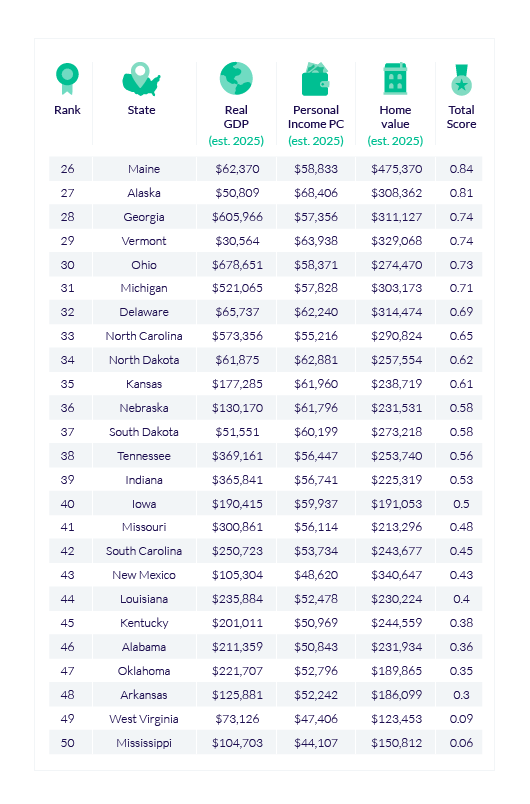
So, what is the richest state in the U.S.? If we look strictly at the numbers, Maryland frequently takes the crown for household income, while Massachusetts and New York often lead in terms of total economic productivity and GDP per capita.
However, for the individual investor or professional, the title of “richest state” is a starting point for a deeper financial conversation. Wealth is the product of high earning potential balanced against the cost of living and the tax environment. While the coastal giants remain the engines of the American economy, the landscape is shifting toward states that offer a competitive balance of high-tech opportunity and fiscal sustainability. Understanding these trends is essential for anyone looking to optimize their personal finance strategy, choose a location for a business, or understand the broader trajectory of the American Dream.
aViewFromTheCave is a participant in the Amazon Services LLC Associates Program, an affiliate advertising program designed to provide a means for sites to earn advertising fees by advertising and linking to Amazon.com. Amazon, the Amazon logo, AmazonSupply, and the AmazonSupply logo are trademarks of Amazon.com, Inc. or its affiliates. As an Amazon Associate we earn affiliate commissions from qualifying purchases.