
In the rapidly evolving landscape of software engineering, data science, and hardware development, the intersection of abstract mathematics and practical application is where innovation happens. One of the most critical, yet often overlooked, mathematical concepts driving today’s tech stacks is “conjugate math.” While many remember the term from high school algebra—specifically the complex conjugate—its role in modern technology extends far beyond the classroom. It is a foundational pillar for digital signal processing, quantum computing, and the optimization algorithms that make artificial intelligence possible.
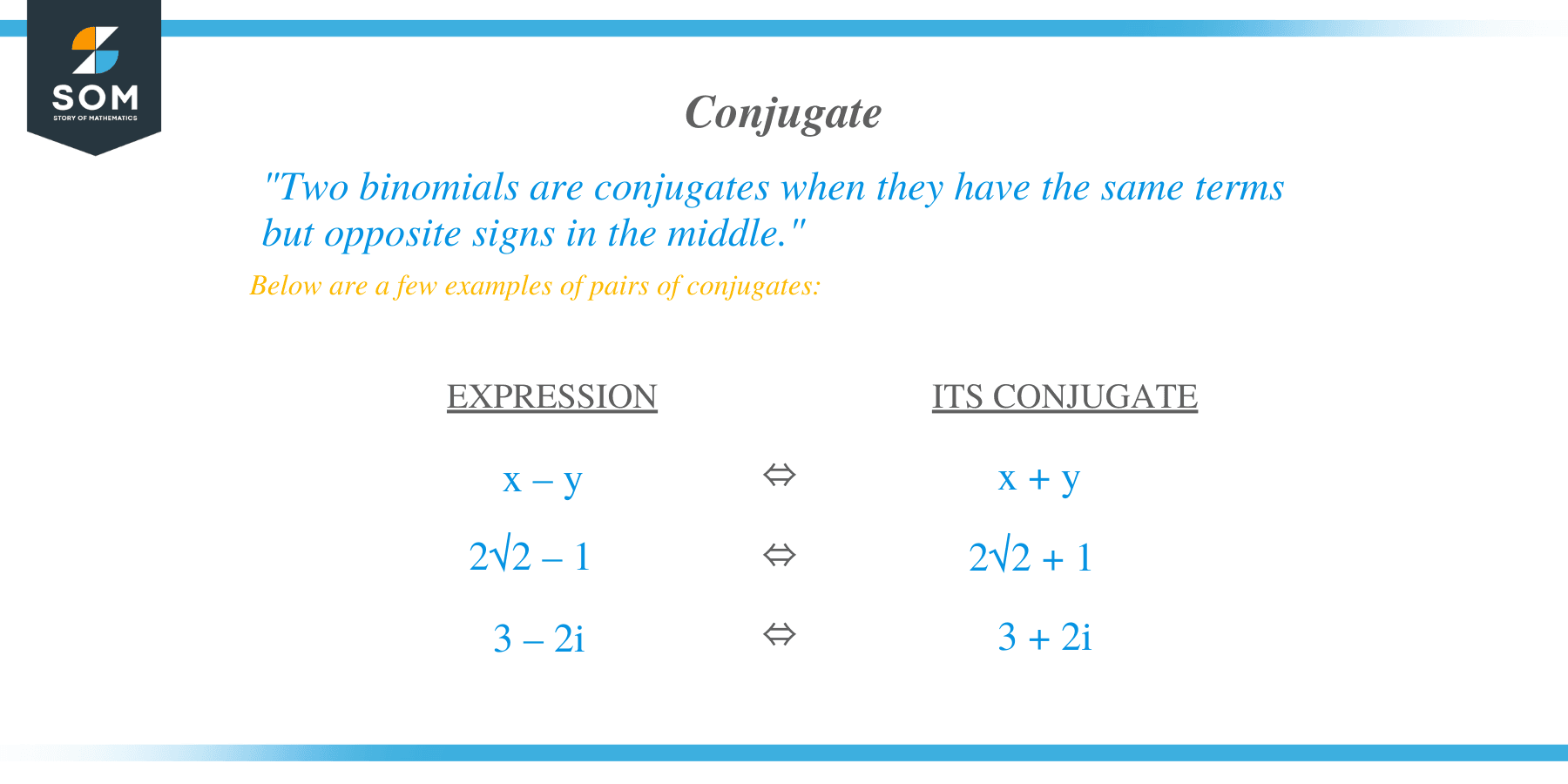
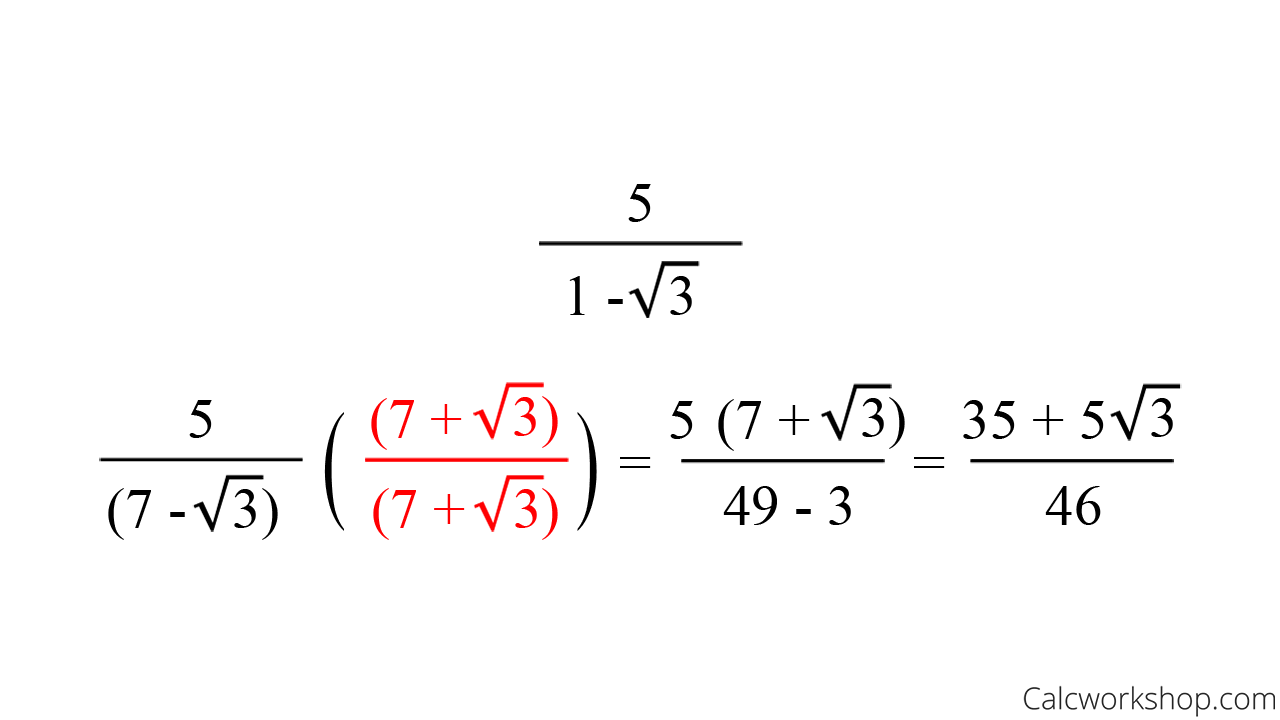
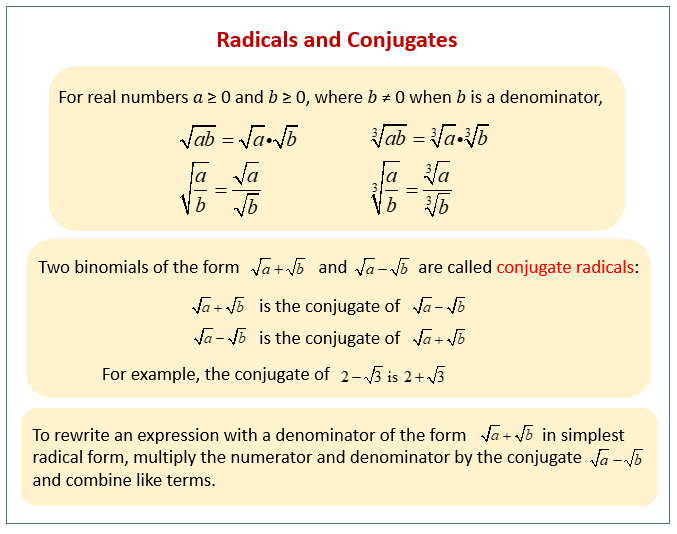
To understand conjugate math in a technical context, one must view it as a tool for symmetry and transformation. At its simplest, the conjugate of a complex number is found by changing the sign of its imaginary part. For a number $a + bi$, the conjugate is $a – bi$. While this seems like a trivial arithmetic flip, the implications for technology are profound. When a number is multiplied by its conjugate, the imaginary components vanish, leaving a purely real number that represents magnitude or intensity—the very data points our devices need to function.
Understanding the Core Logic: Why Conjugates Matter in Computing
At the heart of every digital interaction is a series of binary operations, but the logic governing those operations often relies on complex number theory. In computational systems, complex numbers are used to represent multidimensional data in a way that two-dimensional real numbers cannot.
The Definition of Complex Conjugates in Data Structures
In programming languages like Python (via NumPy) or C++, complex numbers are stored as pairs of floating-point values. The conjugate is essentially the “mirror image” of a vector in the complex plane. By utilizing the conjugate, developers can calculate the “norm” or the absolute value of a complex vector. This is essential in any application that requires the measurement of physical phenomena—such as light, sound, or electricity—through digital sensors. Without the ability to find the conjugate, we could not accurately translate the oscillating waves of the physical world into the stable “real” numbers that software requires for analysis.
From Paper to Processor: How Code Handles Imaginary Numbers
Modern CPUs and GPUs are optimized for SIMD (Single Instruction, Multiple Data) operations, which allow them to process complex conjugates across massive datasets simultaneously. In the realm of high-performance computing (HPC), the conjugate operation is used to ensure mathematical stability. For instance, in graphics rendering, conjugate math helps in normalizing light vectors, ensuring that 3D environments react realistically to light sources. By flipping the sign of the imaginary component, the processor can effectively “cancel out” noise or interference that occurs during complex transformations.
Digital Signal Processing (DSP) and the Role of Conjugates
Perhaps the most significant application of conjugate math in the tech world is within Digital Signal Processing (DSP). Every time you take a photo, stream a video, or make a VOIP call, conjugate math is working in the background to ensure clarity and efficiency.
Noise Reduction and Audio Engineering
Audio signals are complex waveforms. To process them, engineers use the Fourier Transform, a mathematical method that decomposes a signal into its constituent frequencies. In this domain, the conjugate is used to manipulate the phase of the signal. By multiplying a frequency-domain signal by its conjugate, engineers can isolate the power spectrum—essentially identifying which frequencies are loudest without being distracted by their phase. This is the logic behind active noise cancellation (ANC) in high-end headphones and the filters used to clean up “hissy” audio in post-production software.
Wireless Communication: 5G and Beyond
In the telecommunications sector, conjugate math is vital for Phase Shift Keying (PSK) and Quadrature Amplitude Modulation (QAM). These are the methods used to encode data into radio waves for Wi-Fi and 5G networks. Because radio waves are subject to “multipath fading”—where signals bounce off buildings and arrive at different times—the receiver must use conjugate math to realign the phase of the incoming signal. By applying the complex conjugate of the channel’s distortion, the hardware can “undo” the environmental interference, allowing for the high-speed data transfers we rely on today.
Conjugate Gradients: Optimizing Machine Learning Models
As we move into the era of Artificial Intelligence, the word “conjugate” takes on a new meaning through the Conjugate Gradient Method (CGM). This is an algorithm used for the numerical solution of particular systems of linear equations, and it is a cornerstone of machine learning and large-scale data optimization.
Solving Linear Systems at Scale
In AI, we often deal with matrices containing billions of parameters. Traditional methods of solving these equations are computationally expensive and slow. The Conjugate Gradient Method provides a more efficient path. It is an iterative algorithm that finds the nearest local minimum of a function by moving in “conjugate directions.” Unlike simpler “gradient descent” methods, which can sometimes oscillate back and forth inefficiently, conjugate directions ensure that the algorithm doesn’t repeat the same work, leading to much faster convergence.
Speeding Up Neural Network Training
Training a deep learning model requires minimizing a loss function—essentially a math problem where the goal is to make the error as small as possible. High-end optimization libraries, such as those used in PyTorch or TensorFlow, often employ conjugate-based logic to navigate the complex “topography” of a neural network’s weights. By understanding the conjugate relationship between different gradients, these tools can train models on massive datasets in a fraction of the time it would take using standard methods. This efficiency is what has allowed for the rapid scaling of Large Language Models (LLMs) like GPT-4.
Quantum Computing and Complex Duality
If classical computing relies on conjugates for efficiency, quantum computing relies on them for its very existence. In the quantum realm, the state of a qubit (the quantum version of a bit) is represented by a complex probability amplitude.
Qubits and the Geometry of State
To find the probability of a qubit being in a certain state (0 or 1), physicists must take the “inner product” of the state vector. This involves multiplying the vector by its conjugate transpose (also known as the Hermitian conjugate). This operation is the only way to arrive at a “real” probability. Without conjugate math, we would be left with complex probabilities that have no physical meaning in our observable world. Consequently, every quantum algorithm, from Shor’s algorithm for cryptography to Grover’s search algorithm, is built on the foundation of conjugate math.
Reversibility and Quantum Error Correction
Quantum computers are notoriously sensitive to environmental “noise,” which causes errors in calculation. One way researchers are tackling this is through unitary transformations—operations that are reversible. A transformation is only unitary if its inverse is equal to its conjugate transpose. This mathematical symmetry allows quantum developers to design circuits that can “undo” errors or maintain the “coherence” of data across long calculations. As we approach the threshold of “quantum supremacy,” the mastery of conjugate math in software architecture will be the factor that determines which systems are viable for commercial use.
The Future of Conjugate Math in Emerging Tech
As technology continues to advance, the applications of conjugate math are moving from specialized niches into mainstream software development. We are seeing a “democratization” of these complex concepts through high-level APIs and libraries.
High-Performance Computing (HPC) Trends
In the field of climate modeling and genomic sequencing, the scale of data is so vast that every CPU cycle matters. Developers are increasingly turning to conjugate-based algorithms to handle sparse matrices—data structures where most elements are zero. These algorithms allow for the simulation of complex systems, such as the folding of a protein or the movement of a weather front, with unprecedented precision. The ability to utilize conjugates to simplify these calculations means we can run more complex simulations on existing hardware, reducing the carbon footprint of data centers.
AI-Driven Simulation and Modeling
The next frontier for tech is the “Digital Twin”—a virtual replica of a physical object or system. Whether it’s a jet engine or an entire smart city, these twins require real-time updates from IoT sensors. Conjugate math provides the framework for syncing these two worlds. By using conjugate-based filters to process sensor data, developers can ensure that the virtual model reacts with the same physics as the real-world counterpart.
In conclusion, “conjugate math” is far more than a relic of a calculus textbook. It is a sophisticated tool for managing symmetry, energy, and information. For tech professionals, understanding the underlying logic of conjugates offers a deeper insight into how our digital world is constructed. From the phase-shifting logic of a 5G tower to the optimization loops of a generative AI, the conjugate remains an essential, invisible bridge between the complex theoretical world and the real-time technological reality we inhabit today. By mastering these mathematical principles, the next generation of engineers will continue to push the boundaries of what is computationally possible.
aViewFromTheCave is a participant in the Amazon Services LLC Associates Program, an affiliate advertising program designed to provide a means for sites to earn advertising fees by advertising and linking to Amazon.com. Amazon, the Amazon logo, AmazonSupply, and the AmazonSupply logo are trademarks of Amazon.com, Inc. or its affiliates. As an Amazon Associate we earn affiliate commissions from qualifying purchases.