
In the realm of brand strategy, few entities in history have executed a more totalizing or devastatingly effective visual and narrative identity than the National Socialist German Workers’ Party (NSDAP). When scholars ask “what religion were the Nazis,” they often find themselves navigating a complex web of traditional Christianity, occultism, and Germanic paganism. However, from a brand strategy and corporate identity perspective, the “religion” of the Nazi party was, in fact, the brand itself. It functioned as a “secular religion”—a meticulously engineered identity designed to replace traditional spiritual frameworks with a devotion to a political entity.

Understanding how this identity was constructed offers profound, albeit sobering, insights into the power of branding, iconography, and narrative consistency. By treating the party’s development as a case study in high-stakes brand positioning, we can see how they utilized symbols, rituals, and a “messianic” corporate identity to achieve a level of brand loyalty rarely seen in the history of organizational communication.
The Architecture of an Ideological Brand
The success of any global brand rests on its visual identity. For the Nazi party, the creation of a visual language was not an afterthought; it was the foundation of their market penetration. They understood that in a crowded marketplace of ideas, a brand must be instantly recognizable, emotionally evocative, and symbols-driven.
Visual Consistency as a Tool for Control
Long before modern corporations developed style guides, the NSDAP implemented a rigorous system of visual consistency. The most prominent element of this brand was the Swastika. Adopted for its ancient associations with “good fortune” and “well-being,” the party re-branded the symbol into a high-contrast, aggressive icon of “Aryan” purity.
The color palette—red, white, and black—was selected with strategic precision. Red was used to attract the masses and co-opt the visual language of the rival Communist movements; white represented the nationalistic ideal; and black symbolized the struggle. This triad created a visual hierarchy that was unavoidable. By plastering this “logo” on everything from massive banners to small lapel pins, the party achieved a level of brand saturation that modern digital marketers would call “omnipresence.”
The Iconography of the “Political Religion”
To answer “what religion were the Nazis” through a branding lens, one must look at how they co-opted religious iconography. Traditional religious symbols provide a sense of belonging and metaphysical safety. The Nazi brand replaced the crucifix with the Swastika and the saints with “martyrs” of the movement.
This was a masterful execution of “Brand Substitution.” By mirroring the structural elements of a religion—the sacred texts (Mein Kampf), the hallowed ground (Nuremberg), and the infallible leader—they shifted the consumer’s (the citizen’s) loyalty from a church to a state. This is the ultimate goal of high-devotional branding: to move beyond a product or service and become an integral part of the consumer’s identity.
Narrative Crafting: Turning Ideology into a Secular Faith
A brand is more than a logo; it is a story. The Nazi “brand” was built on a narrative of resurrection and salvation. This narrative functioned as the theology of the party, providing answers to the “why” of their existence and the “how” of their future.
The Messianic Leader Archetype
In personal branding, the “Founder Myth” is a powerful driver of engagement. The Nazi brand relied almost entirely on the persona of the Führer. Adolf Hitler was not marketed as a mere politician, but as a messianic figure—a brand savior. This “cult of personality” is a technique often seen in corporate leadership branding today, where a CEO becomes the face of the brand (think Steve Jobs or Elon Musk).
The party’s propaganda machine, led by Joseph Goebbels, used emerging media—radio and film—to curate this image. Every speech was a “product launch,” and every public appearance was a carefully staged brand activation. By positioning the leader as the singular solution to the nation’s problems, the brand reduced complex socio-economic issues into a simple, digestible brand promise.
Creating an “In-Group” through Ritual and Myth
Every successful brand strategy defines who its audience is—and, perhaps more importantly, who it is not. The Nazi “religion” utilized a brand strategy of radical exclusion. They crafted a myth of the “Aryan race,” which served as the primary demographic for their brand.
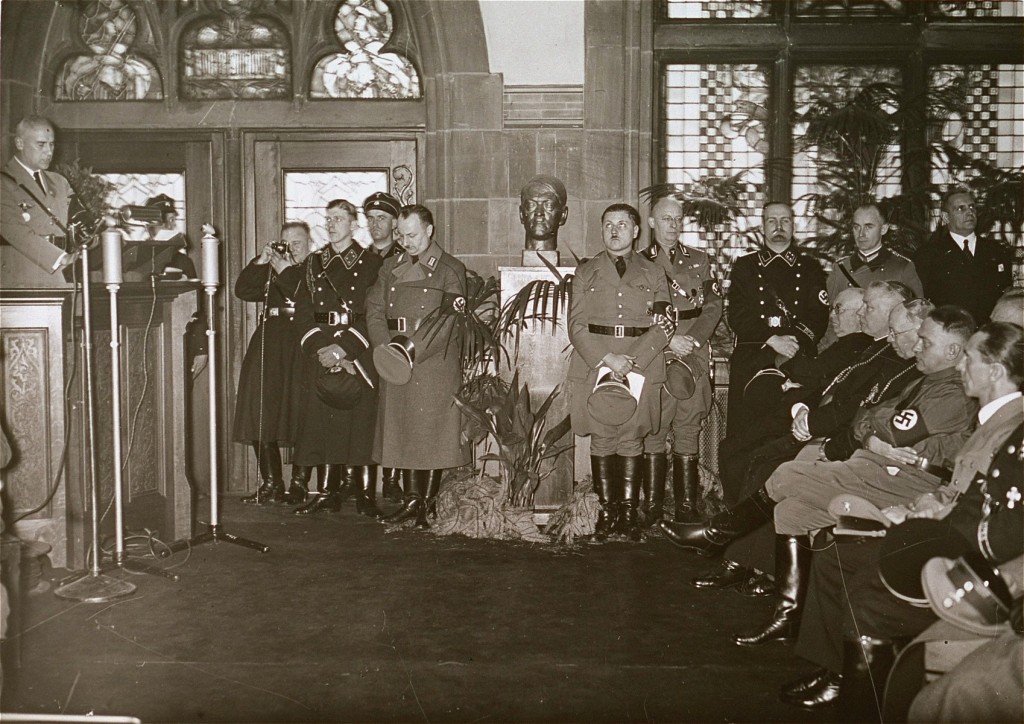
By creating a sense of “exclusive membership,” they fostered deep-seated loyalty. Rituals like the “Heil Hitler” salute functioned as a brand touchpoint—a physical manifestation of brand alignment. These rituals reinforced the narrative that to be a part of the brand was to be part of an elite, chosen group. This is the dark side of “community building” in brand strategy: when a community is built not on shared values of growth, but on the systematic exclusion and dehumanization of “competitors” or “outsiders.”
Experiential Branding: The Liturgy of the Mass Rally
If the visual identity was the logo and the narrative was the mission statement, the mass rallies were the “Brand Experience.” These events were designed to be overwhelming, sensory-rich environments that solidified the brand’s power in the minds of the participants.
Sensory Dominance: Light, Sound, and Spectacle
The Nuremberg Rallies are perhaps the most infamous examples of experiential branding in history. Utilizing the “Cathedral of Light”—152 searchlights aimed skyward to create walls of brilliance—the party created a physical space that felt transcendent.
From a marketing perspective, this was a masterful use of sensory branding. The rhythmic chanting, the synchronized marching, and the towering architecture were designed to make the individual feel small and the “Brand” feel infinite. This sensory dominance bypassed the rational mind and appealed directly to the emotional and subconscious, a tactic often explored in modern neuromarketing.
From Participant to Disciple: The UX of Extremism
The User Experience (UX) of a Nazi event was designed for total immersion. There was no “opt-out” once a participant was in the crowd. The experience was engineered to facilitate a “merging” of the individual with the collective.
In modern branding, we speak of the “Customer Journey.” The Nazi party’s “customer journey” began with youth organizations (the “entry-level product”) and moved through various levels of party membership, culminating in total devotion. By making the brand the center of the user’s social, professional, and spiritual life, they eliminated any “churn.” The cost of leaving the brand was not just social—it was existential.
Modern Implications for High-Stakes Branding
While the history of the Nazi party is a tragedy of unprecedented proportions, the study of their branding and identity strategy remains relevant for modern professionals in brand strategy, design, and marketing. It serves as a reminder of the immense power—and the immense responsibility—that comes with the ability to shape identity and belief.
The Ethical Responsibility of Influence
The “religion” of the Nazis was a brand built on a foundation of hate, yet it used the tools of psychology, design, and narrative to achieve its ends. This highlights the ethical imperative for modern brand strategists. The same tools that can be used to build a community around a helpful product or a positive social movement can be used to manipulate and radicalize.
The study of Nazi iconography and propaganda is a core part of understanding “Dark Patterns” in communication. Modern designers and strategists must ask themselves: Is the identity I am building empowering the user, or is it creating a dependency? Does this brand foster genuine community, or is it built on an “us vs. them” mentality that can lead to radicalization?
Avoiding the “Cult Brand” Pitfalls in Corporate Identity
In contemporary corporate circles, “cult brands” (brands with a fiercely loyal following) are often seen as the gold standard. However, the Nazi case study shows the danger of a brand becoming too much like a religion. When a brand begins to demand total loyalty, discourages dissent, and centers itself around a singular, infallible leader, it moves out of the realm of commerce and into the realm of indoctrination.
True brand longevity and healthy corporate identity are built on transparency, shared values, and a commitment to the greater good. The Nazi party’s “religion” was a brand that eventually consumed itself and the world around it because it was built on the hollow promise of superiority and the destruction of the “other.” In the modern market, brands that thrive are those that foster inclusivity, ethical innovation, and authentic connection.

Conclusion
When we ask “what religion were the Nazis,” the answer from a brand strategist’s perspective is that they were a “Total Brand.” They engineered a system of belief that used the mechanics of religion—sacred symbols, messianic leaders, and transformative rituals—to sell a destructive ideology. By analyzing their methods through the lens of brand strategy, we gain a clearer understanding of how visual and narrative tools can be used to mobilize masses. It stands as a permanent warning to those in the industry of marketing and identity: the power to define reality for others is a power that must be handled with the highest degree of ethical scrutiny.
aViewFromTheCave is a participant in the Amazon Services LLC Associates Program, an affiliate advertising program designed to provide a means for sites to earn advertising fees by advertising and linking to Amazon.com. Amazon, the Amazon logo, AmazonSupply, and the AmazonSupply logo are trademarks of Amazon.com, Inc. or its affiliates. As an Amazon Associate we earn affiliate commissions from qualifying purchases.