
For seasoned investors and casual traders alike, the end of the year represents a period of reflection, portfolio rebalancing, and often, a flurry of last-minute activity. One of the most common questions that arises as the holiday season approaches is: “What time does the stock market close on Christmas Eve?” While it may seem like a simple logistical query, the answer carries significant implications for liquidity, trade execution, and year-end financial planning.
In the United States, the equity markets—specifically the New York Stock Exchange (NYSE) and the NASDAQ—traditionally observe modified hours on December 24th. Understanding these schedules, and the unique market dynamics that accompany them, is essential for any investor looking to navigate the final trading days of the year effectively.

Understanding Christmas Eve Trading Hours and Market Schedules
The operational schedule of the financial markets during the holidays is governed by a combination of tradition and formal exchange rules. For most years, Christmas Eve serves as a transitional day, allowing market participants to finalize trades before the full closure on Christmas Day.
Standard Early Closing Times for Major Exchanges
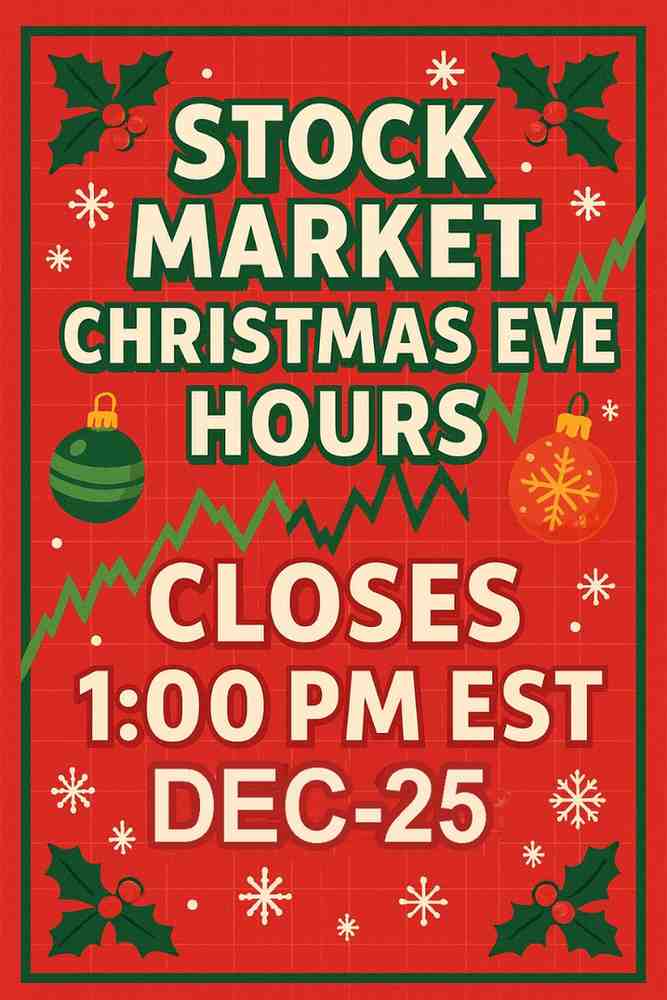
In a typical year where December 24th falls on a weekday, the major U.S. stock exchanges—the NYSE and the NASDAQ—implement an early close. Instead of the standard 4:00 PM Eastern Time (ET) closing bell, the markets officially shut down at 1:00 PM ET. This early closure applies to all equity products, including stocks, ETFs, and most options.
It is also worth noting that the “extended-hours” trading sessions are abbreviated. While pre-market trading usually begins as early as 4:00 AM ET, the post-market session typically concludes much earlier than its usual 8:00 PM ET deadline, often wrapping up by 5:00 PM ET or earlier on Christmas Eve.
How SIFMA Impacts Bond Market Hours
While equity investors focus on the 1:00 PM ET deadline, those involved in fixed income must look to the recommendations of the Securities Industry and Financial Markets Association (SIFMA). SIFMA generally recommends a 2:00 PM ET close for the trading of U.S. dollar-denominated government securities, mortgage-backed securities, and corporate bonds on Christmas Eve.
Because the bond market is decentralized and operates over-the-counter (OTC), these recommendations are widely followed by major banks and broker-dealers. If you are looking to reallocate capital from equities into bonds or vice versa, you must account for this one-hour discrepancy between the two markets.
Variations Based on the Day of the Week
The “1:00 PM rule” only applies if Christmas Eve falls on a Monday through Friday. If December 24th falls on a Saturday, the markets remain closed for the weekend, and usually, no special “observed” holiday occurs on the preceding Friday. If Christmas Eve falls on a Sunday, the markets are closed, and the following Monday (Christmas Day) is the observed holiday.
Crucially, if Christmas Day (December 25th) falls on a Saturday, the markets are typically closed on the preceding Friday, December 24th, in observance of the holiday. In this specific scenario, there is no early trading session; the market is closed for the full day.
The Impact of Early Closures on Liquidity and Volatility
The shortened trading window on Christmas Eve isn’t just about the clock; it profoundly changes the environment in which assets are bought and sold. Institutional presence—the large banks, hedge funds, and pension funds that drive the bulk of market volume—is significantly diminished during this time.
The Phenomenon of Lower Trading Volume
As many professional traders take time off to be with their families, the “depth” of the market thins out. Volume on Christmas Eve is historically among the lowest of the entire year. For investors, low volume means there are fewer buyers and sellers at any given price point.
While this might seem inconsequential for someone buying ten shares of a blue-chip stock, it can be problematic for those dealing in large blocks or less liquid small-cap stocks. Orders that would normally be filled instantly at a specific price might experience “slippage,” where the execution price is slightly worse than expected because there wasn’t enough immediate liquidity to meet the order.
Price Swings and “Thin” Markets
A “thin” market is one where even a relatively small trade can move the price of a security. On a normal Tuesday in mid-October, a $5 million sell order for a mid-cap stock might be absorbed with barely a ripple. On Christmas Eve at 12:45 PM, that same order could cause a temporary price spike or drop.
This environment can lead to increased volatility. While the overall trend of the market during the holidays is often positive (a concept we will explore later), the intraday movements can be erratic. Short-term traders should be wary of using market orders during these hours, as the bid-ask spread—the difference between what a buyer will pay and what a seller will accept—often widens.
The Role of High-Frequency Trading (HFT) During Holidays
In the absence of human traders, automated systems and high-frequency trading (HFT) algorithms often represent a larger percentage of the remaining activity. These systems are programmed to provide liquidity, but they can also pull back quickly if they detect unusual price movements. This can lead to “flash” movements where prices gap up or down in seconds. Investors staying active on Christmas Eve should ensure their limit orders are placed conservatively to avoid being caught in these algorithmic fluctuations.
Strategic Considerations for Investors During the Holiday Season
The final days of December are more than just a countdown to the New Year; they are a critical window for financial house-cleaning. The Christmas Eve early close marks the beginning of the “home stretch” for several key wealth-management strategies.
Executing Year-End Tax-Loss Harvesting
For many investors in the “Money” niche, the primary goal of December trading is tax-loss harvesting. This involves selling securities that are currently trading at a loss to offset capital gains taxes incurred elsewhere in the portfolio.
Because the market closes early on Christmas Eve and remains closed on Christmas Day, the window to execute these trades is shorter than usual. If you wait until the final hour of Christmas Eve to harvest a loss, you risk poor execution due to the aforementioned low liquidity. It is generally recommended to finalize tax-related trades at least a few days before the holiday to ensure the settlement occurs within the current tax year.
Preparing for the “Santa Claus Rally”
The “Santa Claus Rally” is a well-documented seasonal phenomenon where the stock market tends to rise during the last five trading days of December and the first two trading days of January. Theories for why this happens range from holiday optimism and “window dressing” by fund managers to the absence of institutional “short-sellers.”
If you are planning to position your portfolio to capture this potential upside, Christmas Eve is often the pivot point. Investors who believe in the historical data often look to ensure their “long” positions are set before the 1:00 PM ET close, anticipating that the quiet, low-volume environment will lead to a gradual drift upward as the New Year approaches.
Risk Management and Stop-Loss Orders
Given the potential for holiday volatility and the fact that the markets will be closed for at least 40 consecutive hours (from 1:00 PM on the 24th until 9:30 AM on the 26th), risk management is paramount.
If you have open positions, it is wise to review your stop-loss orders. However, be cautious: in a thin market, a temporary “wick” down in price could trigger a stop-loss order that you wouldn’t have wanted to execute in a normal, liquid market. Some investors choose to widen their stops or remove them entirely over the holiday, provided they are comfortable with the “gap risk”—the risk that the market opens much lower on the 26th than it closed on the 24th.
Beyond Christmas Eve: Navigating the Full Holiday Calendar
To manage a portfolio effectively, you must look beyond just the 24th. The period between Christmas and New Year’s Day is a unique “twilight zone” in the financial world that requires a broad perspective on global markets.
New Year’s Eve and New Year’s Day Hours
While Christmas Eve has an early close, New Year’s Eve (December 31st) is usually a full trading day for the U.S. stock markets, with a standard 4:00 PM ET close. However, the bond market often recommends an early 2:00 PM ET close on the 31st.
New Year’s Day (January 1st) is a federal holiday, and all U.S. exchanges are closed. If January 1st falls on a Sunday, the markets are closed on Monday, January 2nd. This extended break means that any news that breaks over the New Year’s weekend will be “priced in” all at once when the opening bell rings in the first week of January, often leading to a high-volume, high-volatility opening session.
International Market Variances
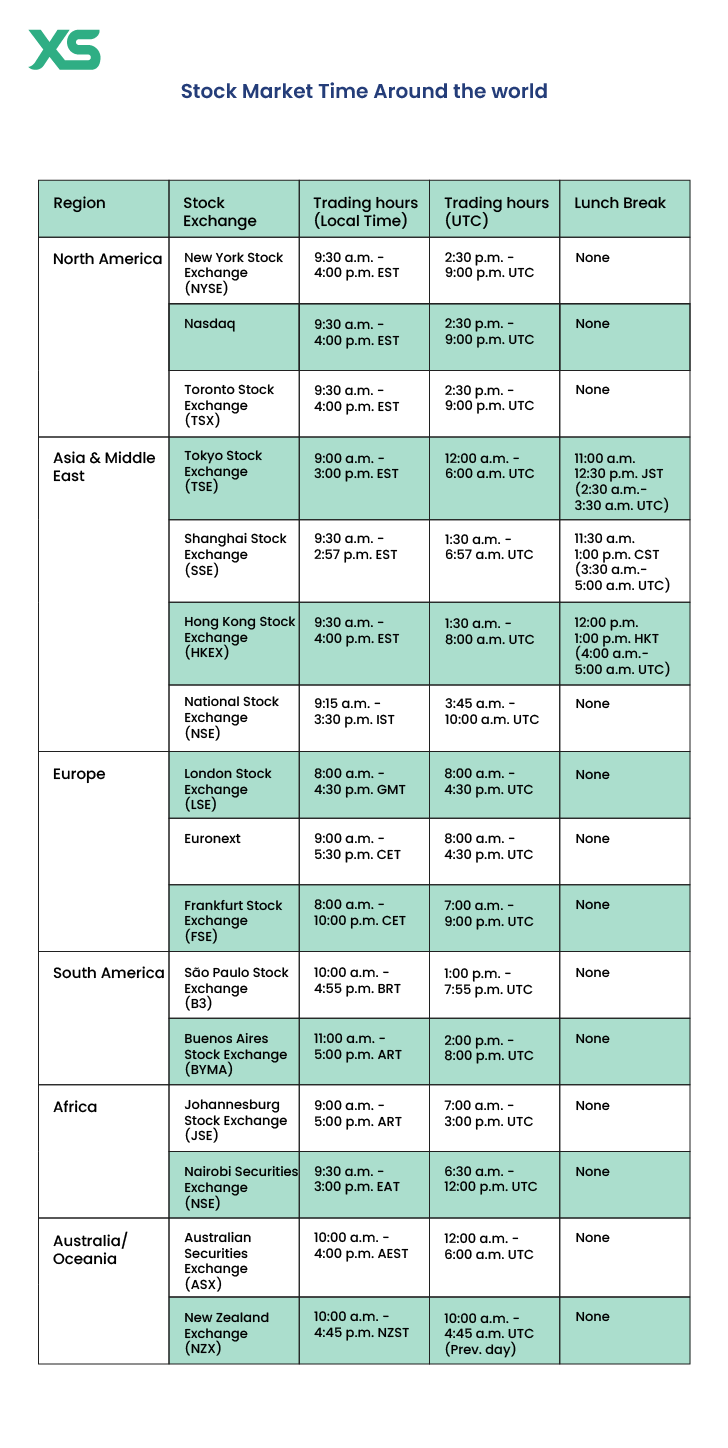
If your portfolio includes international equities or ADRs (American Depositary Receipts), remember that holiday schedules vary by country. For example, while the U.S. markets might be open for a full day on the 31st, many European and Asian markets close early or are shut entirely for New Year’s celebrations.
The London Stock Exchange (LSE) typically closes early on both Christmas Eve and New Year’s Eve, similar to the U.S. schedule. Understanding these global nuances is vital if you are trading across time zones or managing a diversified international portfolio.
Planning Your Portfolio Maintenance for the New Year
Use the quiet hours after the 1:00 PM Christmas Eve close to prepare for the upcoming year. This is the ideal time to:
- Review Expense Ratios: Check if your ETFs or mutual funds are still the most cost-effective options.
- Rebalance Allocations: If the “Santa Claus Rally” has pushed your equity weight too high, plan your sell orders for the first week of January.
- Set Contributions: Ensure your IRA or 401(k) contributions are maximized for the tax year.
In conclusion, while the stock market’s 1:00 PM ET close on Christmas Eve is a minor technical detail on the surface, it serves as a signal for the broader shift in market behavior. By acknowledging the reduced liquidity, preparing for potential volatility, and staying ahead of tax deadlines, investors can ensure that their holiday season is both festive and financially sound. Professionalism in investing means knowing not just what to buy, but when the doors are closing, allowing you to step away from the screen with total confidence in your financial position.
aViewFromTheCave is a participant in the Amazon Services LLC Associates Program, an affiliate advertising program designed to provide a means for sites to earn advertising fees by advertising and linking to Amazon.com. Amazon, the Amazon logo, AmazonSupply, and the AmazonSupply logo are trademarks of Amazon.com, Inc. or its affiliates. As an Amazon Associate we earn affiliate commissions from qualifying purchases.