
In the world of finance, timing is often just as important as the asset itself. For seasoned investors and novices alike, the rhythm of the stock market dictates the flow of global capital, the execution of trades, and the realization of gains. While the digital age allows for the illusion of a market that never sleeps, the reality is that the world’s major exchanges operate on strictly defined schedules. Understanding “what time the stock market opens” is not merely a matter of checking a clock; it is about understanding market liquidity, volatility, and the strategic windows that can make or break a portfolio.
For the majority of investors focusing on the U.S. markets, the schedule is anchored by the New York Stock Exchange (NYSE) and the NASDAQ. However, as we delve deeper into the nuances of global finance, we find a complex tapestry of pre-market sessions, after-hours trading, and international time zones that require careful navigation.
The Standard Trading Day: Navigating U.S. Core Hours
The backbone of the American financial system is the “Core Trading Session.” This is when the highest volume of shares changes hands and when price discovery is at its most efficient. For the NYSE and the NASDAQ, this session occurs Monday through Friday, excluding major holidays.
The Core Session: 9:30 AM to 4:00 PM ET
The standard operating hours for the major U.S. stock exchanges are from 9:30 AM to 4:00 PM Eastern Time (ET). During these six and a half hours, the market is fully open to all participants, from retail traders using mobile apps to institutional hedge funds moving billions of dollars. This period is characterized by the highest levels of liquidity, meaning it is easiest to buy or sell a stock at a price close to its current quote without causing significant price slippage.
The Significance of the Opening Bell
The “Opening Bell” at 9:30 AM ET is more than just a tradition. It marks the moment when the accumulated news, overnight earnings reports, and global economic data are finally priced into the market. The first 30 to 60 minutes of the trading day are often the most volatile. This is because “market orders” placed overnight are executed all at once, leading to rapid price swings. Professional traders often refer to this as the “amateur hour,” where emotions run high before the market settles into a more predictable trend.
The Closing Auction
Similarly, the 4:00 PM ET closing bell represents a critical juncture. The “Market on Close” (MOC) orders are finalized here, and many institutional investors rebalance their portfolios in the final minutes. This “Power Hour” (3:00 PM to 4:00 PM ET) often sees a surge in volume as traders look to exit positions before the day ends, ensuring they aren’t exposed to the risks of overnight price movements.
Extended Hours: Trading Before and After the Bell
While the core session is the primary focus, the modern financial landscape offers opportunities to trade outside of these hours. This is known as extended-hours trading, which includes pre-market and after-hours sessions.
Pre-Market Trading (4:00 AM – 9:30 AM ET)
Many brokerage firms allow investors to participate in pre-market trading. While some platforms open as early as 4:00 AM ET, the bulk of pre-market activity usually picks up around 8:00 AM ET. This session is vital for reacting to breaking news that occurs before the official open—such as government employment reports or international geopolitical events. However, the pre-market is notoriously “thin,” meaning there are fewer participants, which can lead to wide bid-ask spreads and extreme price volatility.
After-Hours Trading (4:00 PM – 8:00 PM ET)
The after-hours session begins immediately after the closing bell and typically runs until 8:00 PM ET. This is perhaps the most critical time for investors during “Earnings Season.” Most major corporations release their quarterly financial results shortly after 4:00 PM to ensure the market has time to digest the information without causing a mid-day panic. If a company misses its revenue targets, the stock can plummet 10% or more in minutes during the after-hours session.
The Risks of Extended Hours
For the average personal finance enthusiast, extended-hours trading should be approached with extreme caution. Because liquidity is lower, a small trade can have a disproportionately large impact on the stock price. Furthermore, many brokers only allow “limit orders” during these times to protect investors from executing trades at unfavorable prices. Understanding the mechanics of these sessions is essential for protecting your capital.
Global Markets and the 24-Hour Cycle
The U.S. market does not exist in a vacuum. Investing is a global endeavor, and the opening times of international exchanges often dictate the “gap” at which the U.S. market opens.
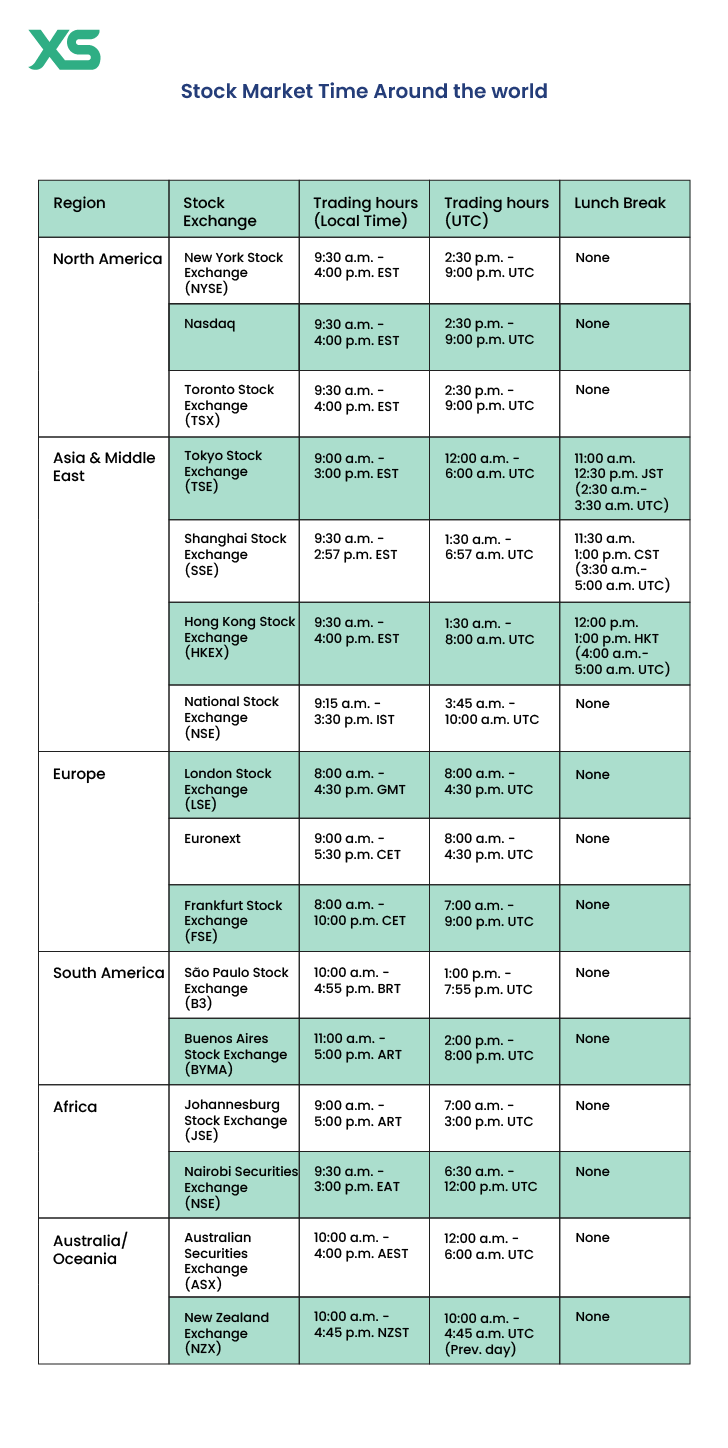
Major International Exchange Hours
To be a well-rounded investor, one must keep an eye on the following major global markets:
- London Stock Exchange (LSE): Opens at 3:00 AM and closes at 11:30 AM ET.
- Tokyo Stock Exchange (TSE): Operates from 7:00 PM to 1:00 AM ET (with a lunch break).
- Hong Kong Stock Exchange (HKEX): Operates from 8:30 PM to 3:00 AM ET.
Because the London market overlaps with the U.S. morning session, the period between 9:30 AM and 11:30 AM ET is often the most liquid time of the day globally, as both European and American traders are active simultaneously.
The “Overnight” Influence
When you wake up at 7:00 AM ET and see that S&P 500 futures are “up,” it is usually because of activity in the European or Asian markets. If the Nikkei in Japan closes with a heavy loss, it often creates a negative sentiment that carries over into the U.S. opening bell. Monitoring these global opening times helps investors anticipate the “opening gap”—the difference between the previous day’s close and the current day’s open.
Time Zone Management and DST
Daylight Savings Time (DST) adds another layer of complexity. Not all countries observe DST, and those that do may switch on different dates. This can temporarily shift the overlap between markets, such as the U.S. and the U.K., by one hour. For serious investors, maintaining a global economic calendar is the only way to track these shifts accurately.
Market Holidays and Modified Schedules
The stock market does not follow a standard 365-day calendar. It observes specific federal holidays, and knowing these dates is crucial for managing liquidity and avoiding “trapped” positions over long weekends.
Standard Market Holidays
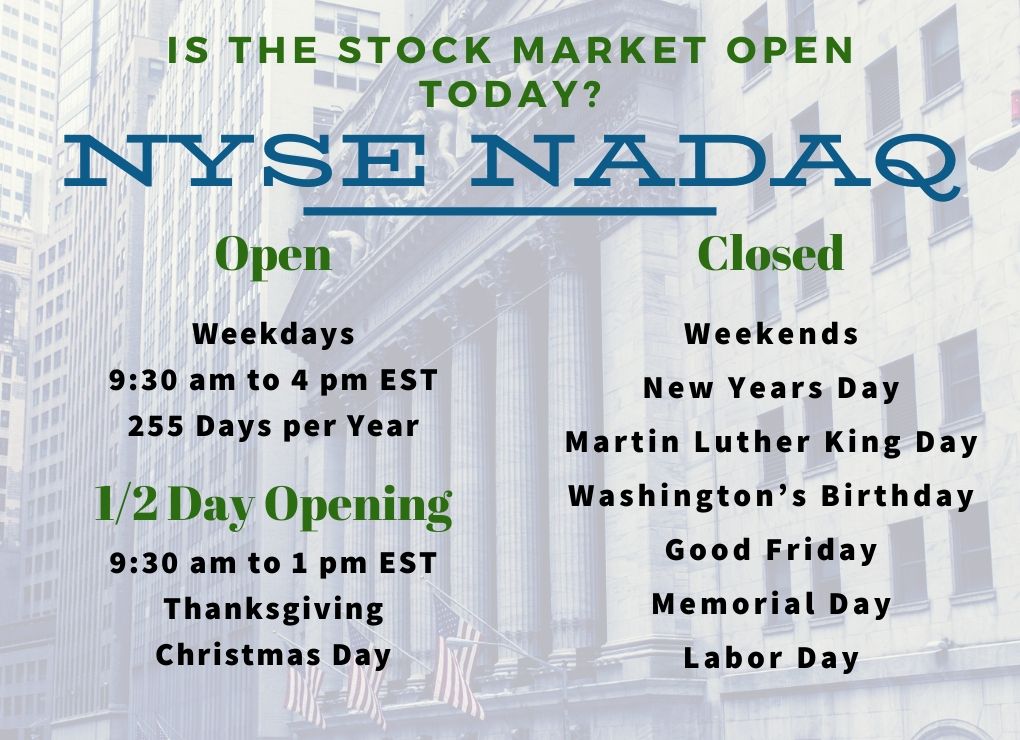
In the United States, the stock markets are closed on several key days, including:
- New Year’s Day
- Martin Luther King, Jr. Day
- Presidents’ Day
- Good Friday
- Memorial Day
- Juneteenth National Independence Day
- Independence Day (July 4th)
- Labor Day
- Thanksgiving Day
- Christmas Day
Early Closures
There are specific days when the market operates on a modified schedule, typically closing at 1:00 PM ET. This usually occurs on the day after Thanksgiving (Black Friday) and sometimes on Christmas Eve or July 3rd, depending on which day of the week the holiday falls. Trading volume on these days is typically very light, leading to “choppy” price action that can be difficult to trade.
The “Weekend Gap” Risk
One of the most important concepts in personal finance and investing is the weekend gap. Because the market is closed from 4:00 PM ET on Friday until 9:30 AM ET on Monday (excluding pre-market), investors are exposed to “event risk.” If a major global event occurs on a Saturday, you cannot sell your stocks to protect your capital until the market reopens. This is why many conservative investors reduce their leverage or “hedge” their positions before the Friday close.
Strategic Timing: When Should You Trade?
Knowing when the market opens is one thing; knowing when to trade is another. Successful investing involves choosing the right window of time to execute your strategy.
The First Hour (9:30 AM – 10:30 AM)
This is the period of maximum liquidity and maximum volatility. It is the best time for day traders who thrive on price movement but can be dangerous for long-term investors. If you are buying a stock for a five-year hold, it is often better to wait for the initial volatility to subside.
The Mid-Day Lull (12:00 PM – 2:00 PM)
Often referred to as the “Lunchtime Slump,” this period typically sees a significant drop in volume as floor traders and institutional algorithms take a breather. Prices may drift aimlessly. For long-term investors looking to add to a position without the stress of rapid swings, this can actually be a very stable time to execute trades.
The Power Hour (3:00 PM – 4:00 PM)
As the market prepares to close, volume surges again. This is when the “smart money”—institutional investors—often makes its moves. Patterns that emerge during the Power Hour are frequently seen as more “reliable” than those in the morning, as they represent where the market wants to settle after a full day of information processing.
Conclusion
Understanding the opening and closing times of the stock market is a fundamental pillar of financial literacy. For the retail investor, these hours define the boundaries of opportunity and risk. By respecting the volatility of the opening bell, utilizing the insights offered by pre-market and after-hours sessions, and remaining aware of the global 24-hour cycle, you can move from being a passive participant to a strategic navigator of your financial future. In the world of money, the clock is always ticking—make sure you know exactly what time it is.
aViewFromTheCave is a participant in the Amazon Services LLC Associates Program, an affiliate advertising program designed to provide a means for sites to earn advertising fees by advertising and linking to Amazon.com. Amazon, the Amazon logo, AmazonSupply, and the AmazonSupply logo are trademarks of Amazon.com, Inc. or its affiliates. As an Amazon Associate we earn affiliate commissions from qualifying purchases.