
The stock market is often viewed through the lens of Hollywood dramatizations—fast-talking traders, flashing screens, and chaotic floor trading. However, beneath the cinematic surface lies a sophisticated, highly regulated, and vital pillar of the global economy. For the individual investor, the stock market represents one of the most effective vehicles for building long-term wealth and achieving financial independence. To navigate it successfully, one must move beyond the noise and understand the fundamental mechanics of how shares are valued, traded, and leveraged for profit.
The Core Mechanics of Equity and Exchanges
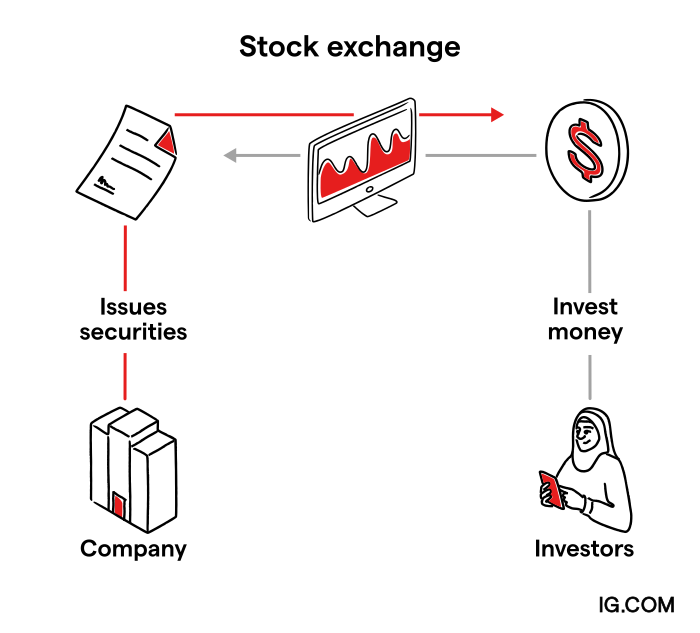
At its simplest level, the stock market is a network of exchanges where investors buy and sell shares of publicly traded companies. It functions as a marketplace, much like any other, but instead of physical goods, the commodities are “pieces” of businesses.

Understanding Equity: What is a Stock?
A stock, also known as equity, represents fractional ownership in a corporation. When you purchase a share, you are essentially buying a small claim on that company’s assets and earnings. If a company has 1,000,000 shares outstanding and you own 10,000 of them, you own 1% of the company. This ownership often entitles you to voting rights on corporate policy and a share of the profits.
The Venue: Stock Exchanges and Marketplaces
Transactions do not happen in a vacuum; they occur on centralized platforms called stock exchanges. The most prominent examples include the New York Stock Exchange (NYSE) and the NASDAQ. While the NYSE traditionally operated with physical floor traders, the modern era is dominated by electronic trading. These exchanges ensure “liquidity,” meaning there are enough buyers and sellers at any given time to allow trades to happen quickly and at fair prices.
The Pricing Engine: Supply and Demand
The price of a stock is determined by the law of supply and demand. If more people want to buy a stock (demand) than sell it (supply), the price moves up. Conversely, if more people are looking to sell than buy, the price drops. This balance is influenced by everything from company earnings reports and product launches to global geopolitical events and interest rate changes by central banks.
The Lifecycle of a Public Company: From Private to Public
Not every business is on the stock market. Most businesses start as private entities, funded by the founders, “angel investors,” or venture capitalists. The transition to the stock market is a monumental milestone in a company’s lifecycle.
The Initial Public Offering (IPO)
The process of a company “going public” is known as an Initial Public Offering (IPO). This is the “Primary Market” where the company creates new shares and sells them to the public for the first time. The primary goal of an IPO is to raise significant capital that the company can use to expand operations, pay off debt, or fund research and development.
The Transition to the Secondary Market
Once the IPO is complete and the initial shares are sold to institutional and retail investors, the stock begins trading on the “Secondary Market.” This is what most people refer to when they talk about “the stock market.” In the secondary market, investors trade shares among themselves. The company that issued the stock does not receive any money from these daily trades; instead, the value is exchanged between the buyer and the seller.
Market Capitalization and Valuation
A company’s size on the stock market is measured by its “Market Cap.” This is calculated by multiplying the current share price by the total number of outstanding shares. Investors use this metric to categorize companies into Small-cap, Mid-cap, and Large-cap (like Apple or Microsoft). Valuation metrics, such as the Price-to-Earnings (P/E) ratio, help investors determine if a stock is overpriced or a bargain relative to its actual profit.
How Investors Generate Wealth in the Market
Investing in the stock market is not merely a hobby; it is a disciplined strategy for capital appreciation. There are two primary ways an investor sees a return on their investment.

Capital Gains: The “Buy Low, Sell High” Philosophy
Capital gains occur when you sell a stock for more than you paid for it. For example, if you purchase shares of a tech company at $50 and the price rises to $75 due to strong growth, your $25 profit per share represents a capital gain. This is the primary driver of wealth for “growth” investors who seek out companies with high potential for future expansion.
Dividends: Passive Income Streams
Some companies, particularly established ones with steady cash flows, choose to distribute a portion of their profits directly to shareholders in the form of dividends. Dividends provide a regular stream of passive income, regardless of whether the stock price goes up or down. For many “value” investors, reinvesting these dividends to buy more shares is a cornerstone of their long-term strategy.
The Power of Compounding
The true “magic” of the stock market is compounding. When you earn returns on your investment—and then earn returns on those returns—your wealth begins to grow exponentially. Over decades, even modest annual returns can transform a small initial investment into a significant nest egg. This is why time in the market is often considered more important than timing the market.
The Ecosystem of Market Participants
The stock market is a diverse ecosystem populated by various players, each with different goals, timelines, and levels of influence.
Institutional vs. Retail Investors
Institutional investors are the “big players”—pension funds, insurance companies, hedge funds, and mutual funds. They manage billions of dollars and can move market prices through high-volume trades. Retail investors are individuals like you and me, trading through personal brokerage accounts. In recent years, the rise of mobile apps and zero-commission trading has significantly increased the influence of the retail sector.
Market Makers and Brokers
To facilitate the millions of trades that happen every second, the market relies on intermediaries. Brokers act as the bridge between the investor and the exchange. Market makers, on the other hand, are firms that stand ready to buy or sell a particular stock at any time, ensuring that there is always a counterparty for your trade. They profit from the “bid-ask spread”—the small difference between the price at which they buy and the price at which they sell.
The Role of Indices: S&P 500 and the Dow
Because there are thousands of stocks, investors use “indices” to gauge the health of the overall market. The S&P 500 tracks the performance of 500 of the largest companies in the U.S., while the Dow Jones Industrial Average tracks 30 major blue-chip corporations. When you hear that “the market is up today,” it usually means these indices have increased in value.
Risk Management and Strategic Investing
While the stock market offers the potential for high returns, it is not without risk. Prices can be volatile, and it is possible to lose money if a company performs poorly or the economy enters a recession.
Diversification: The Only “Free Lunch”
The most effective way to mitigate risk is through diversification. Instead of putting all your money into a single stock, you spread your investment across different companies, industries, and even geographical regions. If one company fails, the impact on your overall portfolio is minimized by the success of others. Many modern investors achieve this through Exchange-Traded Funds (ETFs) or Index Funds, which allow them to own hundreds of stocks in a single transaction.
Fundamental vs. Technical Analysis
Investors generally use two schools of thought to make decisions. Fundamental analysis involves looking at a company’s financial health, its management team, and its competitive position in the industry. It asks: “Is this a good business?” Technical analysis, conversely, focuses on price charts and market trends. it asks: “Is this the right time to buy based on historical patterns?”
Maintaining a Long-Term Perspective
The stock market is prone to short-term fluctuations caused by news cycles and investor emotion (fear and greed). However, historically, the market has trended upward over long periods. Professional investors emphasize the importance of a “long-term horizon,” suggesting that the best way to handle market volatility is to remain invested through the downturns, waiting for the eventual recovery and growth that follows.
In conclusion, the stock market is a complex but accessible system designed to facilitate the flow of capital and the creation of wealth. By understanding how exchanges function, how companies go public, and how to manage risk through diversification, an individual can transform from a passive observer into an active participant in the global economy. Whether your goal is to save for retirement, fund an education, or build a legacy, the stock market remains the most powerful tool in the world of personal finance.
aViewFromTheCave is a participant in the Amazon Services LLC Associates Program, an affiliate advertising program designed to provide a means for sites to earn advertising fees by advertising and linking to Amazon.com. Amazon, the Amazon logo, AmazonSupply, and the AmazonSupply logo are trademarks of Amazon.com, Inc. or its affiliates. As an Amazon Associate we earn affiliate commissions from qualifying purchases.