
The enduring appeal of The Walking Dead extends far beyond its zombie apocalypse narrative. For many fans, the show is a masterclass in survival, resourcefulness, and, undeniably, the effective deployment of weaponry. At the heart of this fascination lies Rick Grimes, the stoic protagonist whose journey from small-town sheriff to hardened survivor is intrinsically linked to his iconic firearms. The question “What gun does Rick Grimes use?” is more than just a trivia point; it delves into the practical considerations of survival, the historical significance of certain weapons, and the powerful symbolism they hold within the context of the show.
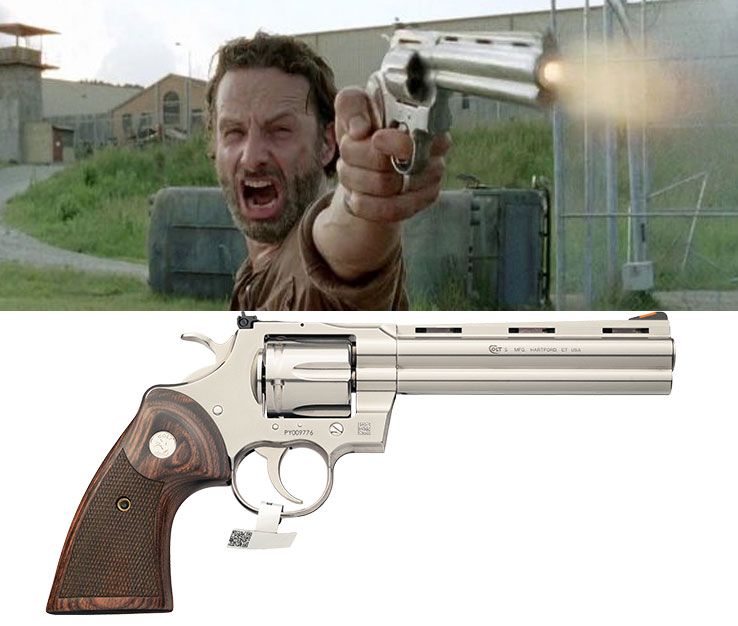
While Rick’s arsenal evolved throughout the series, one weapon stands out as his primary and most recognizable sidearm: the Colt Python. However, understanding the choice of this particular revolver, and the nuances of firearms depicted in The Walking Dead, requires a broader perspective on the technological and practical aspects of weaponry in a post-apocalyptic world. This exploration will focus on the Tech behind these firearms, examining their design, functionality, and relevance in a scenario where advanced manufacturing and readily available ammunition are scarce. We will delve into the specific models, their historical context, and how their technological attributes contributed to Rick’s survival and the show’s overall thematic coherence.
The Reign of the Colt Python: A Technological Masterpiece for the Apocalypse
The Colt Python is not just a gun; it’s a legend. Its presence in Rick Grimes’s holster immediately elevates it beyond a mere tool for dispatching walkers. From a technological standpoint, the Colt Python represents the pinnacle of revolver design for its era, making it a surprisingly pragmatic, albeit iconic, choice for a post-apocalyptic survivor.
Engineering and Reliability: Why the Python Endures
Introduced by Colt’s Manufacturing Company in 1955, the Colt Python is a .357 Magnum revolver celebrated for its exceptional craftsmanship, accuracy, and durability. Its design leverages robust steel construction, a precisely machined cylinder and barrel, and a famously smooth, crisp trigger pull. This level of engineering translates into exceptional reliability – a paramount concern when your life depends on every shot. In a world where sophisticated, modern firearms might quickly become inoperable due to lack of maintenance, specialized parts, or even basic lubrication, a well-built revolver like the Python offers a level of resilience that simpler designs often lack.
The Python’s .357 Magnum chambering is also a significant technological advantage. This powerful cartridge offers substantial stopping power, capable of penetrating walker flesh and bone effectively. Moreover, .357 Magnum ammunition, or its less powerful but more common predecessor, .38 Special, was relatively widespread before the apocalypse. This pre-existing availability, coupled with the revolver’s ability to fire both, provides a tactical edge in scavenging for ammunition. While semi-automatic pistols rely on complex mechanisms like recoil springs and extractors that can fail, revolvers, particularly those as well-engineered as the Python, are comparatively less susceptible to jamming or outright mechanical failure when exposed to the elements or subjected to harsh use.
The Visual and Practical Impact of a Classic Revolver
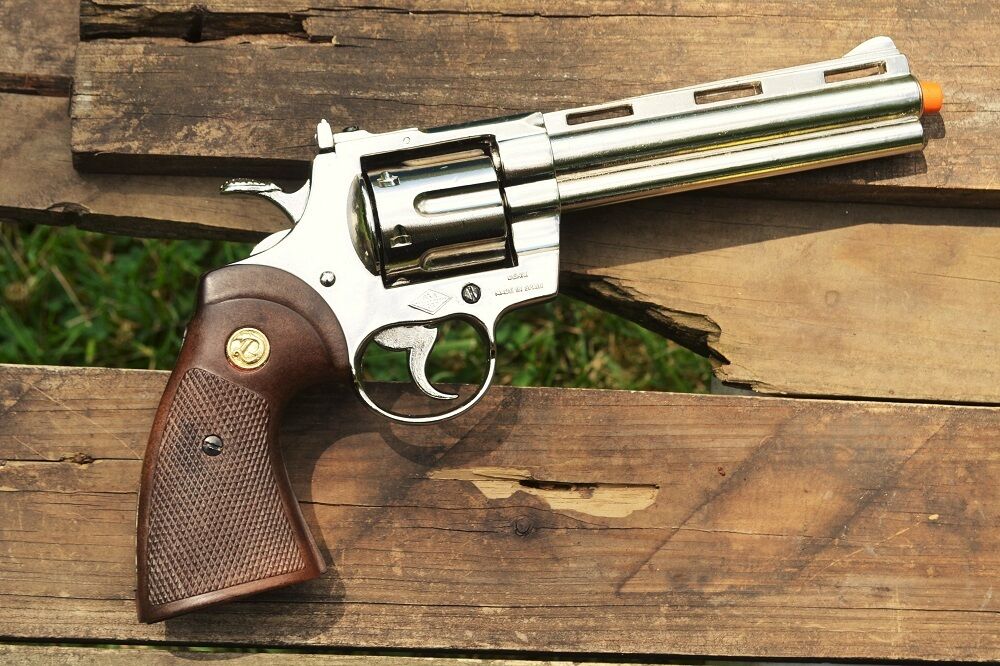
Beyond its internal mechanics, the Colt Python’s visual presence is undeniable. Its sleek lines, polished finish (initially), and substantial weight contribute to its imposing and authoritative image. For Rick, this wasn’t just about having a weapon; it was about projecting an aura of control and competence in a chaotic world. The act of manually cocking the hammer and rotating the cylinder became a visual cue for the audience, signaling a deliberate and calculated action.
From a practical standpoint, the revolver’s simplicity is its strength. There are fewer moving parts to malfunction. Reloading a revolver, while slower than with a semi-automatic pistol utilizing a magazine, is a straightforward process. In a survival scenario, where every piece of knowledge and skill is crucial, mastering the operation of a reliable revolver is a achievable goal for someone with Rick’s background as a law enforcement officer. The iconic “click” of the cylinder spinning, the satisfying heft in hand, and the potent report of the .357 Magnum all contribute to the Python’s status as a weapon of legend, perfectly suited to the brutal realities of The Walking Dead.
Beyond the Python: Exploring Rick’s Evolving Arsenal and Technological Considerations
While the Colt Python became Rick’s signature weapon, the show wisely depicted him acquiring and utilizing other firearms as the narrative progressed. These additions weren’t arbitrary; they often reflected evolving tactical needs, available resources, and the technological landscape of the post-apocalyptic world. Examining these other weapons reveals a nuanced understanding of firearm technology and its application in survival.

The Practicality of Semi-Automatics: When Reliability Meets Firepower
As Rick’s group grew and encountered larger threats, the limitations of a single revolver became apparent. The introduction of semi-automatic pistols, such as the Beretta 92FS and later the Glock 17, offered distinct technological advantages. Semi-automatic pistols provide a higher rate of fire, a larger ammunition capacity per magazine, and faster reloads. This is crucial when facing multiple threats simultaneously, as often happened in The Walking Dead.
The Beretta 92FS, a common sidearm for law enforcement and military personnel, is known for its reliability and ease of use. Its double-action/single-action trigger mechanism and open-slide design contribute to its operational robustness. Similarly, the Glock 17, a polymer-framed pistol, represents a significant technological leap in firearm design. Its lightweight construction, resistance to corrosion, and consistent trigger pull have made it a favorite for its durability and performance in harsh conditions. The prevalence of 9mm Parabellum ammunition, the caliber used by both the Beretta and Glock, meant that scavenging for ammunition could potentially yield a wider variety of compatible sources compared to specialized revolver calibers. The show’s depiction of these semi-automatics reflects a logical progression, acknowledging that in a prolonged survival scenario, adaptability and the ability to leverage readily available and technologically superior firearms would be paramount.
The Power and Versatility of Rifles and Shotguns
Beyond handguns, Rick and his group frequently employed rifles and shotguns, showcasing the technological diversity of firearms available and their specific tactical applications. These long guns offered greater range, accuracy, and stopping power, essential for engaging threats at a distance or dealing with heavily armored walkers.
The M4 Carbine, a shortened version of the M16 rifle, is a prime example of effective modern military technology. Its modular design allows for the attachment of various accessories like optics, lights, and grenade launchers, enhancing its versatility. For Rick’s group, the M4 represented a significant upgrade in firepower, capable of delivering controlled bursts or precise single shots. Similarly, shotguns, such as the Mossberg 500 or Remington 870, provided devastating close-range firepower. Their ability to chamber a variety of shell types – buckshot for crowd control, slugs for increased range and penetration – offered a flexible technological solution for different combat situations. The technology behind these long guns, from their gas-operated or pump-action mechanisms to their rifled barrels, ensured accuracy and effectiveness, crucial for survival in a world where every engagement carried immense risk. The inclusion of these diverse firearm types underscores the show’s commitment to depicting a realistic, albeit dramatized, approach to armed survival.
The Symbology of Firearms: More Than Just Tools in The Walking Dead
While the technological prowess and practical utility of Rick Grimes’s firearms are significant, their role in The Walking Dead extends beyond mere functionality. The weapons he wields have become potent symbols, deeply intertwined with his character development, the group’s struggle for survival, and the overarching themes of the series.
The Sheriff’s Badge and the Revolver: Echoes of the Past
Rick’s initial reliance on his Colt Python is deeply rooted in his identity as a police officer. The revolver, a classic symbol of law enforcement, represents his commitment to order, justice, and protecting the innocent. In the early seasons, when the world was still descending into chaos, the Python was an extension of his moral compass and his duty to uphold the law, even in the absence of any formal structure. The visual of Rick, a lone figure in a decaying world, drawing his iconic revolver, evokes a sense of nostalgia and a yearning for the stability of the pre-apocalypse era. This technological artifact from a bygone era served as a constant reminder of the world they had lost and the values they fought to preserve.
The very act of using a revolver, with its deliberate loading and firing process, can be seen as a metaphor for the careful, measured approach Rick initially took to survival. It demanded precision, forethought, and a deep understanding of his craft. As the series progressed and the threats became more overwhelming, Rick’s reliance on the Python shifted from a symbol of authority to a symbol of his unwavering resolve and his capacity to adapt and endure. The technology of the revolver, in this context, became less about its mechanical specifications and more about the human element it represented – the individual facing overwhelming odds with a reliable, albeit aging, piece of technology.
Evolving Arsenal, Evolving Survivor: Firearms as Agents of Change
As Rick’s journey continued, his arsenal evolved, mirroring his own transformation. The adoption of more modern firearms, like the semi-automatic pistols and assault rifles, reflected not just an increase in tactical necessity but also a hardening of his spirit. The shift from a solely defensive posture to a more offensive one, driven by the need to protect his growing community and secure resources, was visually represented by the more powerful and technologically advanced weapons he employed.
The choice of firearms also became a narrative device for showcasing the group’s resourcefulness and their ability to scavenge and adapt. Finding a functional M4 carbine or a cache of 9mm ammunition was a significant victory, highlighting the importance of technological knowledge and practical application in this new world. The juxtaposition of these modern tools with the primitive and brutal nature of the zombie threat created a compelling visual and thematic tension. In essence, the firearms in The Walking Dead are more than just props; they are technological artifacts that have been imbued with deep symbolic meaning, reflecting the characters’ struggles, their growth, and the enduring fight for survival in a world where even the most advanced technology can be both a savior and a constant reminder of what has been lost.
aViewFromTheCave is a participant in the Amazon Services LLC Associates Program, an affiliate advertising program designed to provide a means for sites to earn advertising fees by advertising and linking to Amazon.com. Amazon, the Amazon logo, AmazonSupply, and the AmazonSupply logo are trademarks of Amazon.com, Inc. or its affiliates. As an Amazon Associate we earn affiliate commissions from qualifying purchases.