
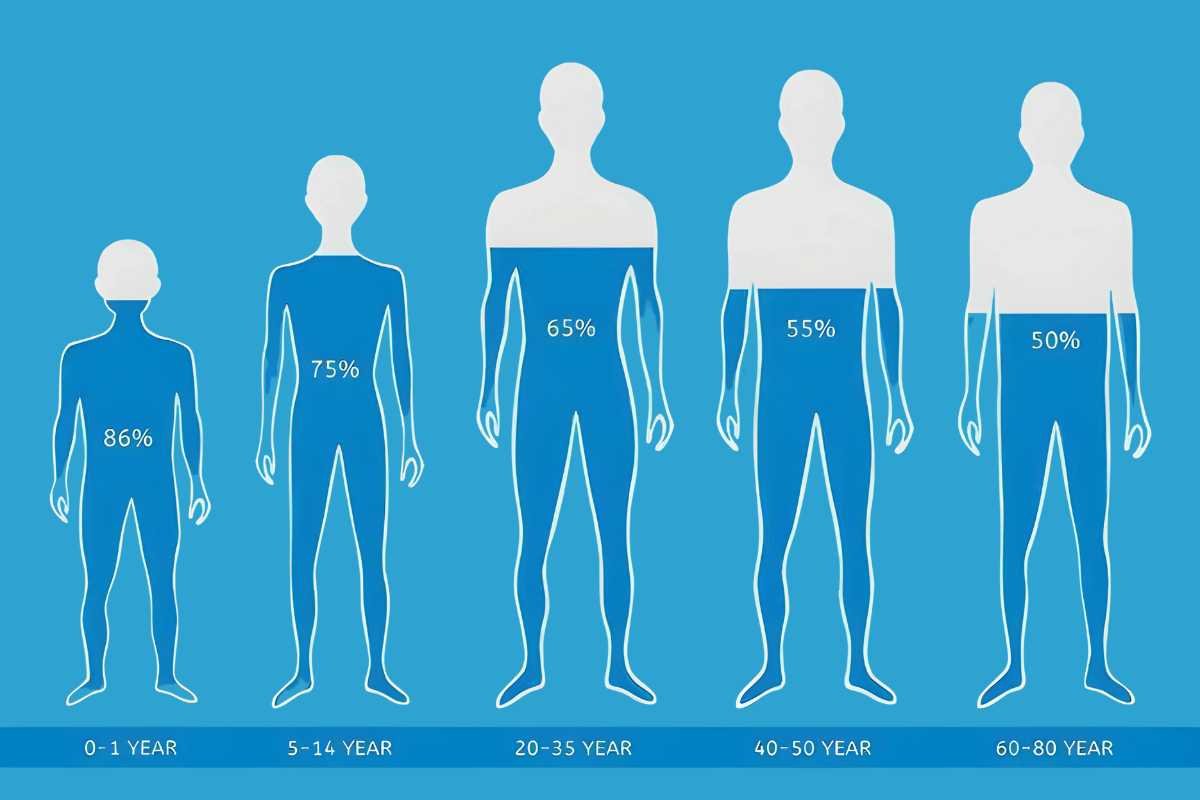
For decades, the standard biological answer to the question “what percent of humans are water?” has been a generalized “about 60%.” However, in the era of precision medicine and high-performance athletics, this approximation is no longer sufficient. Today, a sophisticated ecosystem of hardware, software, and data science is moving beyond the textbook average to provide individual, real-time insights into human body composition.
The technology used to measure and monitor our internal “water weight” has evolved from rudimentary laboratory displacement tests to wearable biosensors and artificial intelligence models. Understanding the “water percent” is no longer just a biological curiosity; it is a data-driven metric that informs everything from professional sports strategy to chronic disease management.

The Digital Science of Bioelectrical Impedance Analysis (BIA)
The most common technological interface for measuring body water today is Bioelectrical Impedance Analysis (BIA). While many consumers are familiar with this through “smart scales,” the underlying technology is a complex interplay of physics and digital signal processing.
The Physics of the Circuit
BIA technology functions by sending a low-level, imperceptible electrical current through the body. Because water is an excellent conductor of electricity, while fat provides resistance (impedance), the device can measure how much resistance the current encounters. High-tech BIA devices use multiple frequencies to distinguish between extracellular water (water outside the cells) and intracellular water (water inside the cells). This distinction is critical for identifying issues like inflammation or cellular dehydration that a simple “percent” doesn’t reveal.
Consumer vs. Clinical Grade Technology
There is a significant technological gap between a $50 bathroom scale and a $10,000 clinical BIA machine. Consumer gadgets often use “foot-to-foot” impedance, which primarily measures the lower body and uses algorithms to estimate the rest. In contrast, clinical-grade tech—such as multi-frequency BIA—uses an eight-point tactile electrode system. These devices generate a comprehensive map of the body’s fluid distribution, providing a precise percentage of total body water (TBW) with an accuracy that rivals the “Gold Standard” of Dual-Energy X-ray Absorptiometry (DEXA) scans.
Wearables and the Rise of Real-Time Hydration Monitoring
While BIA provides a snapshot of body water, the tech industry is currently obsessed with “Continuous Hydration Monitoring” (CHM). For an athlete or a patient with kidney disease, knowing their water percentage at 8:00 AM isn’t enough; they need to know how that percentage fluctuates throughout the day.
The Sweat Sensor Revolution
Recent breakthroughs in microfluidics have led to the development of wearable “sweat patches.” Companies like Nix and Gatorade (with their Gx Sweat Patch) have pioneered sensors that analyze the composition of sweat in real-time. These devices use colorimetric analysis or digital sensors to measure electrolyte concentration and fluid loss rate. By syncing this data via Bluetooth to a smartphone app, the technology can tell a user exactly how many milliliters of water they need to drink to maintain their optimal “60%.”
Optical Sensors and Interstitial Fluid
The next frontier in hydration tech involves optical sensors, similar to those used for heart rate monitoring (PPG). Tech giants and startups alike are experimenting with specific wavelengths of light that can penetrate the skin to measure the volume of interstitial fluid—the water surrounding our cells. By analyzing the “refractive index” of the skin’s layers, these wearables aim to provide a non-invasive, continuous percentage of hydration without requiring the user to produce sweat. This would represent a monumental leap in digital health tracking, moving hydration into the same “always-on” category as heart rate and sleep tracking.
Data Analytics and AI in Personalized Fluid Management
The raw data collected by scales and wearables is only as good as the software that interprets it. The question of “what percent of a human is water” is highly variable, influenced by age, sex, muscle mass, and environmental conditions. This is where Artificial Intelligence (AI) and machine learning come into play.
Predictive Hydration Models
Modern health platforms use AI to create personalized “baselines.” By aggregating data from a user’s body water measurements over time, along with external factors like local temperature (via weather APIs) and exertion levels (via GPS and accelerometers), algorithms can predict dehydration before it happens. Instead of a reactive “I’m thirsty,” the tech provides a proactive “Drink 250ml now to maintain your 62% water threshold.” This predictive modeling is currently being deployed in the military and in high-stakes industrial environments to prevent heat-related injuries.
Clinical Applications and Big Data
In the medical tech sector, monitoring the “water percent” is a matter of life and death. For patients with Congestive Heart Failure (CHF), even a 1% or 2% increase in body water (fluid retention) can lead to a hospital stay. New remote patient monitoring (RPM) platforms use AI to analyze daily weight and BIA data, flagging subtle trends that indicate fluid buildup. These software-as-a-medical-device (SaMD) solutions allow doctors to adjust medications digitally, long before the patient feels physical symptoms.
The Future of Hydration Tech: From Smart Bottles to Nanotech
As we look toward the next decade, the technology used to track our internal water levels will become even more integrated into our environment and our biology. The goal is to make the management of our 60% water composition entirely frictionless.
The IoT of Hydration
The Internet of Things (IoT) has already introduced “smart water bottles” like HidrateSpark, which track intake and glow to remind the user to drink. However, the future lies in the integration of these bottles with the rest of the tech stack. Imagine a scenario where your Apple Watch detects a 0.5% drop in your body water percentage through its optical sensor, communicates with your smart bottle to calculate the exact amount of electrolyte-enhanced water needed, and then logs that intake directly into your electronic health record.
Ingestible and Implantable Sensors
On the cutting edge of research are ingestible “smart pills” and sub-dermal nano-sensors. These devices stay inside the body for a period, measuring the salinity and volume of internal fluids with 100% accuracy. While currently reserved for extreme clinical cases or elite research, this tech represents the ultimate answer to the question of human water composition. By removing the “noise” of skin impedance and environmental variables, these sensors provide a direct digital readout of the body’s internal sea.

Conclusion: The Digitization of Human Biology
The question “what percent of humans are water” is transitioning from a static fact to a dynamic digital variable. Through the advancement of BIA sensors, wearable microfluidics, and AI-driven predictive analytics, we are gaining an unprecedented level of control over our biological makeup.
In the tech sector, water is no longer just a substance; it is a vital sign. As sensors become more accurate and data integration becomes more seamless, the ability to monitor and maintain our “60%” will be a standard feature of the human experience. We are moving toward a future where “smart hydration” is as ubiquitous as the smartphone, ensuring that the most essential component of our biology is managed with the highest level of technological precision.
aViewFromTheCave is a participant in the Amazon Services LLC Associates Program, an affiliate advertising program designed to provide a means for sites to earn advertising fees by advertising and linking to Amazon.com. Amazon, the Amazon logo, AmazonSupply, and the AmazonSupply logo are trademarks of Amazon.com, Inc. or its affiliates. As an Amazon Associate we earn affiliate commissions from qualifying purchases.