
The shoulder press, often referred to as the overhead press, is a foundational movement in human kinesiotherapy and strength training. Historically, our understanding of which muscles are recruited during this movement was limited to cadaveric studies and visual observation. However, the intersection of fitness and technology has revolutionized this understanding. Today, we don’t just “feel” the burn; we measure it using Electromyography (EMG), computer vision, and AI-driven biomechanical modeling.
In the modern tech-driven fitness landscape, identifying what muscles the shoulder press works is no longer a matter of anatomical theory, but a matter of data precision. By leveraging high-frequency sensors and machine learning algorithms, tech developers are creating tools that optimize muscle recruitment, prevent injury, and provide real-time feedback to users.

The Digital Anatomy of the Shoulder Press: Mapping Primary Movers
When we analyze the shoulder press through the lens of biomechanical software, the movement is decomposed into a series of force vectors and joint angles. This technical breakdown allows us to see exactly how the load is distributed across the upper body.
Primary Movers: The Deltoid Complex in 3D Modeling
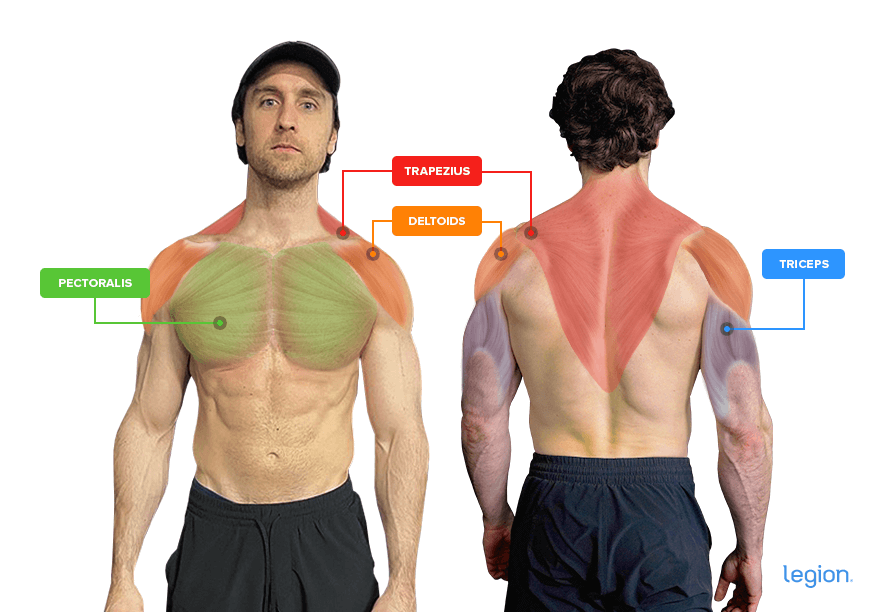
In any digital reconstruction of a shoulder press, the deltoid group is identified as the primary engine of the movement. Advanced 3D modeling software, such as OpenSim, allows researchers to visualize the tension across the three distinct heads of the deltoid:
- Anterior Deltoid (Front): Computer vision analysis shows that the anterior deltoid experiences the highest peak activation during the initial “push” phase of the press.
- Lateral Deltoid (Side): Data suggests that as the arms move away from the midline, the lateral deltoid provides the necessary abduction force to stabilize the weight overhead.
- Posterior Deltoid (Rear): While often overlooked, sensors indicate that the rear deltoid acts as a crucial dynamic stabilizer during the eccentric (lowering) phase of the movement.
Synergists and the Role of the Triceps Brachii
Beyond the shoulders, the shoulder press is a multi-joint compound movement requiring significant elbow extension. Through EMG data collection, we can observe the triceps brachii—specifically the lateral and medial heads—firing as the lifter nears the “lockout” phase. In smart-gym ecosystems like Tonal or Mirror, algorithms track the velocity of this lockout to determine if the triceps are fatiguing faster than the deltoids, allowing for automated weight adjustments.
Wearable Technology and Real-Time Muscle Activation Tracking
The quest to answer “what muscles does the shoulder press work” has moved from the laboratory to the wrist and the fabric of our clothes. Wearable tech has become the bridge between abstract anatomical knowledge and actionable user data.
Smart Fabric and Electromyography (EMG) Integration
The most significant leap in fitness technology is the development of “smart apparel.” These garments are embedded with flexible EMG sensors that sit directly against the skin. Unlike a standard smartwatch that measures heart rate, these sensors detect the electrical activity generated by muscle fibers. When performing a shoulder press, these wearables can provide a heat map of muscle activation.
This data is vital for identifying “muscle amnesia” or compensation patterns. For example, if the software detects high activation in the upper trapezius but low activation in the medial deltoid, it can alert the user that their form is compromised, likely due to shrugging the weight rather than pressing it.
The Role of Accelerometers and Gyroscopes in Form Analysis
Modern wearables utilize 9-axis inertial measurement units (IMUs) containing accelerometers and gyroscopes. During a shoulder press, these sensors track the “bar path.” A perfectly vertical path indicates efficient muscle recruitment. If the sensors detect a forward tilt, the tech can calculate the extra torque placed on the rotator cuff—a group of four small stabilizing muscles (supraspinatus, infraspinatus, teres minor, and subscapularis). By quantifying this stress, technology helps users stay within safe “bio-envelopes,” ensuring the primary muscles do the work without overtaxing the connective tissue.
AI-Driven Computer Vision: Beyond Simple Rep Counting
While wearables provide internal data, computer vision (CV) provides an external, objective perspective on muscle engagement. By using the camera on a smartphone or a specialized gym kiosk, AI models can perform “Pose Estimation” to analyze the shoulder press in real-time.
Pose Estimation and Joint Angle Optimization
AI frameworks like Google’s MediaPipe or Apple’s ARKit can identify key landmarks on the human body, such as the acromion process (shoulder), the olecranon (elbow), and the ulnar styloid (wrist). During a shoulder press, the AI calculates the angles between these points.
Research in sports tech suggests that a specific elbow angle (usually slightly in front of the body in the scapular plane) maximizes the recruitment of the anterior deltoid while minimizing impingement risk. AI coaching apps now use this data to provide haptic feedback, telling a user to “tuck their elbows” to better engage the target musculature.
Identifying Muscle Imbalances Through Algorithm-Based Feedback
One of the most powerful applications of AI in analyzing the shoulder press is the detection of bilateral asymmetry. If a user’s left shoulder rises faster than their right, the AI identifies this as a potential strength imbalance. This is often a sign that the stabilizer muscles (like the serratus anterior and the core) are not firing in sync.
The serratus anterior, often called the “boxer’s muscle,” is essential for upward rotation of the scapula. Tech-enabled platforms can now isolate this data, showing how much the core (rectus abdominis and obliques) is working to prevent the lower back from arching. By analyzing the “leakage” of force, AI helps users keep the tension on the muscles the shoulder press is intended to work.
The Future of Personalized Fitness Tech and Biometric Feedback
As we look toward the future, the integration of Artificial Intelligence and the Internet of Things (IoT) will make the question of “what muscles do the shoulder press work” even more personalized. We are moving away from general anatomy and toward “My-Anatomy.”
Virtual Reality (VR) Coaching and Haptic Feedback
Virtual and Augmented Reality (VR/AR) are beginning to play a massive role in weightlifting. Imagine wearing a VR headset where a digital overlay is projected onto your own body in a mirror. As you perform a shoulder press, the muscles being worked glow in different colors based on their intensity. This “gamification” of biomechanics provides an intuitive understanding of muscle-mind connection. Haptic suits can even provide slight vibrations to the specific muscles—like the lower traps—that need to be “turned on” during the lift.
Predictive Analytics for Injury Prevention
The ultimate goal of tech in this space is predictive rather than reactive. By aggregating data from thousands of shoulder presses, machine learning models can identify the “signature” of a looming injury. For instance, a subtle decrease in the range of motion (ROM) combined with a shift in muscle recruitment from the deltoids to the neck muscles can trigger a “deload” recommendation. This level of technical oversight ensures that the shoulder press remains an effective tool for muscle growth rather than a catalyst for joint degradation.

Conclusion: The Synergy of Tech and Human Movement
In conclusion, understanding what muscles the shoulder press works is a multifaceted challenge that technology is uniquely equipped to solve. From the 3D modeling of the deltoid heads to the real-time EMG tracking of the triceps and stabilizers, tech provides a level of clarity that was previously impossible.
As AI continues to evolve, our ability to optimize the shoulder press—and indeed all physical movements—will only grow. We are entering an era where technology doesn’t just track our steps; it understands our fibers. For the athlete, the coach, and the fitness enthusiast, this means better results, fewer injuries, and a profound, data-backed connection to the mechanics of the human body. Whether through a wearable sensor or a computer-vision app, the digital transformation of the shoulder press is making us stronger, smarter, and more efficient.
aViewFromTheCave is a participant in the Amazon Services LLC Associates Program, an affiliate advertising program designed to provide a means for sites to earn advertising fees by advertising and linking to Amazon.com. Amazon, the Amazon logo, AmazonSupply, and the AmazonSupply logo are trademarks of Amazon.com, Inc. or its affiliates. As an Amazon Associate we earn affiliate commissions from qualifying purchases.