
In the world of high-stakes finance, few milestones carry as much weight as the Series 7 exam. Formally known as the General Securities Representative Qualification Examination (GS), it is widely regarded as the “gold standard” for professionals aiming to build a career in wealth management, investment banking, and retail brokerage. For anyone aspiring to buy or sell securities on behalf of clients, the Series 7 is not just a test; it is a regulatory rite of passage that validates one’s knowledge of the financial markets, investment products, and the stringent ethical frameworks that govern the industry.
Administered by the Financial Industry Regulatory Authority (FINRA), the Series 7 license allows a professional to be registered as a “General Securities Representative.” This designation grants the authority to trade almost all individual securities, including stocks, bonds, options, and mutual funds. In an era where financial literacy and prudent investment management are more critical than ever, understanding the nuances of the Series 7 exam is the first step toward a successful career in the “Money” sector.
The Foundation of a Financial Career: Defining the Series 7 Exam
The Series 7 exam is a rigorous assessment designed to ensure that entry-level registered representatives possess the minimum level of competency required to perform their jobs effectively. It is not an exam one takes in a vacuum; it is part of a broader regulatory ecosystem intended to protect investors and maintain the integrity of the capital markets.
The Transition to the “Top-Off” Model
In October 2018, FINRA restructured its examination process. Previously, the Series 7 was a massive, six-hour behemoth that covered everything from basic industry terminology to complex options strategies. Today, the process is split into two parts. First, candidates must pass the Securities Industry Essentials (SIE) exam, which covers introductory industry concepts, regulatory agencies, and basic product knowledge.
Once the SIE is completed, candidates move on to the Series 7 “Top-Off” exam. This second stage focuses more specifically on the day-to-day responsibilities of a general securities representative. This modular approach allows for a more streamlined entry into the profession while ensuring that the “Top-Off” portion remains focused on high-level application and critical thinking.
Who Needs a Series 7 License?
The Series 7 is a prerequisite for anyone who wishes to work as a stockbroker or a financial advisor at a FINRA-member firm. While some limited licenses, like the Series 6, allow professionals to sell only “packaged” products like mutual funds and variable annuities, the Series 7 is far more comprehensive. If your career goals involve managing a diverse portfolio that includes individual equities, municipal bonds, corporate debt, or derivatives, the Series 7 is mandatory. It is the baseline requirement for most roles at major wirehouses, independent broker-dealers, and investment banks.
Deep Dive into the Exam Structure and Curriculum
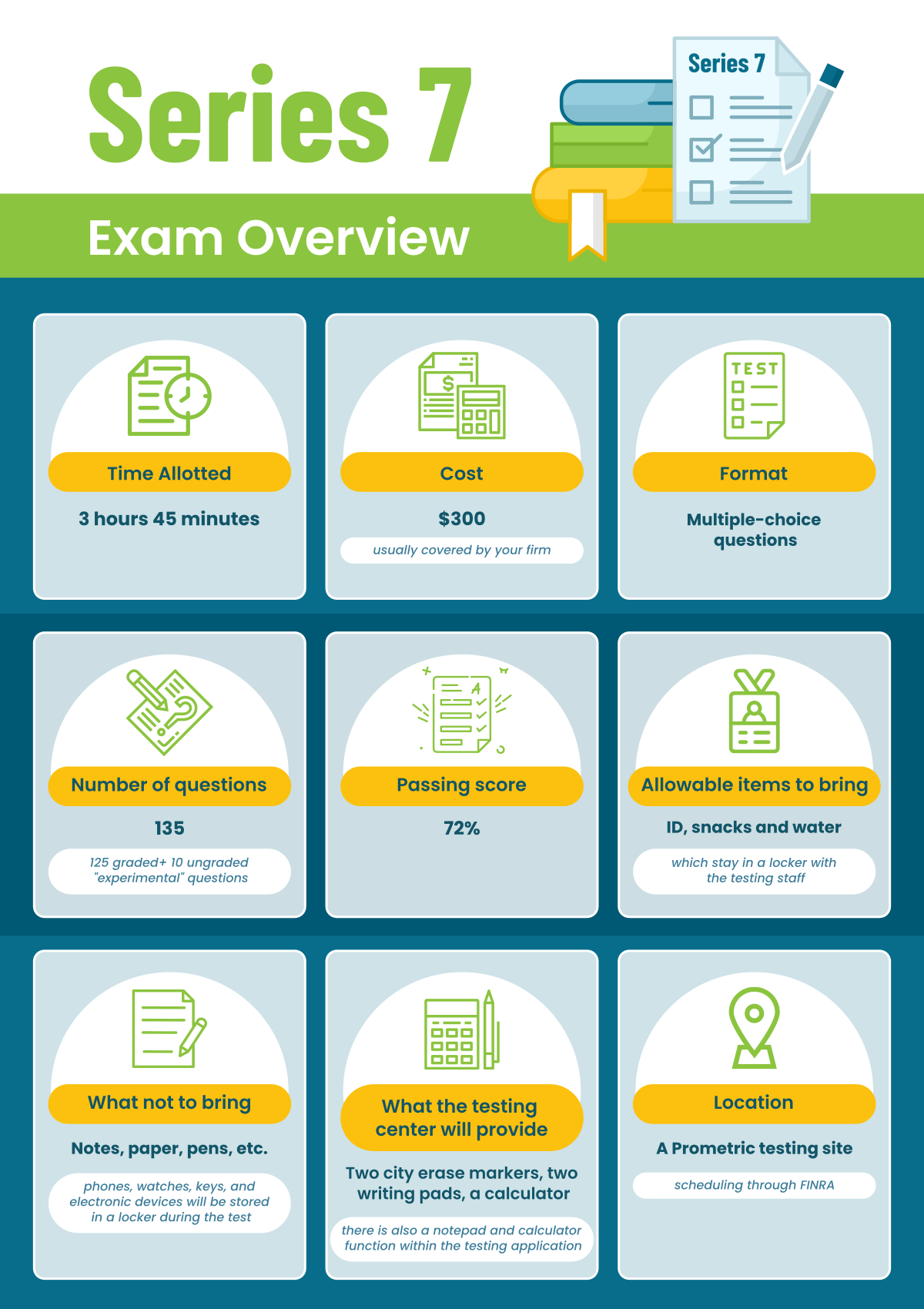
The Series 7 Top-Off exam consists of 125 multiple-choice questions, plus 10 “pre-test” questions that do not count toward the final score. Candidates are given three hours and 45 minutes to complete the test. To pass, a candidate must achieve a score of 72% or higher. While the format sounds straightforward, the content is notoriously dense, covering four primary “Job Functions.”
Breaking Down the Four Main Job Functions
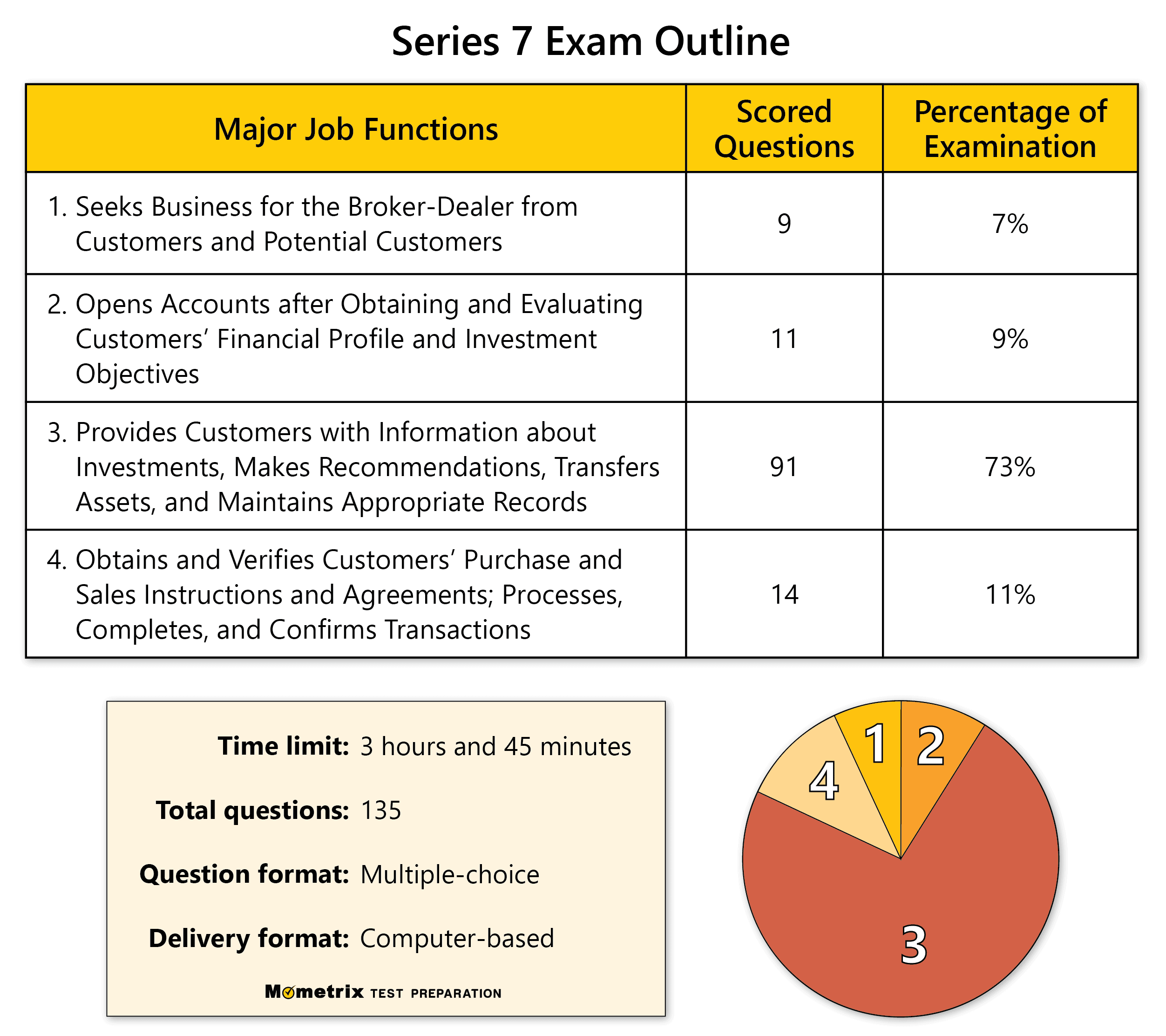
The exam is structured around the actual tasks a financial professional performs. FINRA weights these sections based on their importance to the role:
- Function 1: Seeks Business for the Broker-Dealer (7% of the exam): This section covers how representatives find new clients through prospecting, cold calling, and seminars. It also touches upon the regulations regarding communications with the public and retail nuances.
- Function 2: Opens Accounts After Obtaining and Evaluating Customers’ Financial Profile (9% of the exam): This focuses on “Know Your Customer” (KYC) rules. It tests a candidate’s ability to gather financial data, understand a client’s risk tolerance, and identify investment objectives.
- Function 3: Provides Customers Information about Investments (73% of the exam): This is the heart of the exam. It covers the features, risks, and rewards of various investment vehicles and, most importantly, the “Suitability” of those investments for different types of clients.
- Function 4: Obtains and Verifies Customers’ Purchases and Sales (11% of the exam): This section deals with the technical aspects of trade execution, settlement dates (T+1), and the administrative handling of client accounts.
Essential Investment Vehicles: From Equities to Options
A significant portion of the Series 7 is dedicated to product knowledge. Candidates must demonstrate a mastery of:
- Equity Securities: Common and preferred stock, rights, warrants, and American Depositary Receipts (ADRs).
- Debt Securities: Corporate bonds, U.S. Treasury securities, and the highly complex world of Municipal Bonds.
- Packaged Products: Mutual funds, Closed-end funds, Exchange-Traded Funds (ETFs), and Real Estate Investment Trusts (REITs).
- Options: This is often the most difficult part of the exam, requiring candidates to calculate breakeven points, maximum gain/loss, and hedging strategies using puts and calls.
Master the Technical Challenges: The “Big Three” of the Series 7
While the exam covers a vast array of topics, three areas are consistently cited as the most challenging for test-takers: Municipal Bonds, Options, and Suitability. Mastering these “Big Three” is often the difference between a passing grade and a retake.
Municipal Bonds and Tax Implications
Municipal bonds (Munis) are debt securities issued by states, cities, or counties to fund public projects. The Series 7 delves deep into the different types of Munis, such as General Obligation (GO) bonds and Revenue bonds. What makes this section difficult is the heavy focus on tax implications. Candidates must understand the “Tax-Equivalent Yield” and why a municipal bond might be more attractive to a high-net-worth individual in a high tax bracket than a corporate bond with a higher nominal interest rate.
The Complexity of Options Strategies
Options are derivatives, and their behavior can be counterintuitive. The Series 7 requires candidates to understand not just simple long calls and long puts, but also complex multi-leg strategies like spreads and straddles. You must be able to determine if a strategy is “bullish” or “bearish” and calculate the precise financial outcome of a trade based on the movement of the underlying stock. For many, this requires a shift from memorization to mechanical application.
Investment Company Products and Suitability
“Suitability” is the golden rule of the Series 7. It’s not enough to know how a mutual fund works; you must know who should buy it. For example, a candidate might be presented with a scenario involving an 80-year-old widow seeking capital preservation and be asked to choose the most suitable investment among a growth fund, a high-yield bond fund, or a Treasury money market fund. This section tests the representative’s ethical judgment and their ability to align products with a client’s specific financial needs.
Strategic Preparation: How to Pass on Your First Attempt
The Series 7 has a reputation for being a “weed-out” exam. Because the passing score is relatively high and the breadth of material is wide, passive reading is rarely enough to ensure success.
Building a 100-Hour Study Plan
Most industry experts recommend at least 80 to 120 hours of focused study time. This should be spread over several weeks to avoid burnout. A common mistake is “cramming” the weekend before the test. Instead, a successful candidate typically spends the first half of their study period reading the textbook and the second half focused almost exclusively on practice questions. Consistency is key; studying for two hours every day is far more effective than one marathon twelve-hour session once a week.
The Power of Practice Questions and Simulations
You cannot truly understand the Series 7 until you see how FINRA asks questions. Many prep courses provide “Q-Banks” containing thousands of practice questions. Taking full-length, timed simulation exams is crucial for building “exam stamina.” It helps you learn to pace yourself so you don’t spend too much time on a difficult options calculation and run out of time for the easier suitability questions at the end.
Beyond the Exam: Career Pathing in the Financial Industry
Passing the Series 7 is a transformative moment for a financial professional. It represents a transition from a trainee to a licensed practitioner capable of generating revenue and managing client wealth.
The Series 7 as a Catalyst for Wealth Management
With a Series 7 license, you are officially in the business of money. You can build a book of business, manage discretionary accounts, and participate in the growth of the global economy. It is the foundation upon which advanced designations, such as the Certified Financial Planner (CFP) or Chartered Financial Analyst (CFA), are built. It provides the legal authority to act as a fiduciary and a counselor for families and institutions alike.

Complementary Licenses: Series 63, 65, and 66
The Series 7 is often just the beginning. Most firms require their representatives to also take the Series 63 (Uniform Securities Agent State Law Examination) to comply with state-level “Blue Sky” laws. Alternatively, those who wish to charge fees for advice (rather than just commissions on trades) will take the Series 65 or the combined Series 66. Together with the Series 7, these licenses form a comprehensive legal shield and a robust toolkit for any modern financial advisor.
In conclusion, the Series 7 exam is much more than a test of memory; it is a test of professional readiness in the fast-paced world of finance. By mastering the intricate details of investment products, regulatory requirements, and client suitability, candidates prove they are ready to handle the awesome responsibility of managing other people’s money. While the road to passing is demanding, the rewards—a career of influence, technical mastery, and financial opportunity—are well worth the effort.
aViewFromTheCave is a participant in the Amazon Services LLC Associates Program, an affiliate advertising program designed to provide a means for sites to earn advertising fees by advertising and linking to Amazon.com. Amazon, the Amazon logo, AmazonSupply, and the AmazonSupply logo are trademarks of Amazon.com, Inc. or its affiliates. As an Amazon Associate we earn affiliate commissions from qualifying purchases.