
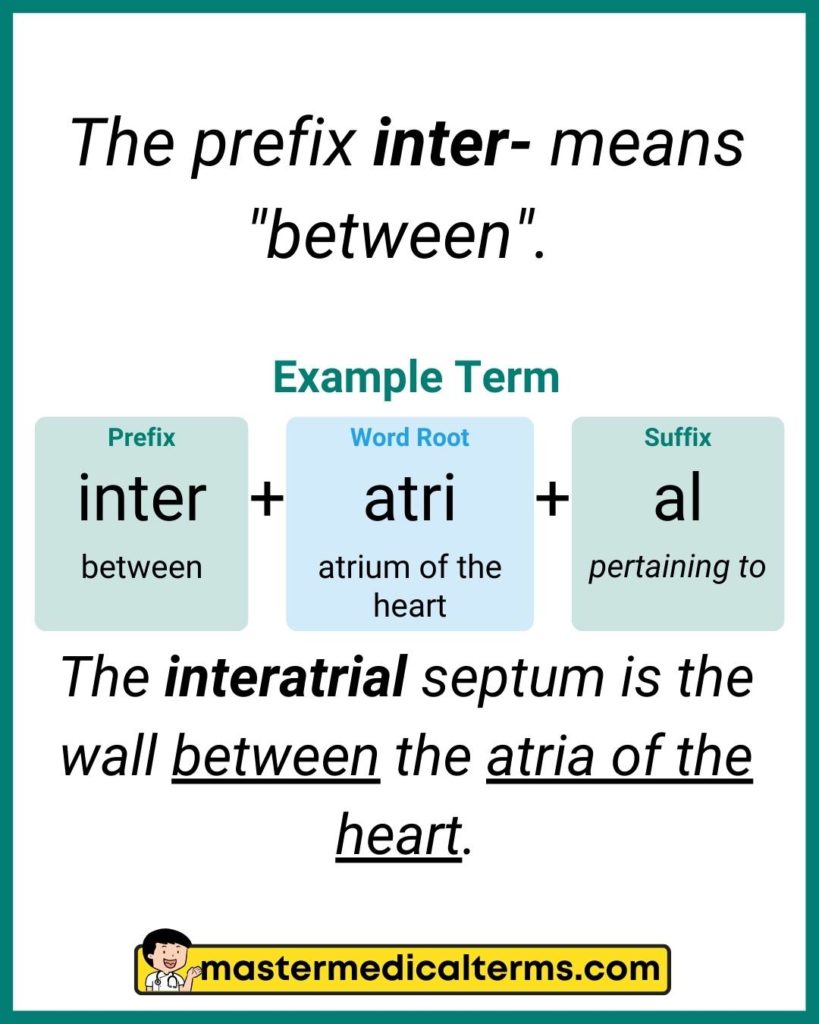
In the lexicon of the digital age, few linguistic components are as pervasive or as foundational as the prefix “inter-.” Derived from Latin, meaning “between,” “among,” “mutually,” or “in the midst of,” this five-letter prefix serves as the structural backbone for the most significant technological advancements of the last century. From the very concept of the “Internet” to the complex mechanics of “Interoperability,” the prefix defines a shift from isolated, siloed systems to a world characterized by relationship, exchange, and synergy.
In a professional technology context, “inter-” signifies the transition from the “what” to the “how.” It focuses on the space between nodes, the dialogue between software applications, and the interaction between humans and machines. To understand the prefix “inter” is to understand the architecture of modern connectivity.
The Infrastructure of Connectivity: The Internet and the IoT
The most obvious application of the prefix is, of course, the Internet. However, the technical depth of this term is often overlooked in casual conversation. To a technologist, the prefix “inter-” in “Internet” describes the “internetworking” of separate, autonomous networks.
The Evolution of Interconnected Networks
Before the Internet, computers existed largely as isolated islands or within closed Local Area Networks (LANs). The breakthrough came with the development of protocols that allowed these disparate networks to communicate “between” one another. The “inter” here signifies the bridges built by TCP/IP protocols, allowing a packet of data to travel across a global patchwork of hardware while maintaining its integrity. It is the prefix of unity in diversity—allowing a Linux server in Tokyo to exchange data with a Windows laptop in New York.
The Internet of Things (IoT): Communication Between Objects
The prefix takes on a more physical dimension with the Internet of Things. In this ecosystem, “inter-” refers to the machine-to-machine (M2M) communication that occurs without human intervention. When a smart thermostat communicates with a power grid to optimize energy consumption, we see the “inter-” prefix in action. It represents the connective tissue between hardware, sensors, and cloud analytics, transforming static gadgets into a collaborative, intelligent network.
The Human-Machine Bridge: Interfaces and Interaction
While connectivity handles how data moves, the “inter-” prefix also defines how that data is experienced. In the realms of software engineering and UX (User Experience) design, the prefix is central to how we bridge the gap between binary logic and human cognition.
The Interface: The Layer Between States
The term “interface” (inter-face) literally refers to the surface or boundary where two independent systems meet and act on or communicate with each other. In tech, this manifests as the User Interface (UI) or the Application Programming Interface (API).
The UI is the “inter” layer between a human’s intent and the computer’s execution. Without this layer, the machine remains inaccessible. Professional software design focuses on making this “inter” space as frictionless as possible. The prefix here implies a shared boundary—a place where the user’s biological world and the machine’s digital world find common ground.
Interactive Systems and Responsive Feedback
The term “interactive” describes a mutual action or influence. In modern software development, interactivity is the benchmark of quality. It moves beyond a linear, “one-way” command structure toward a “two-way” dialogue. When an AI tool provides real-time suggestions as you type, or a cloud dashboard updates instantaneously as data flows in, the system is demonstrating high levels of interactivity. The prefix “inter-” reminds us that modern technology is no longer a passive tool; it is a responsive partner that reacts to and influences the user in a continuous feedback loop.
Interoperability: The Standard for Modern Software
In the enterprise tech sector, “interoperability” is perhaps the most critical term utilizing the prefix. It refers to the ability of different systems, devices, or applications to connect and exchange information in a coordinated manner, within and across organizational boundaries.

Breaking Down Data Silos
For decades, the tech industry struggled with proprietary “walled gardens”—software that worked perfectly within its own ecosystem but refused to speak to others. The drive for interoperability is the drive to put the “inter” back into enterprise software.
True interoperability allows a CRM (Customer Relationship Management) system to pull data seamlessly from an accounting software, which in turn feeds into a logistics platform. This “inter-system” harmony is achieved through standardized data formats (like JSON or XML) and open standards. It represents a shift in philosophy: the value of a tech tool is no longer just in what it does, but in how well it plays “among” others.
APIs: The Digital Intermediaries
If interoperability is the goal, then Application Programming Interfaces (APIs) are the primary tools. An API acts as an intermediary (another “inter” word) that allows two applications to talk to each other. By providing a defined set of rules and protocols, APIs enable the “inter-mingling” of services. For example, a travel website uses APIs to gather data “from between” various airlines and hotels to present a unified view to the user. This is the prefix “inter” at its most functional—acting as the translator in a multi-lingual digital world.
Security, Interference, and the Challenges of Connection
The prefix “inter-” is not always associated with seamless harmony; in technical fields, it also describes the challenges and threats that emerge in the spaces between systems. Where there is connection, there is also the potential for disruption.
Signal Interference and Hardware Reliability
In hardware engineering and telecommunications, “interference” (inter-ferre, meaning “to carry between” or “strike between”) is a critical concern. Whether it is Electromagnetic Interference (EMI) or Radio Frequency Interference (RFI), the “inter” here describes the unwanted energy from one system that disrupts the performance of another. Managing this “between-system” noise is essential for the reliability of everything from 5G networks to satellite communications.
Interception and the “Man-in-the-Middle”
In digital security, the “inter-” prefix highlights vulnerabilities. “Interception” is the unauthorized access to data as it travels “between” two points. The infamous “Man-in-the-Middle” (MitM) attack is a literal exploitation of the “inter” space.
As data moves across the internetwork, it is at its most vulnerable. This has led to the rise of end-to-end encryption, which seeks to secure the “inter-transit” phase of data. In this context, cybersecurity professionals focus on the “inter-” to ensure that the bridge between sender and receiver remains a private tunnel rather than an open highway.
The Future of “Inter”: Intercloud and Decentralization
As we look toward the future of technology, the prefix “inter-” continues to lead the way, defining the next generation of cloud computing and decentralized networks.
The Rise of Intercloud Architecture
While “Multi-cloud” refers to using several cloud providers, “Intercloud” is a more advanced concept. It refers to a “cloud of clouds”—an integrated network of different cloud service providers that can seamlessly move workloads between them based on demand, cost, and latency. The “inter-” here signifies a level of integration that goes beyond simple coexistence; it implies a global, fluid ecosystem where the boundaries between Amazon Web Services, Microsoft Azure, and Google Cloud become invisible to the end application.
Decentralization and Peer-to-Peer Interactivity
In the burgeoning world of Web3 and decentralized finance (DeFi), the prefix “inter-” is undergoing a transformation. Traditional systems rely on a central hub, but decentralized systems focus on “inter-peer” relationships. Whether it is “inter-blockchain” communication (IBC) or peer-to-peer (P2P) file sharing, the focus is moving away from a central “center” toward the “inter”—the connections between individual nodes. This represents a more democratic and resilient form of technology, where the power lies in the relationships between participants rather than a singular authority.

Conclusion: The Prefix of the Future
Understanding what the prefix “inter” means provides a roadmap for the entire technological landscape. It is the prefix of the modern age because it encapsulates the most important trend in tech: the move from individual components to integrated systems.
In every sector—whether it is the way we build global networks, the way we design user experiences, or the way we secure our data—the “inter” is where the innovation happens. It is the space between the parts where the magic of the whole is created. As we continue to innovate, our success will be defined not by the power of our isolated machines, but by the strength, speed, and intelligence of the “inter-sections” we build between them.
aViewFromTheCave is a participant in the Amazon Services LLC Associates Program, an affiliate advertising program designed to provide a means for sites to earn advertising fees by advertising and linking to Amazon.com. Amazon, the Amazon logo, AmazonSupply, and the AmazonSupply logo are trademarks of Amazon.com, Inc. or its affiliates. As an Amazon Associate we earn affiliate commissions from qualifying purchases.